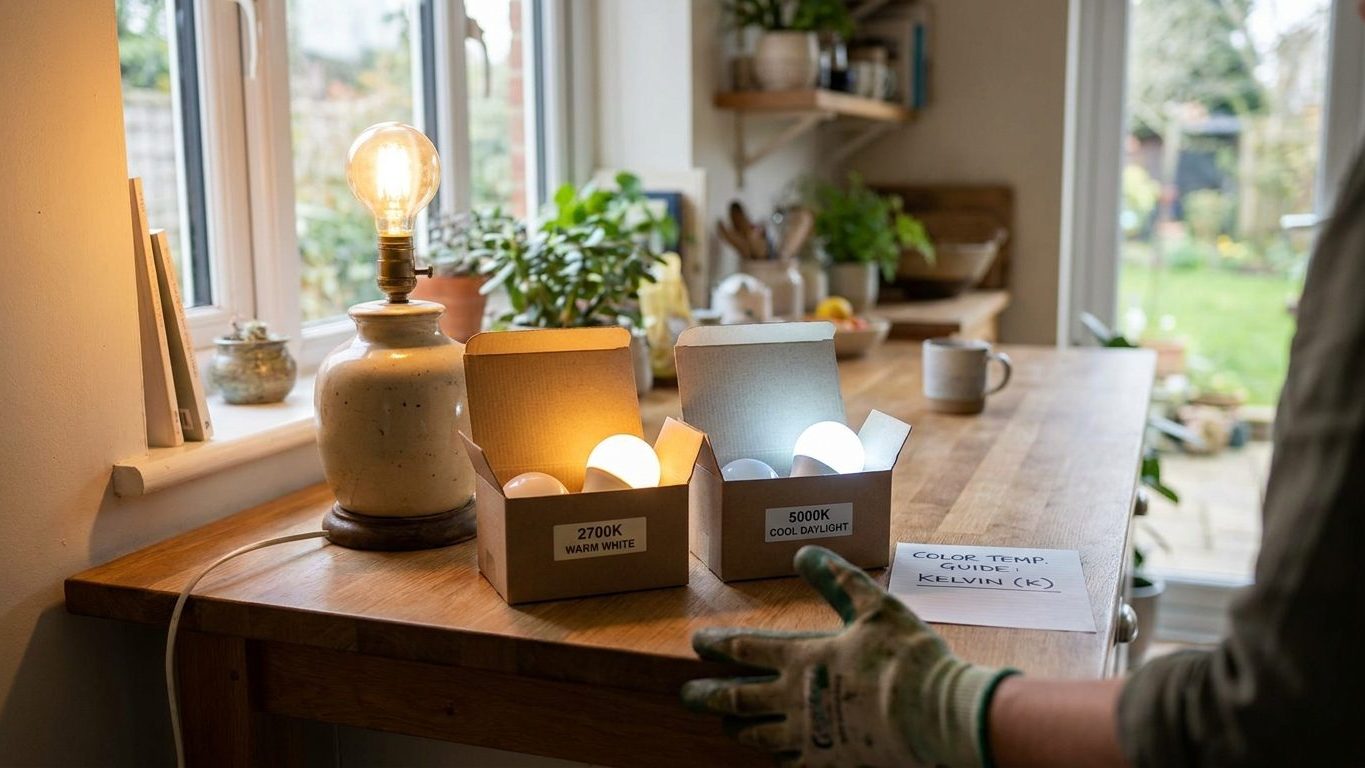

Kelvin numbers don’t tell you how bright a bulb is. A 2700K bulb and a 5000K bulb can put out the exact same number of lumens and still make a room feel like two different places, one lived-in and gold, the other clinical and blue-white. The number on the box describes tint, not power. Before replacing a bulb in a room you already like the feel of, match the Kelvin number of the bulb that’s already there, not just its wattage or lumen count.
What is actually going on

Where the scale comes from
Color temperature describes the tint of a light source on a scale that runs from red through orange and yellow to white and then blue, measured in Kelvin (K). The scale borrows its logic from physics: heat an object and it glows red at lower temperatures, then yellow, then white, then blue-white as it gets hotter. Bulb manufacturers use the same scale to describe the color of the light itself, so a lower Kelvin number means a warmer, more amber light and a higher number means a cooler, bluer one, even though nothing inside the bulb is running anywhere near that actual temperature.
Warm white sits in the neighborhood of 2700K to 3000K, close to the color of a traditional incandescent filament. Neutral or “soft white” runs around 3500K to 4100K. Daylight or cool white bulbs start around 5000K and climb from there, closer to the color of an overcast sky at midday than to a sunset.
Tint versus accuracy
A separate number, the Color Rendering Index (CRI), measures something else entirely: how accurately a light source shows the true color of what it’s shining on, scored on a scale that tops out at 100. Two bulbs can carry the same Kelvin rating and still render color differently if their CRI differs, one making red tomatoes and skin tones look flat and dull, the other making the same objects look natural. Kelvin sets the tint. CRI sets the accuracy. A bulb box that lists only wattage and lumens, with neither number on it, tells you brightness and nothing about color at all.
Under a warm bulb, reds, oranges and browns intensify and skin tones look flattering, which is one reason a lived-in living room or a restaurant dining room is often lit at the low end of the scale. Under a cool bulb, blues and whites sharpen and grays read crisper, which is one reason hospital corridors and garages are often lit at the high end. Neither end is more correct than the other. The Kelvin number describes the light’s color, not a grade of its quality, and it’s the room’s function that decides which end suits it, not a rule about the bulb itself.
Doing it
Matching color temperature to a room is less about taste and more about function, and a mismatch shows up fast when two different Kelvin ranges sit inside the same sightline.
What suits which room
| Room | Common range | Why this end suits it | What goes wrong if skipped |
|---|---|---|---|
| Living room, bedroom | 2700K to 3000K, warm | Skin tones and wood read warm, closer to firelight, and the space settles for evening use | A cool bulb here reads sterile and unwelcoming after dark |
| Kitchen, bathroom | 3500K to 4100K, neutral | Neutral light shows food color and makes tasks like shaving or checking makeup easier to judge accurately | Too warm and colors on a plate or a face look distorted, too cool and the room feels clinical |
| Home office, workshop, garage | 5000K and up, cool daylight | Cooler light gives sharper contrast, useful for reading fine print or matching paint colors | The same range in a bedroom reads harsh and works against winding down at night |
Why mixing looks wrong
Put a 2700K lamp and a 5000K overhead fixture in the same room and the eye catches it immediately, even though neither bulb looks wrong on its own. The brain adapts to a single light source’s tint and treats it as neutral within a few minutes, which is why a room lit entirely by 2700K bulbs looks perfectly normal once you’re standing in it. Add a cooler bulb into that same room and there’s no longer one white point to adapt to, so one pool of light reads amber and another reads blue at the same time, and neither looks right. This is exactly where layering different fixtures for different tasks, instead of relying on a single overhead light, is worth thinking through, covered in Why One Ceiling Light Is Never Enough. Matching Kelvin across every lamp in a room matters more once there’s more than one light source to keep consistent.
Wattage and lumen output decide how much light a room gets. Kelvin decides what color that light is. Choosing a bulb by brightness alone and ignoring the Kelvin number printed next to it is the single most common reason a newly bought bulb doesn’t match the rest of a room.
What it looks like when it goes wrong
A cosmetic mismatch
The most common failure is a color clash: one lamp glowing amber while the ceiling fixture next to it glows blue-white. It’s easy to spot from across the room and it’s the sign that two different Kelvin ratings ended up in the same fixture or the same visual field. This is always correctable. Swap one bulb for a matching Kelvin rating and the clash disappears immediately, with no rewiring or fixture replacement needed.
A quieter version of the same failure is buying a bulb marked “daylight” or “cool white” for a room meant to feel relaxed, then wondering why it never feels finished no matter what furniture or paint goes in. The room isn’t wrong, the light is. A 5000K bulb in a reading lamp next to a warm sofa and warm wood floor will always sit slightly out of place, because the light itself pulls every color in the room toward blue while everything around it is warm-toned. This, too, is a bulb swap, not a redecorating job.
A wiring problem, not a Kelvin problem
Flicker, buzzing, or a bulb that dims unevenly is not a color temperature issue at all, no matter what Kelvin rating is printed on the box. That’s a sign the bulb and the dimmer switch or fixture aren’t electrically compatible, which is a wiring and hardware problem rather than a cosmetic one. If a fixture buzzes, flickers, or runs hot to the touch, it’s worth having checked by an electrician rather than solved by trying a different Kelvin rating, because the two problems have different causes and only one of them is safe to leave alone.
What to settle first
Before buying a bulb by Kelvin number, settle what’s already there. Check the fixture the bulb goes into. An enclosed globe or a recessed can fixture needs a bulb rated for enclosed use regardless of its Kelvin rating, and ignoring that rating is a heat problem, not a color one. Check whether the fixture runs on a dimmer switch, because not every LED bulb dims smoothly on every dimmer, and a Kelvin number printed on the box says nothing about dimmer compatibility.
What’s inside the wall matters too
If the plan is to add a new fixture rather than swap a bulb in an existing one, the wall or ceiling decides what’s possible before Kelvin becomes a question at all. A pendant or a sconce needs a junction box rated for the fixture’s weight and wiring, and what sits behind the wall, stud, plaster, brick, or an open cavity, decides how that box gets mounted and whether the job is a straightforward swap or one that needs an electrician. That groundwork holds regardless of which Kelvin range gets chosen afterward, and it’s covered in Hanging, Shelving and Fixing: The Wall Decides. Requirements for new wiring or a new fixture differ by location, so check with a licensed electrician or the local building department before starting rather than guessing at what’s allowed.
Once the fixture itself is settled and safe, matching a room’s existing bulbs to a new one is a matter of reading the Kelvin number on the old box or, if that’s long gone, checking the room against a few labeled options in daylight rather than guessing. One more thing worth checking before Kelvin: a bulb’s color temperature and its base type, a standard screw base, a smaller candelabra base, or a pin-type base for a recessed can, are two completely separate specs, and getting the color right does no good if the base doesn’t fit the socket at all.
Common questions
What Kelvin is closest to natural daylight?
Bulbs marked around 5000K to 6500K are usually labeled “daylight” and come closest to the color of an overcast sky at midday. Direct sunlight itself shifts through a wide range depending on the time of day, warmer at sunrise and sunset and bluer at midday, so no single bulb matches outdoor light exactly all the time.
Can I mix Kelvin ratings in the same room if the fixtures are in different areas?
Two separate zones in one open room, like a kitchen and an adjoining living area, can run different Kelvin ranges without looking wrong as long as there’s a clear visual break between them, a wall, an island, or a change in ceiling height. The clash shows up when both ranges sit inside the same sightline, not when they’re genuinely separated.
Does a higher Kelvin number mean a brighter bulb?
No. Brightness is measured in lumens, printed as a separate number on the same box. A 2700K bulb and a 5000K bulb can be built to the exact same lumen output. A cool bulb often looks brighter only because blue-white light reads as more intense to the eye at the same lumen level, not because it’s actually putting out more light.
Why does my “warm white” bulb look different from the one I bought last year?
Manufacturers don’t all draw the line at the same Kelvin number for “warm white,” so one brand’s 2700K can look noticeably different next to another brand’s 3000K sold under the same label. Checking the actual Kelvin number on the packaging, not just the marketing name, is the only reliable way to get a consistent match.