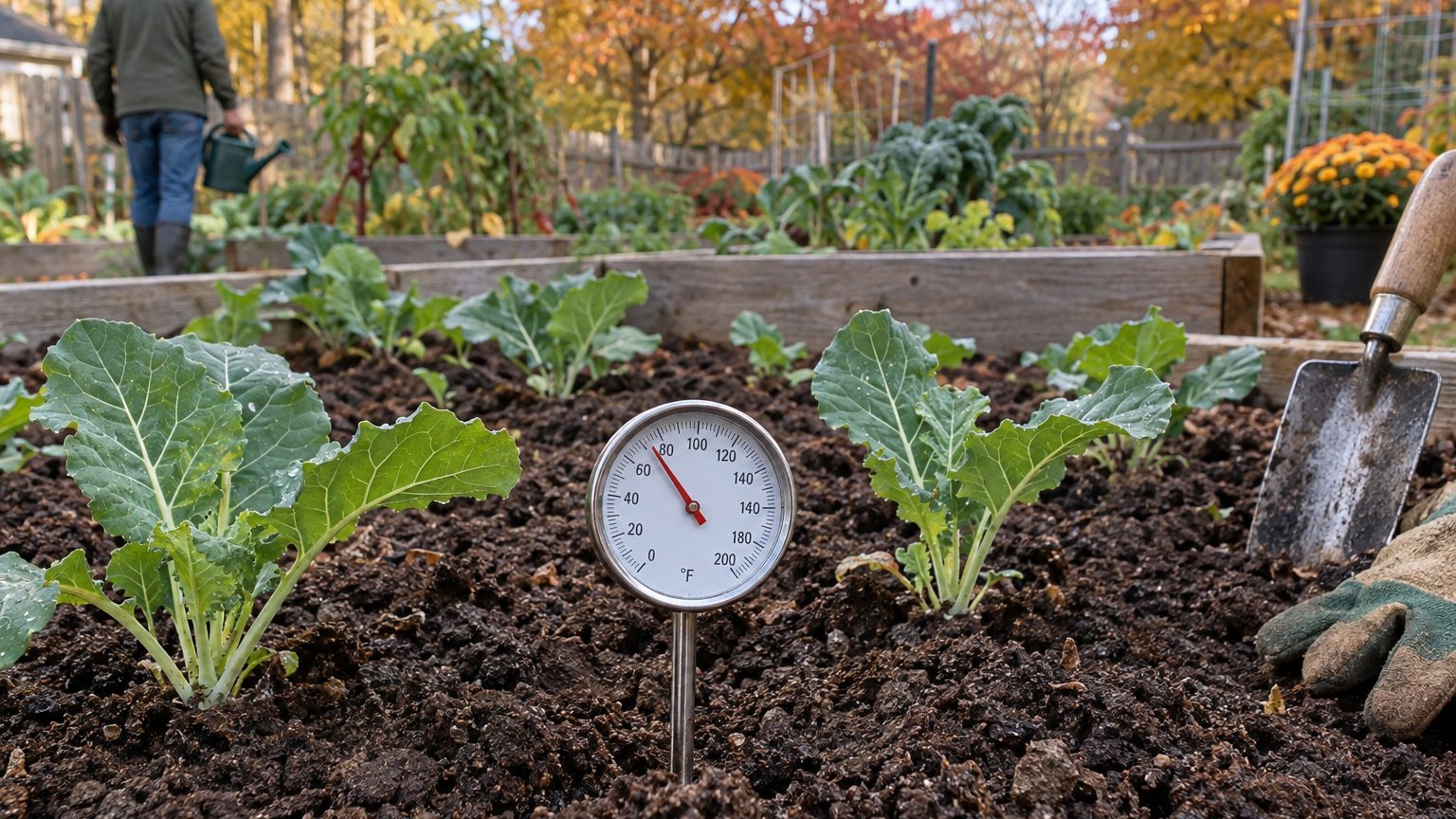

Collards go in the ground here once the coldest nights have passed, and in much of Kentucky they can stay in the garden clear into winter, picked leaf by leaf long after the tomatoes are gone. The state’s split hardiness zones, its humid summers, and its chilly wet winters shape almost every decision: sowing date, plant spacing, and whether this crop ends at Thanksgiving or keeps producing into the new year.
When the soil is warm enough in Kentucky

Gardeners tend to ask about frost first, and that’s a reasonable starting point, but it isn’t the real answer. Frost is a proxy for something collards actually care about: soil temperature. A frost-free morning doesn’t mean the ground has caught up yet, especially after a cold, wet March. Collard seed germinates poorly in cold soil, and transplants set into a chilled bed just sit there, sulking, while weeds that don’t mind the cold get a head start.
For the Louisville reference station, NOAA’s 1991-2020 Climate Normals put the last spring freeze in the window between March 24 and April 4, based on the 30 to 70 percent freeze-probability band. That’s a range, not a promise. It means that in roughly three years out of ten, a freeze could still land after that window closes, and in another three out of ten, the last freeze happens earlier than March 24. Treat the dates as odds you’re playing, not a calendar guarantee.
There’s a real catch with this particular station, too. The National Weather Service office in Louisville has noted that this urban station tends to run later in spring and earlier in fall than the rural parts of surrounding Jefferson County, and that pattern almost certainly repeats itself in other cities and their farm belts across the state. If you garden outside city limits, in a low spot, or at higher elevation in eastern Kentucky, assume your actual frost-free window is tighter than the Louisville numbers suggest, and lean on the later side of the spring band and the earlier side of the fall band when you plan.
Practically, that means direct-seeding or setting transplants once you’re past April 4 gives you a safer margin than jumping in at the first mild week in March, especially for rural gardens. Some growers do push earlier under row cover to warm the soil artificially, and that’s a legitimate strategy, but it comes with the same freeze risk the frost-probability band is describing, just shifted a few weeks sooner.
Collards are also a brassica, the same family as cabbage, kale, mustard and turnips, and that matters beyond the planting date. Whatever bed hosted any of those crops in the last few seasons carries the same soil-borne pests and diseases collards are prone to, so a new collard planting that follows cabbage in the rotation hasn’t actually rotated anything. Check the rotation guidance on this site before you pick the spot.
How long the season lasts here
Kentucky’s frost dates bracket a season that runs longer than people expect for a state this far north. The first fall freeze, per the same NOAA Climate Normals, falls between November 2 and November 12 at the Louisville station. Pair that with the spring window of March 24 to April 4, and the safest planning window, using the later spring date and the earlier fall date, comes out to roughly 212 days between the point you can trust the ground has warmed and the point a hard freeze becomes likely again.
That’s a long season by collard standards. Collards themselves don’t need all 212 days, they’re a relatively fast crop compared to something like a storage cabbage, which opens up a real option most Kentucky gardeners skip: a second sowing. A spring planting set right after the frost-risk window closes can be harvested through summer, and a second round seeded in mid to late summer will mature into the cooler, sweeter conditions of fall, when collards actually taste better anyway, since cold weather converts some of the plant’s starches to sugar.
Whether that second sowing is worth the bed space depends on how the first planting is doing by midsummer. In a short-season territory, gardeners often have to choose between one planting and the risk of a late frost cutting it short. Kentucky’s window is generous enough that the choice flips: the question becomes whether you have room, water, and shade cloth to keep a second round of seedlings alive through the hottest stretch of July and August, since that’s usually the harder part of a summer sowing, not the calendar.
If you’re weighing that second planting, the succession sowing guide on this site walks through timing it against your specific fall frost date rather than a generic calendar rule, which matters more in a state where the frost window itself spans an 11-day range depending on where you sit.
Heat and water in Kentucky

Kentucky summers run warm and humid enough that collards set out too early in spring, before the soil and air have settled, tend to bolt or stall rather than thrive, and the same humidity that makes July uncomfortable for people is exactly what fungal diseases like downy mildew and black rot favor on brassica leaves. Good airflow between plants and avoiding overhead watering late in the day both matter more here than in a drier climate.
The bigger factor, though, is winter, and this is where Kentucky splits into two different growing strategies depending on exactly where you garden. The state’s coldest-month mean daily minimum, again from the Louisville reference station, sits at 27.8°F. That’s the average low for the coldest month of the year, not a record low and not a monthly average temperature, and it lands right at the edge of what collards handle without protection. Collards are among the hardier greens in the brassica family, and a mean minimum in the high 20s generally lets them keep going as a standing crop, picked through the fall and into the depths of winter, especially with a layer of mulch and maybe a row cover on the coldest nights.
But 27.8°F is a mean, not a floor, and Kentucky’s hardiness zones split between 6a and 7a across the state. That range means a garden in the warmer 7a pockets can likely treat collards as a true standing winter crop, harvesting leaf by leaf from November into March the way growers do farther south. A garden in a colder 6a location, particularly at higher elevation or in a frost pocket, should plan for collards as an autumn crop instead, one that produces its main harvest before the hard freezes typical of a Kentucky winter shut it down for good. The winter low decides that plan, not the summer heat, so it’s worth knowing which side of that zone split your own yard falls on before you commit bed space to a fall planting you’re hoping will overwinter.
Which collards suit Kentucky
None of this points to a single variety, and that’s deliberate. The right choice depends on which of Kentucky’s growing conditions matters most in your particular yard, and that’s a question about type, not brand name.
Where the concern is a shorter effective season, whether that’s a rural garden with a tighter frost window than the Louisville station shows, or simply a late start after a cold spring, an earlier-maturing type buys back some of that lost time and still gets a real harvest in before fall frost arrives. Where summer heat and humidity are the bigger worry, a type known for tolerating warm conditions, paired with wider spacing for airflow and a bit of afternoon shade at the root zone, holds up better through Kentucky’s muggy July stretch than a variety bred for cooler climates. And where disease pressure is the concern, which it often is given the state’s humid summers, a type selected for resistance to downy mildew or black rot should be the first thing you look for, ahead of leaf size or color.
What this page won’t do is hand you a cultivar name, because that recommendation only means something when it comes from someone who has actually trialed varieties under Kentucky conditions. That’s exactly the job of the University of Kentucky Cooperative Extension Service, which publishes variety trial results and current recommendations specific to the state’s counties, and it’s worth a call or a visit to their site before you buy seed, since the varieties that performed best in a university trial plot two counties over will tell you more than anything a general gardening article can guess at. Their address is available for anyone ready to move from type to specific seed packet.
One more thing worth remembering before harvest: collards themselves don’t store like a root crop, but any turnips or rutabagas grown alongside them in the same bed do, and those roots deserve a real inspection before you count on them keeping. A soft patch, a weeping spot, or a moldy crown means that root gets used now or composted, not tucked away for later, no matter how sound the rest of it looks.