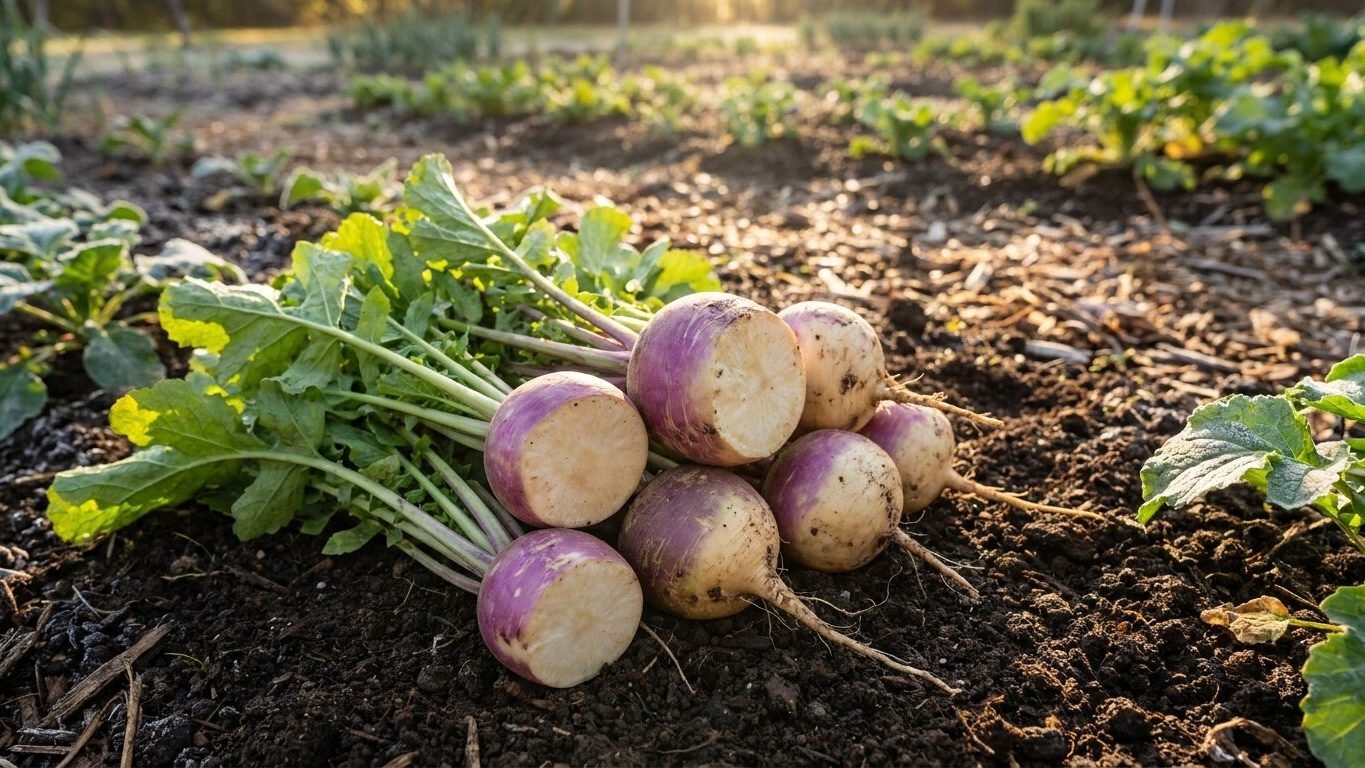

In North Dakota, turnips and rutabaga are an autumn crop, and the cold decides how well they finish. Sow once the soil has warmed and the last spring freeze is behind you. At the Fargo reference station that freeze falls between May 4 and May 15. Harvest after a few light frosts, but before the ground locks up. The details below explain why.
When the soil is warm enough in North Dakota
May 4 to May 15. That is the last-spring-freeze band in NOAA’s 1991-2020 U.S. Climate Normals, built from the 32°F freeze probabilities (the 30 to 70 percent band) at the airport reference station for Fargo. It is a probability, not a promise, so a freeze after the band is always possible. It is also a reference-city figure, not a statewide guarantee. Rural and suburban gardens usually see the last spring frost one to two weeks later than the airport does, and more so at elevation. Check your own county before you commit to a date.
The frost date is a stand-in
Turnips and rutabaga do not read calendars or thermometers on the porch. They respond to the temperature of the soil, and soil lags behind the air. Snowmelt leaves North Dakota ground cold and often wet well after the days turn pleasant. The soil warms after the frost risk ends, not at the same moment. The frost date is a convenient proxy, nothing more. Seed in cold, saturated ground can sit, sulk, or rot, while seed in soil that has warmed comes up evenly.
A cheap soil thermometer settles the argument. Push it a couple of inches down in the morning, when the reading is at its lowest, and sow when the number is steady rather than when it spikes on one sunny afternoon. The minimum soil temperature for good germination is something your state extension service can give you for your area, and it is better to take it from them than from a rule of thumb on a seed packet.
What to look for in the bed itself
Soil that crumbles in your hand instead of smearing into a ribbon is ready to work. Tilling wet ground in a North Dakota spring (heavy clay is common in the Red River Valley) leaves clods that fork the roots later. Forked, stunted turnips usually start with a seedbed that was too rough or too wet.
Spring sowing and autumn sowing are different jobs. A spring planting gives you tender small roots early in the season, while the main crop, and nearly all the rutabaga, is meant to size up as nights cool. For the full crop calendar, the parent guide, Growing Turnips and Rutabaga: An Autumn Crop, Sweetened by Frost, covers it. This page is about what North Dakota’s numbers change.
One more point on varieties: this page does not name cultivars. Talk in types here (quick small turnips, larger storage turnips, slow-growing rutabaga) and ask NDSU Extension which varieties have been trialled where you garden.
How long the season lasts here
Both frost dates come from the same NOAA normals. The last spring freeze falls May 4 to May 15, and the first fall freeze falls September 25 to October 5. Subtracting gives a frost-free window of roughly 133 to 154 days at the reference station.
| Case (Fargo reference) | Last spring freeze | First fall freeze | Days between |
|---|---|---|---|
| Longest window | May 4 | October 5 | 154 |
| Shortest window | May 15 | September 25 | 133 |
Those are airport numbers. A country garden that sees its last frost a week or two later and its first a week or two earlier loses between two and four weeks from the window. Treat 133 days as a ceiling for many gardens, not a floor.
What does that allow? A moderate window, one that is not generous and not stingy. There is room for a spring sowing and, with planning, one more sowing in midsummer for the fall harvest. The method is to take the days-to-maturity printed on your seed packet and count back from the fall frost range. A turnip is a cool-season crop that tolerates light frost, so the first fall freeze does not end its season the way it ends tomatoes. Rutabaga is the slow one and gets a single, well-timed sowing. Start the count too late and it finishes small. The succession sowing guide on this site shows how to space those plantings without wasting seed.
Transplanting is where a shorter window gets tempting. Both crops make a taproot, and a taproot that is bent or nicked by transplanting tends to fork or split. The root check is the cost: gaining a couple of weeks indoors is worth it only if the seedling goes out with an undisturbed root ball, in a peat-free cell or pot, and in soil that has warmed. For turnips, direct sowing is almost always the better bet. For rutabaga, in a county with a late spring, starting a few seedlings is a reasonable hedge, as long as you accept the risk of root damage.
Gardeners who want to see how a different window reshapes the calendar can compare Growing Turnips and Rutabaga in Washington and Growing Turnips and Rutabaga in California. The same crop, with a very different timetable.
Heat and water in North Dakota
This page does not carry a verified count of days above 90°F or a summer rainfall total for the Fargo reference station, so it quotes neither. That absence is informative in its own way. North Dakota is a northern territory, and heat is not what governs this crop. Hot spells do happen and can push roots toward bolting and woodiness, which is why shade at the root (mulch, or neighboring plants that cover the soil) and steady watering matter during them. But the hot-climate worries that dominate southern turnip advice are not the central ones here.
What a cool, damp summer brings instead is a different list: powdery and downy mildew on the leaves, slow ripening, and soilborne disease in wet ground. Turnips and rutabaga are brassicas, so they share these troubles with cabbage, kale and mustard. A bed that grew any of those last year carries their problems, and rotating turnips into it rotates nothing. Keep the rotation guide in mind when you plan the bed, and give the crop airflow by thinning to the spacing on the packet.
The cold facts decide the harvest
For an autumn crop, the two facts that matter are cold ones. The first is the coldest month. The mean daily minimum in the coldest month at Fargo is 0.2°F (NOAA Climate Normals 1991-2020). That is an average of the nightly lows, so many nights run colder. At that level the ground freezes hard, and leaving roots in place under a mulch blanket is not a plan to count on here. Lift them and store them. Where the winter is milder than Fargo, in a sheltered pocket or under deep reliable snow, a few roots might survive a mulched winter, but a gardener who expects fresh turnips in January from the garden bed is going to be disappointed.
The second is the winter low, and the proxy here is the USDA Plant Hardiness Zone Map (2023, built on 1991-2020 normals), which puts the state in zones 3a to 4b. That system rests on one variable, the average annual extreme minimum temperature, and the range covers the whole territory, so your own corner may sit at either end. It tells you the cold arrives early and stays, which shrinks the sweetening window: cold converts starch in the root to sugar, but only between the first frosts (September 25 to October 5 at the reference station) and the day the ground freezes too hard to dig. The date of that hard freeze is not in this page’s data, so watch the forecast and pull the crop after several light frosts, not after a deep freeze.
Storage touches food safety, so a few rules. Before roots go into storage, inspect each one. They should be firm all the way through, with no soft patch, no weeping spot and no moldy crown. A single soft spot ends the question for that root, and a root that looks sound on the outside is not proof that it is safe. Discard what fails the check, and do not promise yourself a keeping time. Check the pile regularly and remove anything that changes.
Which turnips and rutabaga suit North Dakota
No variety names appear on this page, and the omission is deliberate. The only recommendation that means anything is one from a trial in your region, and this page does not have those results. A made-up name would be worse than none, because it sends you to a seed catalog for something that may not exist or may not perform. The right source is NDSU Extension, whose staff know which varieties have been grown locally.
Reasoning from this territory’s facts, though, gives you the criteria to ask about. A season of 133 to 154 frost-free days at the reference station, and shorter in many rural gardens, favors the earliest types. For turnips, that means quick, small-rooted types you can sow twice. For rutabaga, it means the earliest-maturing type you can find, sown on time, since rutabaga is the crop with the least slack.
Hot spells favor roots given airflow and shade at the base. Choose types with a reputation for holding quality in warm weather, and plan spacing and mulch to match. A damp summer, which North Dakota can deliver, makes disease resistance the first criterion. Ask the extension office which types hold up against the mildews and root problems common in your county. A resistant type grown in a bed where brassicas have just been is still carrying the previous crop’s disease, so rotation matters as much as the seed you pick.
Storage is a separate criterion. Larger-rooted, slower types are the ones usually kept after the harvest, while the quick small ones are for eating soon. Whatever you keep, run the inspection described above, and let the extension office confirm the handling that fits your cellar or garage.
Common questions
When can I sow turnips in North Dakota?
Once the soil is workable and warming, which at the Fargo reference station follows the May 4 to May 15 last-freeze band. Rural gardens often run one to two weeks later. Use a soil thermometer rather than the calendar, and sow again in midsummer for a fall crop.
Can I leave rutabaga in the ground over winter?
Not as a plan. The mean daily minimum of the coldest month at Fargo is 0.2°F, and the ground freezes hard. Lift the roots after several light frosts and before the ground locks, then store them.
How do I know stored roots are safe to eat?
Looking sound is not enough. Check that each root is firm throughout, with no soft patch, weeping spot or moldy crown. If you find any of those, discard the root. Keep checking the pile as the weeks pass.
Can I plant turnips where cabbage grew?
No. Turnips and rutabaga are brassicas, and they share pests and diseases with cabbage, kale and mustard. Moving them into a cabbage bed rotates nothing. Give the bed a break from every brassica first, and check the rotation guide for how long.