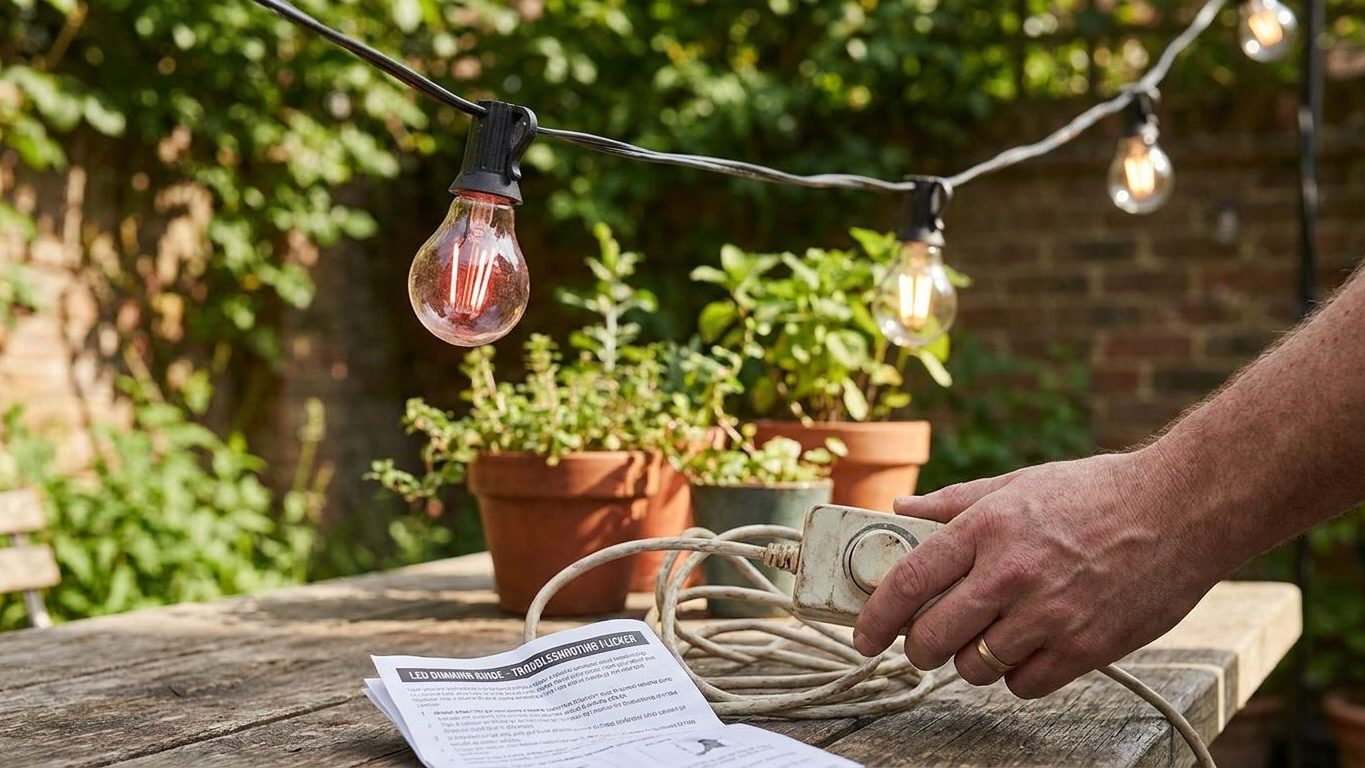

Incandescent bulbs dimmed on almost any switch you put behind them, because a plain filament just gets dimmer as you cut its power. LED and CFL bulbs are small electronic devices with their own internal circuitry, and that circuitry only cooperates with a dimmer built to talk to it. Check the bulb’s packaging for a dimmable rating and match it to a dimmer rated for LED loads before you touch any wiring.
What is actually going on

The thing to understand here is mismatch. An old rotary or slide dimmer was designed to cut power to a resistive load pulling a real amount of wattage, and it did that by chopping the electrical wave at a certain point in each cycle. Incandescent filaments have no opinion about how that chopped wave looks. They just heat up less and glow less. A dimmer built for that job assumes the bulb behind it is a simple resistor, and for decades that assumption held.
A modern LED bulb is not a resistor. Inside the base is a small driver circuit that converts household power into the steady low-voltage current the diodes actually run on. That circuit expects power delivered in a particular shape, and it draws far less wattage overall than an incandescent bulb ever did, often a fraction of what the dimmer was designed to sense and control. When an old-style dimmer chops the wave in a way the driver circuit was not built to interpret, the driver either misreads the signal, cannot draw enough current to run smoothly, or shuts on and off many times a second faster than the eye can consciously track.
That is flicker. It is also the reason for the buzz you sometimes hear from the fixture or from inside the dimmer itself, which is the transformer or driver coil vibrating at the frequency of that chopped signal. And it is why some bulbs will dim down to a certain point and then stubbornly refuse to go lower, or jump straight from dim to off with no smooth fade between. Flickering, buzzing, and a dead zone at the bottom of the dial are not three separate faults. They are the same compatibility problem showing up in three different ways, depending on how far off the match between bulb and switch actually is.
The fix is rarely a defective bulb and rarely a defective dimmer. It is usually a dimmer built for one kind of load being asked to run a completely different one. The dimmer’s technology has to match what the driver circuit inside the bulb expects, not just the wattage printed on the box. This is also why swapping one bulb for a supposedly identical one sometimes fixes the problem and sometimes does not: driver circuits vary between manufacturers even when the bulb looks the same on the shelf, and a dimmer that gets along with one brand’s driver may not get along with another’s.
Doing it
Work through the bulb side and the switch side separately before deciding anything needs replacing. Skipping a step here is how people end up buying a second dimmer that fails for the same reason the first one did.
Checklist, in order
- Confirm the bulb is actually rated dimmable. Not every LED or CFL is. A non-dimmable bulb on any dimmer, old or new, will flicker or buzz no matter what you change on the switch side. Skipping this step means chasing a wiring problem that does not exist.
- Identify the dimmer’s technology, not just its age. Older rotary and slide dimmers are usually built for resistive loads. Newer dimmers sold specifically for LED or CFL use a different switching method suited to low-wattage electronic loads. Skipping this step means buying a replacement dimmer that is just as incompatible as the one it replaces.
- Check the dimmer’s stated minimum load. Many dimmers, even ones marketed for LEDs, list a minimum wattage they need to sense in order to work cleanly, and a handful of very low-wattage bulbs on one switch can fall under that floor. Skipping this step is the single most common reason a dimmer bought specifically to fix flicker still flickers.
- Add up the total wattage on that one switch. If several fixtures or bulbs run off a single dimmer, their combined draw has to sit inside the dimmer’s rated range, both the minimum and the maximum. Skipping this step risks a dimmer that overheats under a load it was never rated to carry.
- Check whether the switch box has a neutral wire. Some dimmer technologies need one and some do not, and this is wiring inside the wall, not something visible from the faceplate. This is the point where the job stops being a swap-the-part task and becomes an electrician’s job, because confirming what is actually in the box means opening it safely and knowing what you are looking at.
If you are already swapping bulbs and fixtures as part of a bigger lighting update, this is also the moment to get the shade proportions right, covered in Choosing a Lampshade That Fits, since a mismatched shade can trap heat around a driver circuit that is already working harder than it should.
What it looks like when it goes wrong
Some of these failures are cosmetic annoyances. A couple are not, and the difference matters.
Cosmetic, and correctable
A bulb that flickers only in the bottom third of the dial, or that jumps rather than fades near off, is almost always a compatibility issue and not a safety issue. It is correctable by matching the dimmer’s technology to the bulb, adjusting the total load on that switch, or in some cases changing to a bulb from a different driver design. A faint glow when the switch is fully off is the same story: current is still leaking through at a level the driver interprets as “barely on.” None of this damages anything by itself, but it is worth fixing because it points at a mismatch that can shorten the working life of both the bulb and the dimmer over time.
Safety issues, and not correctable by adjustment
A dimmer faceplate that feels hot to the touch, shows discoloration, or has a faint burning smell is a different category entirely. That is a load exceeding what the dimmer or the wiring behind it can dissipate safely, and it does not get fixed by choosing a different bulb. A warm faceplate is normal for some dimmer designs, a hot or discolored one is not, and the distinction is worth learning rather than guessing at. A breaker that trips when the dimmer is switched on, or a dimmer that hums loudly enough to be heard from across the room even at full brightness, both belong in the same category. Stop using the switch and have the wiring checked before continuing, rather than trying another bulb or another setting to see if it goes away.
What to settle first
Before buying anything, settle what the wall actually is. A switch box in a house built decades ago may not have the neutral wire that some modern dimmer technologies require, and that is not something you can tell from the trim plate. It is also worth knowing whether the box holds a single switch or is part of a multi-location setup controlling the same fixture from two places, because not every dimmer technology supports that configuration, and forcing one to can reproduce every symptom described above.
Settle, too, whether the load belongs on that circuit at all. A dimmer rated for a certain wattage range assumes everything on that switch adds up within its limits. A ceiling fan with an integrated light kit, multiple recessed fixtures on one switch, or a fixture added later without checking what already shares that circuit can all push the total past what the dimmer was ever designed to carry. None of this is guesswork you can resolve by trial and error, and a local electrician or your area’s building department is the right place to confirm what a given circuit is rated for before you commit to a fixture plan.
Reading a wall correctly matters for more than switches. The same questions about what is behind the drywall and what it can support come up in Hanging, Shelving and Fixing: The Wall Decides, which is worth reading if this project is part of a wider room refresh rather than a single swapped switch. And if that same wall is also getting a cluster of framed pictures once the electrical work is done, it is worth planning that layout separately with Arranging a Group of Frames Without Guessing, since both jobs depend on knowing exactly what is behind the surface before anything goes up.
Common questions
Why does my LED bulb work fine at full brightness but flicker as soon as I lower it?
That points squarely at the dimmer’s minimum load or its switching technology rather than the bulb itself, because at full brightness the dimmer is barely doing any work and the mismatch has nothing to act on. Lowering the dial is exactly when the chopped waveform starts to matter to the driver circuit inside the bulb.
Can I just add more bulbs to the same dimmer to get past the minimum load requirement?
Adding load can solve a minimum-wattage problem, but only if the total still sits under the dimmer’s rated maximum, and only if every bulb added is itself rated dimmable. Adding a non-dimmable bulb to fix a minimum-load issue trades one failure for another.
Is it safe to leave a slightly buzzing dimmer alone if the bulb still works?
A faint buzz from the bulb or fixture coil is usually cosmetic and not dangerous by itself. A buzz coming from inside the dimmer housing alongside heat or discoloration is a different situation and should be checked rather than tolerated.
Do I need a different dimmer for every room I switch to LED bulbs?
Not necessarily, but each switch needs to be evaluated on its own, since the wiring behind one box in a house can differ from another, especially between older and newer sections of the same home. Treat each dimmer as its own compatibility check rather than assuming one fix applies everywhere.