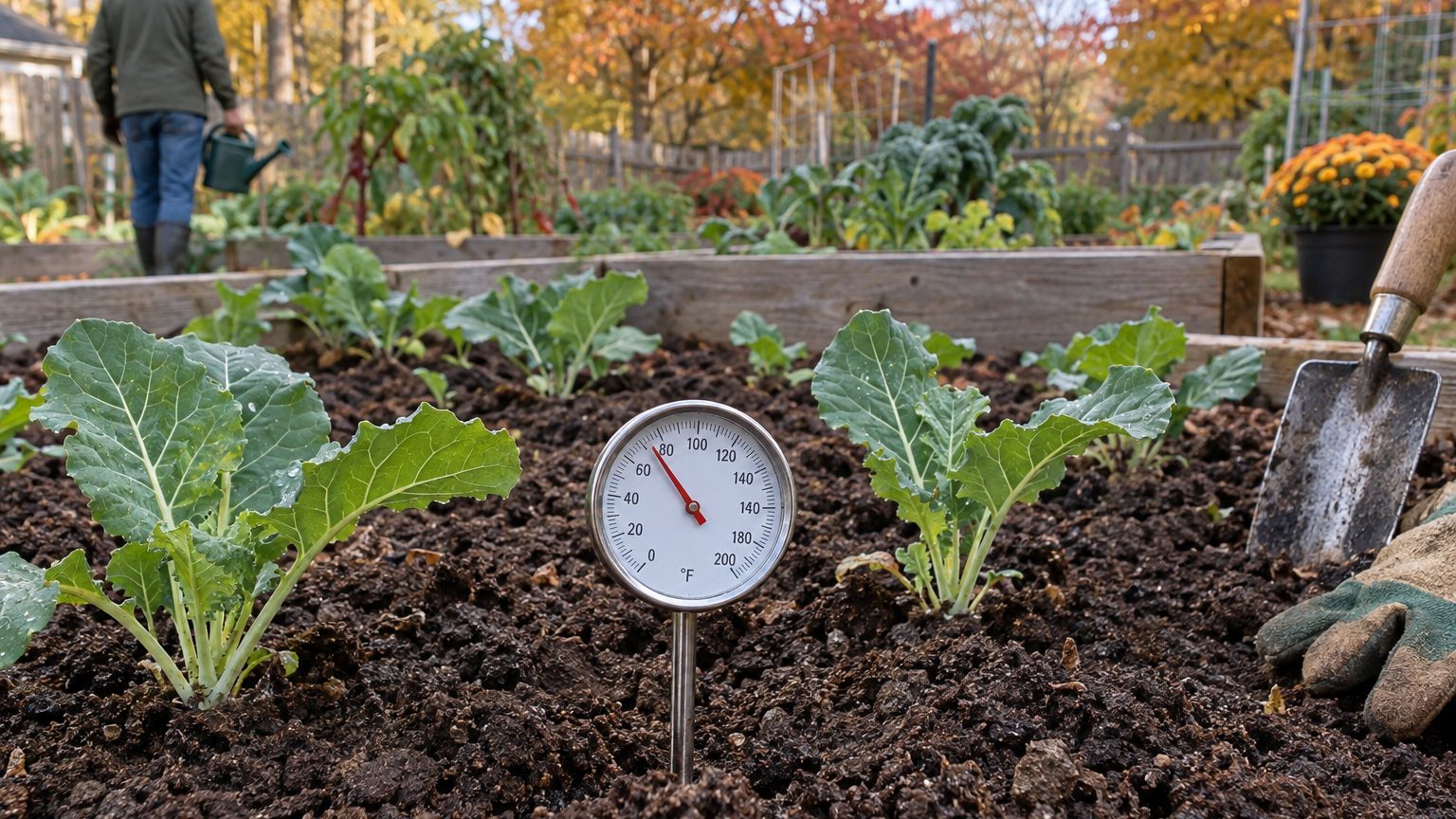

Collards go into Massachusetts soil once the ground has warmed past the last frost risk, usually mid to late April near Boston and a bit later inland. The plant shrugs off cool spring nights and thrives through the state’s humid summers, and in the mildest coastal pockets it can stand in the garden from November clear through March. Everything else, timing, season length, and variety choice, depends on exactly where in the state you garden.
When the soil is warm enough in Massachusetts

Boston Logan Airport, the reference station NOAA uses for the state’s climate normals, shows a 30 to 70 percent probability of a 32°F freeze landing somewhere between April 1 and April 8 (NOAA NCEI 1991-2020 Climate Normals). That window is a probability, not a promise: some years the last frost lands earlier, some years later, and the number only describes odds at one waterfront station.
Frost date is a proxy anyway. What actually matters for collards is soil temperature, and soil lags behind air temperature by a couple of weeks even after the frost odds have dropped. Waiting until the calendar clears the frost window and then giving the ground another stretch of warm days before transplanting or direct-sowing is the safer read of the data, especially since Logan sits on the water and runs warmer than almost anywhere else in the state. Inland suburbs west of Route 128 and the Berkshire valleys frost measurably later in spring and earlier in fall, so a gardener in Springfield or Pittsfield should treat the Logan window as an early estimate, not a start date.
Because collards tolerate a light frost better than most vegetable seedlings, some gardeners set transplants out a week or two before the window closes and cover them on the coldest nights rather than waiting out the full probability band. Direct-seeding is the more forgiving choice for a first-time bed since it skips the transplant shock entirely, though it costs a couple of weeks compared to starting indoors. Either way, avoid rotating collards into a bed that grew cabbage, kale, mustard, turnip, or rutabaga the previous year: all of these share the same pest and disease pressures because they belong to the same brassica family, and skipping that rotation step undoes most of the benefit of rotating at all.
For the actual leaf type to plant, the University of Massachusetts Amherst Extension Service (ag.umass.edu) maintains the current list of varieties trialled for New England conditions, and that list changes as breeders release new disease-resistant lines. A cultivar recommended for a Georgia trial field won’t necessarily perform the same in a Worcester County garden.
How long the season lasts here
Stack the two frost windows against each other and the frost-free stretch runs from as short as 209 days (using the latest possible last frost, April 8, against the earliest possible first fall frost, November 3) to as long as 227 days (April 1 against November 14). Either way, that’s roughly seven months of open ground, which is generous by New England vegetable-garden standards.
A window that long allows more than one collard planting. A spring sowing feeds the household through summer, and a second sowing in mid to late summer produces a fall crop that often tastes better anyway, since collard leaves sweeten after a touch of frost. Gardeners working a shorter growing space, or those further inland where the practical window runs closer to the 209-day end, get more value out of starting transplants indoors rather than direct-seeding twice, since transplants buy back the days that direct-seeding costs. The collard growing guide for this territory lays out the succession-sowing timing in more detail, including how to stagger a spring and fall crop in the same bed.
The length of the window also changes how much risk is worth taking with the second sowing. In a year running toward the long end of the range, a late-summer planting has room to mature even if a few warm days push the first fall frost back further than the average. In a year running toward the short end, that same late sowing is racing the clock, and a gardener who wants a guaranteed fall harvest is better off treating the spring planting as the only one that matters and putting effort into keeping it productive as long as possible instead.
Heat and water in Massachusetts

Massachusetts summers are moderate compared to most of the collard’s traditional range further south. Long runs of 90-degree days are uncommon here, and rainfall tends to arrive as scattered storms through the growing season rather than disappearing into a prolonged dry spell. That combination is generally kind to collards, but it comes with its own headache: cool, damp stretches in a New England summer favor downy mildew and other leaf disease more than they favor sunscald or bolting, so airflow between plants and morning watering (so leaves dry by evening) matter more here than shade cloth does.
The number that actually decides how this bed gets planned is winter, not summer. Boston’s coldest month averages a daily minimum of 23.1°F (NOAA NCEI 1991-2020 Climate Normals), mild enough that collards near the coast frequently survive as a standing crop, picked leaf by leaf from November into March rather than pulled at the first hard freeze. The USDA Plant Hardiness Zone Map puts the state at 5a to 7b, and that range matters more than a single zone number would suggest: Boston sits toward the milder 7b end, while inland valleys and the Berkshires run closer to 5a, where a genuine hard freeze ends the collard season for good each fall.
Because that winter split is the whole story, it’s worth seeing how differently the same crop behaves elsewhere in the region:
| Territory | Winter pattern | How collards are grown |
|---|---|---|
| Massachusetts (coastal) | Mild, coldest month mean min around 23°F | Often a standing crop into winter |
| Michigan | Colder, longer hard-freeze stretch | Strictly an autumn crop, ends at first hard freeze |
| Texas | Mild to warm most winters | Frequently grown nearly year-round |
A Massachusetts gardener planning next winter’s bed should think less about the summer’s rainfall and more about which side of that 5a-7b line their own yard falls on.
Which collards suit Massachusetts
The honest answer is that this page can’t hand you a variety name, and that’s not a dodge. Extension trials change from year to year as new disease-resistant lines get released and older ones fall out of favor, so any cultivar named here could be outdated or simply wrong for a specific county by the time you plant it. What this page can do is point you toward the traits worth asking about when you check the current UMass Extension list.
Reasoning from the state’s own numbers, three things matter more than any brand name:
- Leaf type: smooth-leaf types tend to grow faster in a cool spring, useful where the season runs toward the shorter 209-day end; curled or savoyed-leaf types often hold up better to the wet, humid stretches that bring on leaf disease.
- Disease resistance: given how often Massachusetts summers run cool and damp rather than hot and dry, resistance to downy mildew and other leaf disease should rank above earliness or leaf size on any shortlist.
- Winter habit: gardeners near the coast planning a standing winter crop want types known locally for holding quality after repeated light frosts, while inland gardeners planting a straight autumn crop can prioritize speed over cold tolerance.
The UMass Amherst Extension Service (ag.umass.edu) runs the variety trials that actually matter for this state, comparing performance across its own test sites rather than a national average. That’s the list worth checking each planting season, since it reflects what grew well in Massachusetts conditions the year before, not what grew well somewhere with a very different winter.