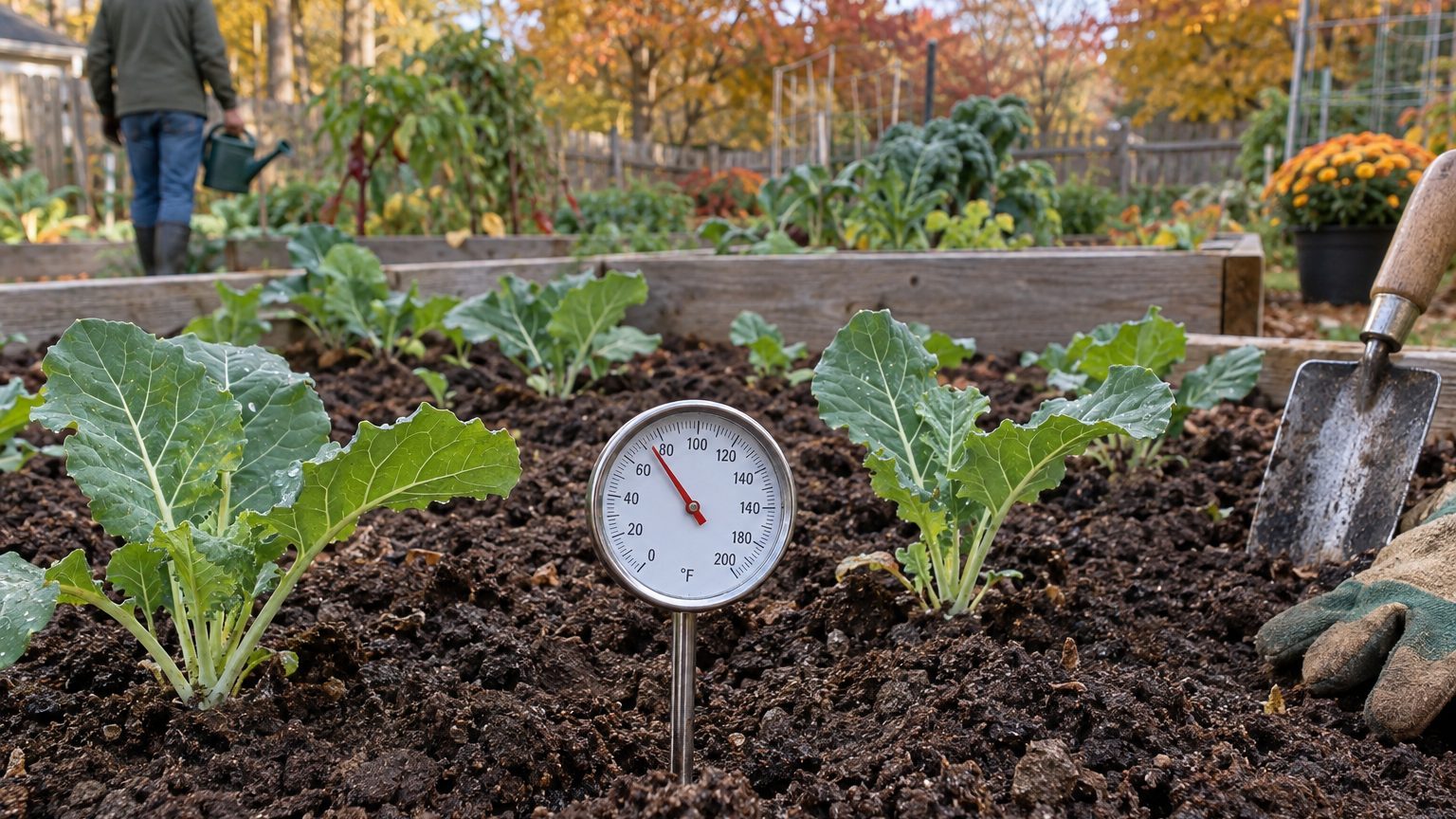

Detroit’s last spring frost falls around April 30, and that’s the number most Michigan gardeners fixate on before starting collards. It’s the wrong one to watch. Collard seed germinates by soil temperature, not by the calendar square marking frost risk, so wait until the ground itself has warmed rather than counting days from a frost date.
When the soil is warm enough in Michigan

Every Michigan collard grower wants the same answer in March: a date safe to sow. MSU Extension’s Frost-Free Dates data puts the last spring frost at around April 30 in the Detroit area, with early to mid May typical across most of the Lower Peninsula. That’s the figure most seed packets and garden calendars point to, and it’s useful, but it answers the wrong question.
A frost date tells you the odds of a killing cold snap, not the temperature of the dirt under your boots. Collard seed germinates poorly in cold, wet soil no matter what the calendar says, and it will sit there rotting until the ground catches up. Frost risk usually clears before the soil is actually warm enough to push seedlings along, so treat the frost date as the earliest the countdown can start, not the day to sow. Keep in mind that any frost date is a probability built from decades of past years, not a guarantee for this one. A late cold snap after the “average” date is common enough that a floating row cover is worth keeping on hand through May.
Testing the ground instead of the calendar
Push a bare finger a couple of inches into the bed. If it feels cold enough to make you flinch, the soil isn’t ready, no matter how far past the frost date you are. Collards germinate and grow in cool soil better than most vegetables, which is exactly why they get pushed too early. Give the bed another week or two after frost risk passes before direct-sowing, and start transplants indoors instead if you want a head start without gambling on outdoor soil temperature. If you want to nudge the soil along faster, lay a sheet of black plastic or garden fabric over the bed for a week before you plan to sow. It traps daytime heat and can bring the top few inches up noticeably faster than bare soil left alone. Pull it back before sowing so seed contact isn’t smothered.
Before any of that, work compost or aged manure into the bed, since collards are heavy feeders that stall out fast in thin soil. They also belong to the brassica family along with cabbage, kale, mustard, turnip and rutabaga, so don’t plant them where any of those grew last year. Rotating collards into a bed that held cabbage the season before hasn’t rotated anything, and it lets clubroot and root maggot populations carry over from one crop to the next. If you haven’t worked through bed prep and spacing yet, the full walkthrough in Growing Collards: One Planting, Months of Harvest covers that groundwork before this page picks up.
How long the season lasts here
Stack the two Michigan frost dates against each other and you get the shape of the whole growing year. MSU Extension puts the last spring frost at around April 30 near Detroit, sliding to early-to-mid May farther north and inland, and its Michigan Garden Calendar puts the first fall frost for zone 6a at October 6 to October 21. That leaves a frost-free window of roughly five months in the Detroit area, shorter the farther north or inland you garden.
What that window is actually good for
Five months is enough room to treat collards as a two-round crop rather than a one-shot planting. Sow the first round as soon as the soil has warmed past frost risk, then start a second round in mid to late summer timed to mature as the weather cools, since collard flavor actually improves after a light frost sweetens the leaves. Gardeners with the shorter window farther north or on higher ground don’t have that luxury. One sowing timed for a fall harvest is the safer bet there, because a second round pushed too late risks running out of season before it sizes up. The general logic of staggering plantings rather than committing a whole bed to one sowing date is worth working through before you decide.
Do the arithmetic in ranges, not points. Late April to early October is close to five months in the Detroit area, but late April to mid October pushes closer to five and a half. Farther inland, where spring frost risk holds on into early-to-mid May, that same window shrinks by a week or two on the front end. Either way, it’s long enough to carry a full-sized planting to maturity, with room left over for a second one if you’re near the earlier end of the window.
Collards tolerate the approach of frost far better than the heat of a Michigan July, so the fall end of the window is where the crop actually thrives. A planting timed to hit maturity in the weeks around the first fall frost gets cool nights, lighter pest pressure, and that frost-sweetened flavor collards are known for. Gardeners in southeastern Massachusetts work with a similarly narrow autumn window for the same reason. See Growing Collards in Massachusetts for how that plays out on the coast. In Michigan, the practical move is to count backward from the first fall frost date rather than forward from the last spring one when deciding on a second sowing.
Heat and water in Michigan

The number that actually decides how you plan a collard bed in Michigan isn’t a summer figure at all. It’s how cold the winter gets. NOAA’s NCEI 1991-2020 climate normals put the average low during the coldest month at the Detroit reference station at 19.2°F, far short of the mild winters where collards get picked leaf by leaf from November clear into March. In Michigan, plan for collards as an autumn crop that runs its course and ends at the first hard freeze, not a standing one you keep harvesting through winter.
Why the winter number outranks the summer one
The USDA’s Plant Hardiness Zone Map, built on 1991-2020 normals, places Michigan across zones 4a to 6b, a wide spread for one state. Southeastern spots near Detroit sit toward the milder end of that range, while northern counties and higher ground sit well toward the cold end. Wherever you garden in the state, that winter low is the number to build the calendar around, not a summer heat index the way a Southern grower would use.
Michigan summers rarely turn punishing the way they do in the Southwest or the Mid-South. Extreme heat is the exception rather than the rule here, and collards, which handle mild heat better than most greens, don’t usually need the shade cloth or heavy mulching that growers farther south rely on. The bigger hazard in a Michigan summer is dampness. Humid air sitting still over a leafy bed is exactly what powdery mildew and black rot need to take hold. Space plants for airflow, water at the soil line instead of overhead, and pull off any leaf that starts showing gray powder or dark, angular spots before it spreads through the row.
Michigan summers aren’t uniformly wet either. A dry stretch in July or August can still stress a shallow-rooted crop like collards, so a couple of inches of mulch around the base does double duty. It keeps roots from drying out between rains and slows the splash-up of soil-borne fungal spores onto lower leaves. That trade-off, mild heat but sticky humidity, is close to the opposite of what a grower in a place like Utah deals with, where dry air keeps fungal disease down but real heat and low rainfall push collards toward bolting and bitterness instead. See Growing Collards in Utah for that version of the problem. In Michigan, plan water and airflow around fungal risk, not drought stress.
Which collards suit Michigan
This page won’t hand you a variety name, and that’s deliberate. Which collard actually performs best depends on trials run in your own state’s growing conditions, and Michigan’s span of hardiness zones, from 4a in the north down to 6b near the Great Lakes shoreline, means a cultivar that thrives near Detroit can struggle two hundred miles north. MSU Extension, reachable through canr.msu.edu/outreach, is the source for cultivars actually trialled under Michigan conditions, and that recommendation carries more weight than any generic list ever could.
Matching type to trait, not name
What this page can do is point you toward the right type for the traits Michigan’s climate rewards.
- Fast-maturing types matter most for the shorter growing window farther north in the state, where a slower variety may not size up before the first hard freeze.
- Disease-resistant types, bred against powdery mildew and black rot, earn their keep in Michigan’s humid summers, where still, damp air favors fungal problems more than heat does.
- Types described on the seed packet as improving in flavor after light frost suit a Michigan fall planting, since the crop here runs as an autumn harvest rather than a winter-long one.
Days-to-maturity figures on a seed packet are counted from transplant under average conditions, and they shift by a week or more depending on the season you actually get, so treat any printed number as a starting estimate rather than a fixed date. Cross that catalogue figure against the frost window described earlier rather than trusting it outright. A type listed as needing a long stretch to mature is a poor match for a garden near the shorter end of Michigan’s frost-free window, no matter how disease-resistant it is.
If you’re choosing between direct-sowing and starting transplants indoors, lean toward transplants for any type with a longer catalogue maturity figure, since a month’s head start indoors effectively borrows time from the front end of the frost-free window. For gardeners near the Detroit end of the state, where that window runs longest, direct-sowing a fast type in spring and transplanting a second round in summer covers both the early and late slots in the calendar described above.