
Collards go into a Missouri garden once the soil has shed its spring chill, which in most of the state means waiting past the April 6 to April 20 frost window before setting transplants or direct-seeding. Because Missouri winters run too cold for the leaf-by-leaf harvest gardeners enjoy in milder regions, the crop here is almost always a single fall planting, chosen for quick maturity and disease resistance, with the local variety list coming from University of Missouri Extension rather than a seed rack.
When the soil is warm enough in Missouri

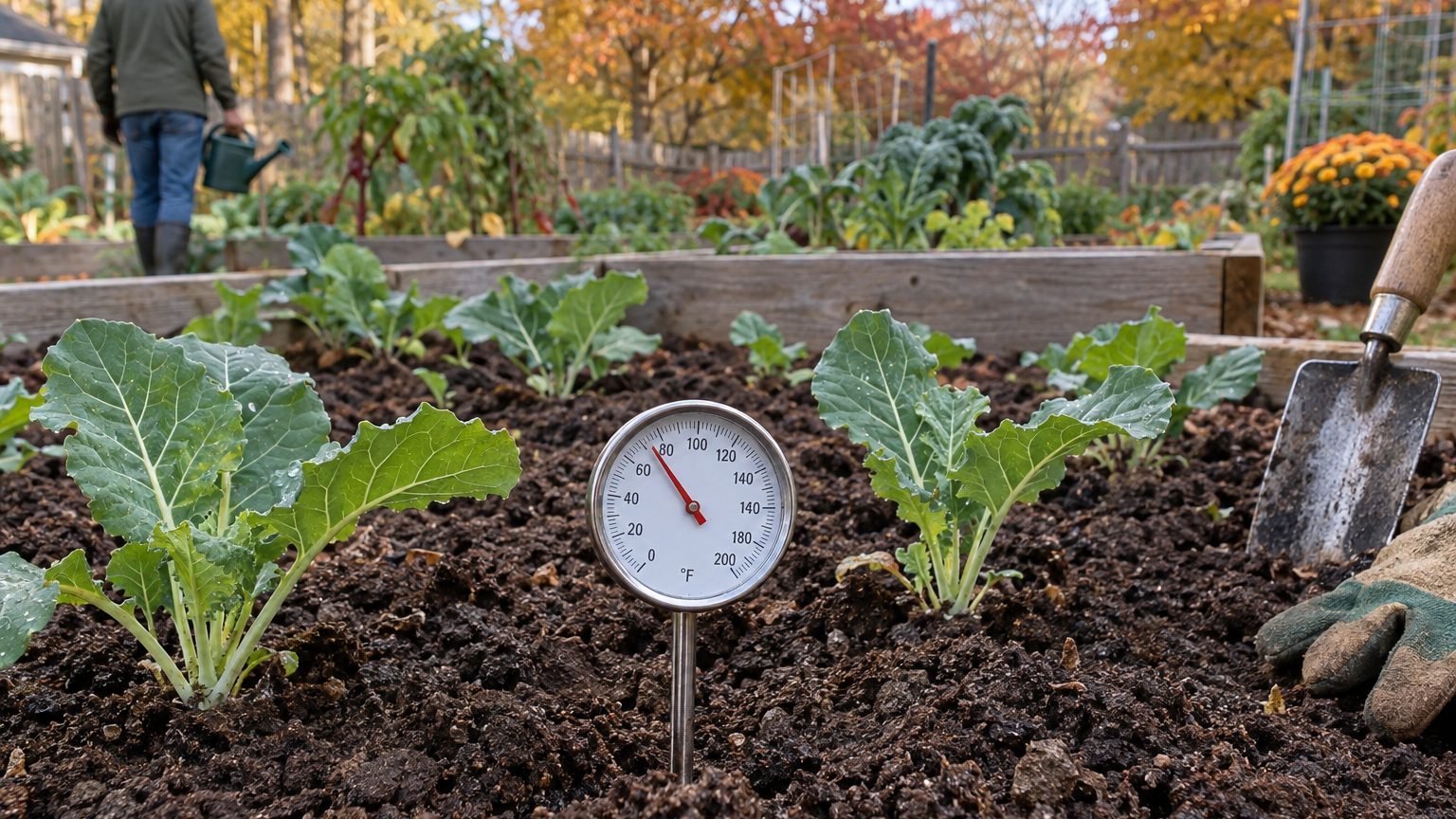
The frost date gets all the attention, but it’s really a stand-in for the number that matters: soil temperature. NOAA’s 1991-2020 Climate Normals put the last spring freeze for the Kansas City reference station (USW00003947) between April 6 and April 20, a 30 to 70 percent probability band, not a guarantee that the cold snaps stop on cue. That station sits well north of downtown Kansas City, and its numbers run about five days later than the city center. Southern Missouri, from the Ozarks down toward the Bootheel, warms earlier still.
Soil doesn’t know the calendar. It warms after the freeze risk fades, sometimes by a week or more, because a cold snap chills the ground faster than it chills the air, and the ground takes longer to recover. A gardener who plants collard seed or sets out transplants the day the average frost date passes is often planting into soil that’s still cold and slow, which shows up later as patchy germination or transplants that sit and sulk instead of growing.
The safer read of that frost date is a green light for preparation, not planting. Turn beds, work in compost, and watch the week ahead rather than the calendar square. Once nights stop dipping near freezing and the ground has had a stretch of sun, collards move fast: this is a cool-season brassica that tolerates a light frost far better than it tolerates heat stress, so erring a few days late costs little.
Collards share a family, and a family’s worth of trouble, with cabbage, kale, mustard, turnip and rutabaga. Clubroot, black rot and the cabbage worms that shred young leaves all move through this same brassica group, which means a bed that grew any of those crops last year, or the year before that, isn’t a clean rotation just because the crop’s name changed. Track what’s gone into each bed and give brassicas at least a few seasons’ break from themselves.
How long the season lasts here
Subtracting the two frost windows gives a working season of roughly 180 to 205 days, depending on where in the state, and where in each frost band, a particular garden falls. The last spring freeze runs April 6 to April 20; the first fall freeze runs October 18 to October 29, both from the same Kansas City-area NOAA station. That’s a season long enough to matter for planning, but it isn’t infinite, and it isn’t uniform across a state that stretches from the Iowa line to the Arkansas border.
A window that long allows more than one bite at collards. A spring sowing, timed for harvest before summer heat turns the leaves bitter and tough, can be followed by a second planting in mid-to-late summer aimed at the sweeter, frost-touched leaves of fall. That second sowing is often the better one in Missouri, since collards actually improve in flavor after a light freeze, and the fall crop avoids the worst of the season’s heat stress entirely.
Whether a second planting is worth the trouble comes down to timing backward from that first fall frost date rather than forward from spring. A gardener in the northern half of the state, working from the earlier end of the fall frost band, has less room to stagger plantings than someone in the Bootheel, where frost arrives closer to the later date. Anyone stacking a spring and fall crop in the same year should work from the succession sowing guide on this site to line up sowing dates against both frost windows instead of guessing.
The length of the season also decides whether transplanting makes sense at all. In a shorter effective window, starting seedlings indoors and setting out started plants buys back the weeks that direct-seeding would cost, while a longer window gives more slack to seed straight into the bed and thin as it grows.
Heat and water in Missouri

Missouri summers are genuinely hot and often humid, the kind of stretch that pushes cool-season crops like collards toward bitterness, slow growth, and fungal trouble on crowded leaves. That combination of heat and moisture in the air, rather than any single number, is what actually shapes how a collard bed is managed here: consistent watering at the root instead of overhead sprinkling, mulch to keep soil temperature and moisture even, and enough spacing between plants that air moves through the row and dries the leaves after a storm.
What decides the bigger question, whether this is a spring, fall, or standing winter crop, is the cold end of the year rather than the hot one. The mean daily minimum for the coldest month at the Kansas City reference station runs 19.5°F, and the statewide USDA Plant Hardiness Zone range sits at 5b to 7b. That’s well below the threshold where collards can be picked as a standing crop straight through winter, the way gardeners manage them along the Gulf Coast or the milder parts of the Carolinas. In Missouri, collards are an autumn crop: they take a light frost or two in stride, and often taste better for it, but a hard freeze at that kind of low ends the harvest for the year.
That distinction changes how a bed gets planned from the start. A gardener aiming for a standing winter harvest, common further south in this same crop family’s territory, is planning for a climate Missouri doesn’t have. Here, the working plan is to time the fall sowing so the bulk of the harvest lands before that hard freeze arrives, with row cover as a way to stretch the picking season by a couple of weeks rather than a way to carry the crop through the whole winter.
The state’s hardiness range also isn’t one number. Kansas City sits toward the cooler end at 5b/6a, while the southeastern Bootheel runs closer to 7b, mild enough that the gap between “autumn crop” and “occasional light winter picking” narrows considerably. Anyone gardening south of the I-44 corridor should weigh their own county’s normal winter low rather than assume the Kansas City figure applies.
Which collards suit Missouri
None of this points to a single variety, and that’s deliberate: this page can’t responsibly name one. Seed catalogs change, regional trial results shift year to year, and a cultivar that performs well in a University of Missouri variety trial this season may be replaced by a better performer next season. What the state’s climate does point to is a type of collard, and the specific name that fits that type belongs to University of Missouri Extension, which runs the trials that actually test performance under Missouri conditions.
Given a roughly six-month season that runs from mid-spring into late fall, an earlier-maturing type of collard fits better than a slow one, especially for a spring planting that needs to finish before summer heat sets in. For the fall crop, where flavor actually improves after frost, a slightly slower type is less of a liability, since the goal there is timing the harvest around the first hard freeze rather than beating the heat.
The combination of hot, sometimes humid summers argues for disease resistance as close to a first criterion as any single trait gets here, particularly resistance to the fungal and bacterial leaf diseases that spread fastest when air is still and leaves stay wet. Spacing that allows airflow does some of that work on its own, but starting with a resistant type reduces how much depends on getting spacing and watering exactly right in a bad year.
Asking the local extension office which types have actually held up in Missouri trials is a stronger move than trusting a seed packet’s marketing copy, and it’s the one step this page can’t substitute for.