
Collards can be planted almost any month somewhere in Nevada, but the state stretches from low desert basins to mile-high mountain valleys, and that gap changes everything: when the soil is ready, how long the season runs, and whether the plant survives outdoors all winter. The short answer is to check your county extension office before trusting a single date, because Nevada’s USDA hardiness zones range from 4a to 10a within one state line.
When the soil is warm enough in Nevada

The most detailed frost record for Nevada comes from the Las Vegas airport station, tracked by NOAA NCEI under station ID USW00023169. Using 1991-2020 climate normals, the last spring 32°F freeze at that station falls somewhere between January 7 and February 1, the window that carries a 30 to 70 percent chance of that freeze happening. That’s a real, sourced figure, but it describes one desert site sitting in an urban heat island. Reno, Carson City and any garden with real elevation see their last frost months later in spring, and their first fall frost months earlier, so this figure is a caution about how extreme the low desert reading is, not a planting calendar for the whole state.
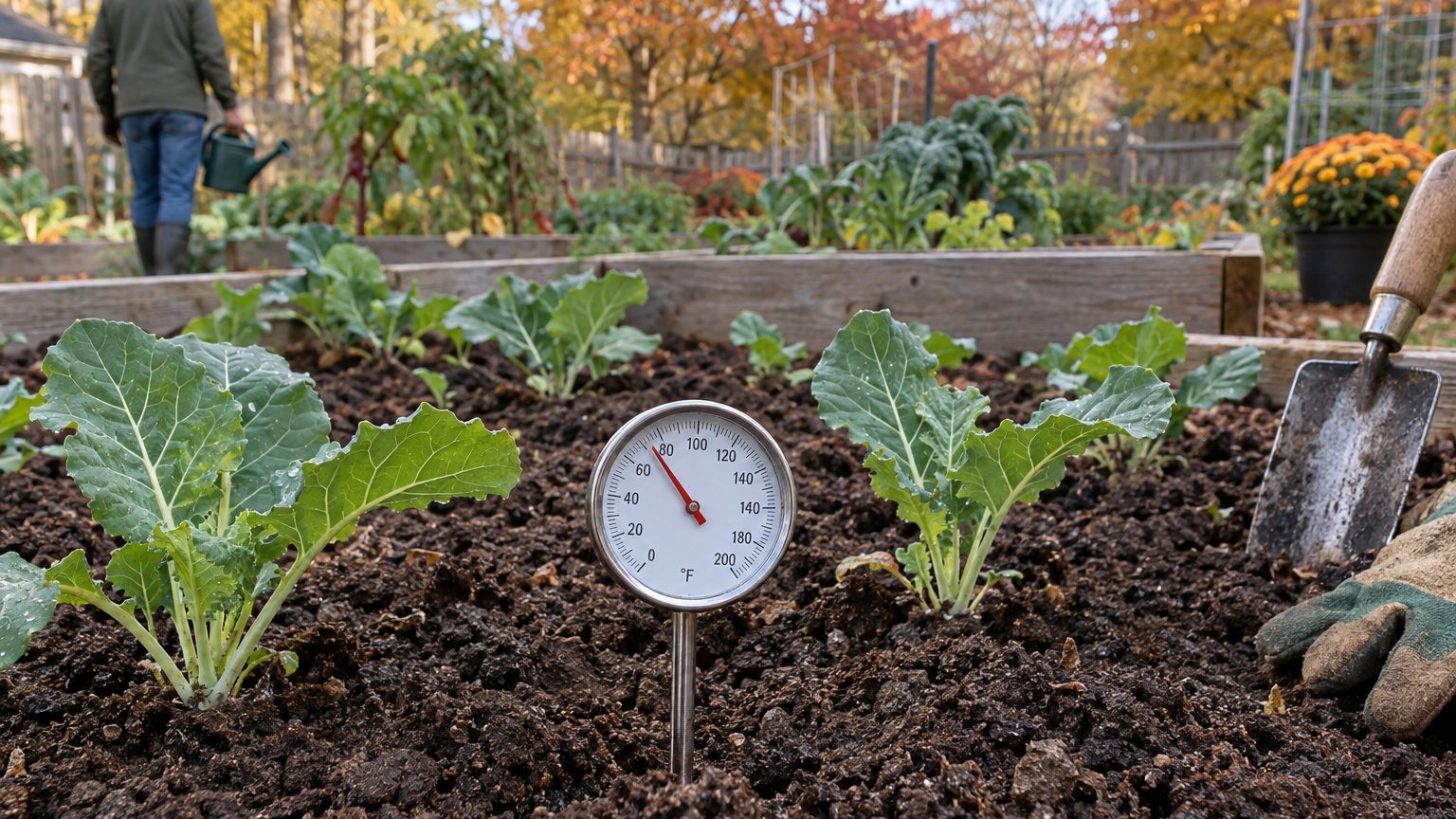
Frost is only a proxy anyway. Collards don’t germinate or grow on a freeze date, they grow once the soil itself has warmed, and soil lags behind the air by days or weeks depending on how wet and how shaded the ground has been. A garden bed at elevation near Elko or Ely can sit cold and slow to warm long after a low desert bed has already produced a full round of leaves. The more reliable habit is a soil thermometer pushed a few inches into the bed, checked in the early morning before the sun has had a chance to skew the reading.
Direct-sown seed rots in soil that’s still cold and wet from spring runoff, and it germinates too slowly to be worth the wait once the calendar has moved on. Transplants avoid that particular risk but bring their own: a root ball left too long in a small pot goes root-bound, and a root-bound transplant rarely recovers fully once it’s in the ground. Before planting, pull one plant out of its pot and look at the roots. Healthy roots are pale and loosely branched. A dense brown tangle, or roots that circle the pot wall, mean the plant has already been stressed.
Collards belong to the brassica family along with turnip, rutabaga, cabbage, kale and mustard, and all of them draw the same soil pests and the same soil-borne diseases out of the ground. Putting this year’s collard bed where any of those crops grew last season isn’t a rotation, it’s the same risk with a different name on the row marker. The main collards growing guide on this site walks through how to plan that rotation properly across a multi-year bed.
For an actual date to plant by, the extension office under the University of Nevada, Reno Extension tracks frost risk by county and elevation, and can give guidance a statewide number never could.
How long the season lasts here
At that same Las Vegas station, the first fall 32°F freeze falls between December 8 and December 23, again in the range NOAA rates at 30 to 70 percent probability. Pair that with the spring window (January 7 to February 1) and, using the more cautious dates on each end, the frost-free stretch runs from February 1 to December 8, which comes out to roughly 310 days without a freeze risk at that specific desert station.
That’s an extraordinary number, and it belongs to one heat-island site, not to Nevada as a whole. A grower at elevation, in Carson City or in a mountain valley, is working with a season that can run to a small fraction of that length, sometimes just a handful of frost-free months. That difference decides more than convenience. Where the window runs long, there’s room for a second sowing of collards later in the season, planted while the first round is still being picked. The succession approach, plus the full timing logic, is covered on the collards growing guide for this site.
Where the window is short, the first sowing is the only sowing, and that changes how much weight the root check from transplants carries. A root-bound start that would cost a low desert grower a slightly slower first few weeks costs a short-season grower the whole crop, because there’s no second attempt if that plant stalls. Compare Nevada’s split personality to a state like Tennessee, where a single long, humid season dominates almost the whole state, or to Wyoming, where frost risk crowds out most of the calendar everywhere, not just at elevation. Nevada is unusual in holding both extremes within one set of state lines.
The practical move is to find out which version of Nevada a given garden actually sits in before deciding on one sowing or two. A soil and elevation check with the county extension office answers that faster than any statewide frost map.
Heat and water in Nevada

Nevada’s official climate data for this comparison centers on winter, not summer, and that’s the more useful number for collards anyway. At the Las Vegas reference station, the coldest month averages a daily minimum of 39.6°F, a figure mild enough that collards there behave less like an autumn crop and more like a standing one, picked leaf by leaf from November into March without a hard freeze forcing an end date. That reading applies to the desert reference station specifically, under the USDA Plant Hardiness Zone Map’s own definition, built on average annual extreme minimum temperature.
The state’s hardiness zones run from 4a to 10a, and that range says plainly that the Las Vegas experience isn’t the Nevada experience. A 4a zone, found in the colder mountain valleys and higher elevations, means hard freezes arrive early and often, and a collard bed there behaves the way it does almost everywhere else in the country: it’s an autumn crop, planted for fall harvest and finished off once a real hard freeze sets in, not a plant left standing through winter.
That winter contrast matters more here than any summer heat count, because the two versions of Nevada call for two different planting plans. In the mild-winter pockets, a fall planting can be treated as the main event, cut leaf by leaf for months. In the cold-winter zones, fall planting is a race against the first hard freeze, and once it lands, the bed is done for the season regardless of how the leaves looked the week before.
Specific counts for days above 90°F and summer rainfall aren’t part of the state-level climate normals cited for this page, and inventing numbers to fill that gap would be worse than leaving it open. What can be said generally is that most Nevada gardens sit under dry air with little summer rain, which cuts down on the mildew and slow-ripening problems that plague collards in humid climates, but raises the opposite problem: beds need steady irrigation, because dry heat pulls moisture out of leaves faster than a garden hose on a timer might assume.
| Nevada climate zone | Coldest month minimum | Winter crop behavior |
|---|---|---|
| Low desert (Las Vegas reference station) | 39.6°F average daily minimum | Standing crop, picked November through March |
| Mountain valleys and higher elevation (Reno, Carson City, rural counties) | Well below freezing, colder end of the 4a-6a range | Autumn crop, ends at first hard freeze |
Which collards suit Nevada
None of this points to a single collard variety, and that’s deliberate. The right cultivar for a low desert bed with a 310-day frost-free window and a mild winter is not the right cultivar for a mountain valley bed with a short season and a hard freeze locked in for months. Naming one variety on a page meant to cover both would be guessing, and a gardener who plants based on a guessed name is the one who notices first when it doesn’t perform.
What can be reasoned out is the type of collard worth looking for once the local season is known:
- In short-season, cold-zone gardens, look for the earliest-maturing types available, since there’s rarely a second sowing to fall back on.
- In the low desert’s long, hot stretch, look for types described as heat tolerant, and plan the bed itself with airflow and some afternoon shade at the root zone, since heat stress at the roots does more damage than heat on the leaves.
- In any Nevada garden that runs damp or shaded for stretches, disease resistance, especially against the common leaf and soil diseases that hit the whole brassica family, becomes the first thing to check before yield or flavor.
That last point matters because collards share their disease and pest pressure with turnip, rutabaga, cabbage, kale and mustard. A resistant type planted into a bed that grew any of those crops within the last couple of seasons is still exposed to whatever built up in that soil, which is one more reason the rotation plan on the collards growing guide is worth reading before locking in a variety choice.
The one step this page can’t skip past is the same one repeated above: the University of Nevada, Reno Extension office maintains variety trial results for this state specifically, tested against Nevada’s own soil, elevation and water, and that list is worth more than any general recommendation written for the country as a whole. A collard chosen off a national seed catalog might do fine in a mild Las Vegas winter and fail outright in a Carson City frost, and there’s no way to know which without checking a source that’s actually tested it here.