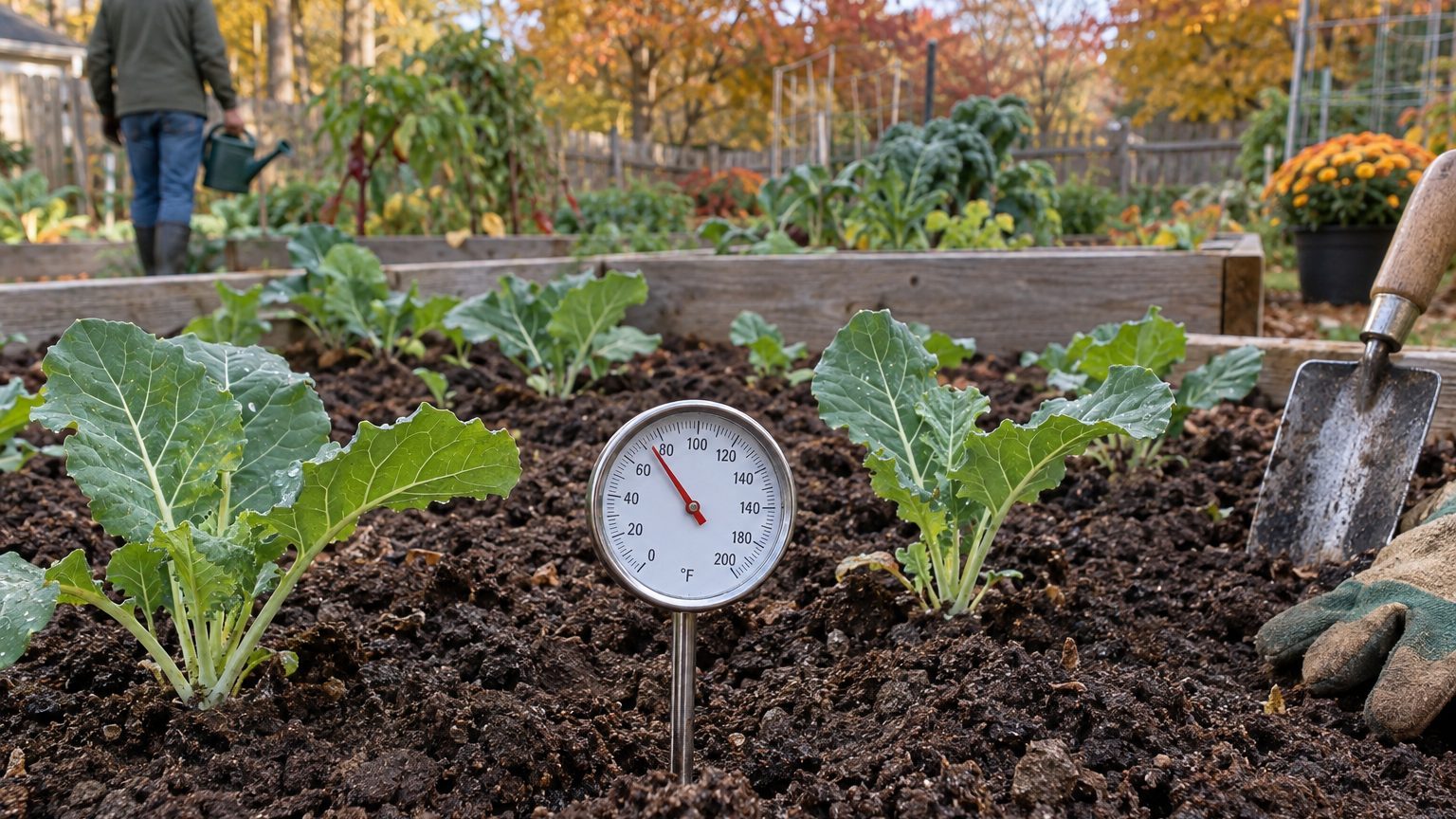

Collards go into Tennessee soil once the ground itself has warmed, not the moment the calendar clears frost risk. Statewide, that generally means a few weeks after the last spring freeze fades, with a second sowing in late summer for a fall or winter harvest. Where you garden inside Tennessee’s wide hardiness range changes both dates, and whether the crop stands in the bed all winter or finishes at the first hard freeze.
When the soil is warm enough in Tennessee

Tennessee’s last spring frost, based on 1991-2020 NOAA climate normals at station USW00013897 (Nashville), falls in a window of March 31 to April 12. That’s a 30-70% freeze-probability band, not a promise: some springs the risk clears earlier, some later, and it’s a stated probability rather than a guaranteed cutoff. East Tennessee and the Cumberland Plateau run cooler and later than this Nashville reference, so a gardener in those hills should treat the window as a starting point, not a fixed date.
That frost date is a proxy, and a rough one. What collards actually wait on is warm soil, and soil doesn’t warm the instant frost risk drops off, it warms over the days and weeks that follow as the sun climbs higher and nights stop dipping into the 30s. A bed that’s still cold and wet in early April will sulk a direct-sown collard seed no matter what the frost calendar says. The practical fix most Tennessee gardeners use is to let the soil dry enough to crumble rather than clump before working it, and to hold off seeding a week or two past the frost date if the spring has been cold and wet.
Direct seeding versus transplants
Collards handle both. Direct-seeded plants often catch up to transplants by midsummer, and skip the shock of root disturbance. Transplants started indoors give a head start where East Tennessee’s later frost window shortens the usable season. Either way, thin or space seedlings so leaves get airflow, since collards are brassicas and share the same fungal and pest pressure as cabbage, kale, mustard, turnip and rutabaga. Working a collard bed into rotation with those crops, rather than following one brassica with another, is the single move that does the most to hold disease pressure down over several seasons.
Skip pesticide products entirely if you can manage it with timing and airflow instead; the practice of rotating beds and spacing plants for air movement matters more here than any specific spray, and naming a product doesn’t help a Tennessee gardener whose local pest pressure and label rules differ by county.
How long the season lasts here
Between the last spring frost window (March 31 to April 12) and the first fall frost window (October 28 to November 8), also from NOAA NCEI 1991-2020 normals at the Nashville station, Tennessee’s conservative frost-free stretch runs from the latest likely spring frost to the earliest likely fall frost: April 12 to October 28. That’s 199 days, or roughly six and a half months, a gardener can generally count on before either end of the season closes in.
A window that long allows more than one planting. Tennessee gardeners can sow collards in spring for a summer harvest and sow again in July or August for a fall crop that often runs well past the first frost, since a light freeze rarely stops collards outright, it usually sweetens them. Compare that to a much shorter-season territory like the one covered on the Manitoba collards page, where a single sowing is often the only realistic option because the frost-free stretch is so much shorter. Tennessee’s length is the reason a second, late-summer sowing is worth planning for rather than an afterthought.
That second sowing also changes the transplant-versus-direct-seed decision. A gardener who direct-seeded in spring and is now setting out transplants in midsummer heat should check root stock closely before it goes in the ground: a soft patch, a weeping spot, or a moldy crown on any transplant or stored root ends the question of using it, no matter how sound the top growth looks. For the general planting calendar and how a second sowing fits into a full-season plan, the site’s main collards growing guide lays out the mechanics beyond what’s specific to Tennessee.
Heat and water in Tennessee

The figure that actually decides how a Tennessee collard bed gets planned isn’t a summer heat count, it’s the coldest month’s mean daily minimum: 30.1°F, from NOAA NCEI 1991-2020 normals at the Nashville reference station. That’s a mean minimum, not a record low and not a monthly average, and it sits right at the freezing line. It’s also the figure that splits collards into two entirely different crops depending on where in the state you’re standing.
Where the coldest month stays close to that mild Nashville-area figure, collards behave as a standing crop, picked leaf by leaf from November into March without ever being pulled. Where winters run colder, and Tennessee’s stated hardiness range of 5b-8a (USDA Plant Hardiness Zone Map, 2023) makes clear that a lot of the state does, collards behave instead as an autumn crop that ends outright at the first hard, sustained freeze. East Tennessee and the Cumberland Plateau, sitting toward the cooler end of that zone range, are the areas where planning for an autumn-only harvest makes more sense than betting on a standing winter bed.
This page doesn’t have a sourced count of days above 90°F or a summer rainfall figure for Tennessee, so it won’t invent one. What’s known and useful instead is that Tennessee summers run long, hot and humid enough that fungal disease pressure, not dryness, is the bigger risk to a collard bed here. That’s a different problem than a hot, dry territory faces; the Nevada collards page deals with heat paired with low humidity and irrigation scheduling, while a Tennessee bed needs airflow and spacing to keep leaves from staying wet after the frequent summer rain that humid Southern summers bring.
Which collards suit Tennessee
The choice in Tennessee comes down to matching a type to the winter a gardener actually has, not the one they wish they had. Where the coldest month stays mild, the priority is a type suited to extended standing through winter, one that holds leaf quality over repeated light freezes rather than bolting or turning bitter. Where the coldest month drops harder, as it does across East Tennessee and the Cumberland Plateau, an earlier-maturing type that gets a full harvest in before the season’s hard freeze matters more than winter hardiness, since the crop won’t be standing through January anyway.
| Region | Zone tendency within 5b-8a | How the crop is best planned |
|---|---|---|
| West & Middle Tennessee | toward 7a-8a | Standing winter crop, picked through the cold months |
| East Tennessee & Cumberland Plateau | toward 5b-6b | Autumn crop, harvested out before hard freeze |
Statewide, Tennessee’s humid summers make disease resistance the first thing to check on any seed packet or transplant tag, ahead of leaf shape or color. But this page can’t name a specific cultivar responsibly, because the varieties actually trialled and performing well in Tennessee’s soil and climate are the ones tracked by University of Tennessee Extension, not a general growing guide written for every state at once. Their extension service keeps current, locally tested variety recommendations, and that’s the one list worth checking before buying seed.
Whatever type gets chosen, keep it out of a bed that grew cabbage, kale, mustard, turnip or rutabaga the season before. All of those share a brassica family with collards, meaning they share the same soil-borne diseases and pest cycles, and a rotation that just moves collards into last year’s cabbage row hasn’t actually rotated anything.