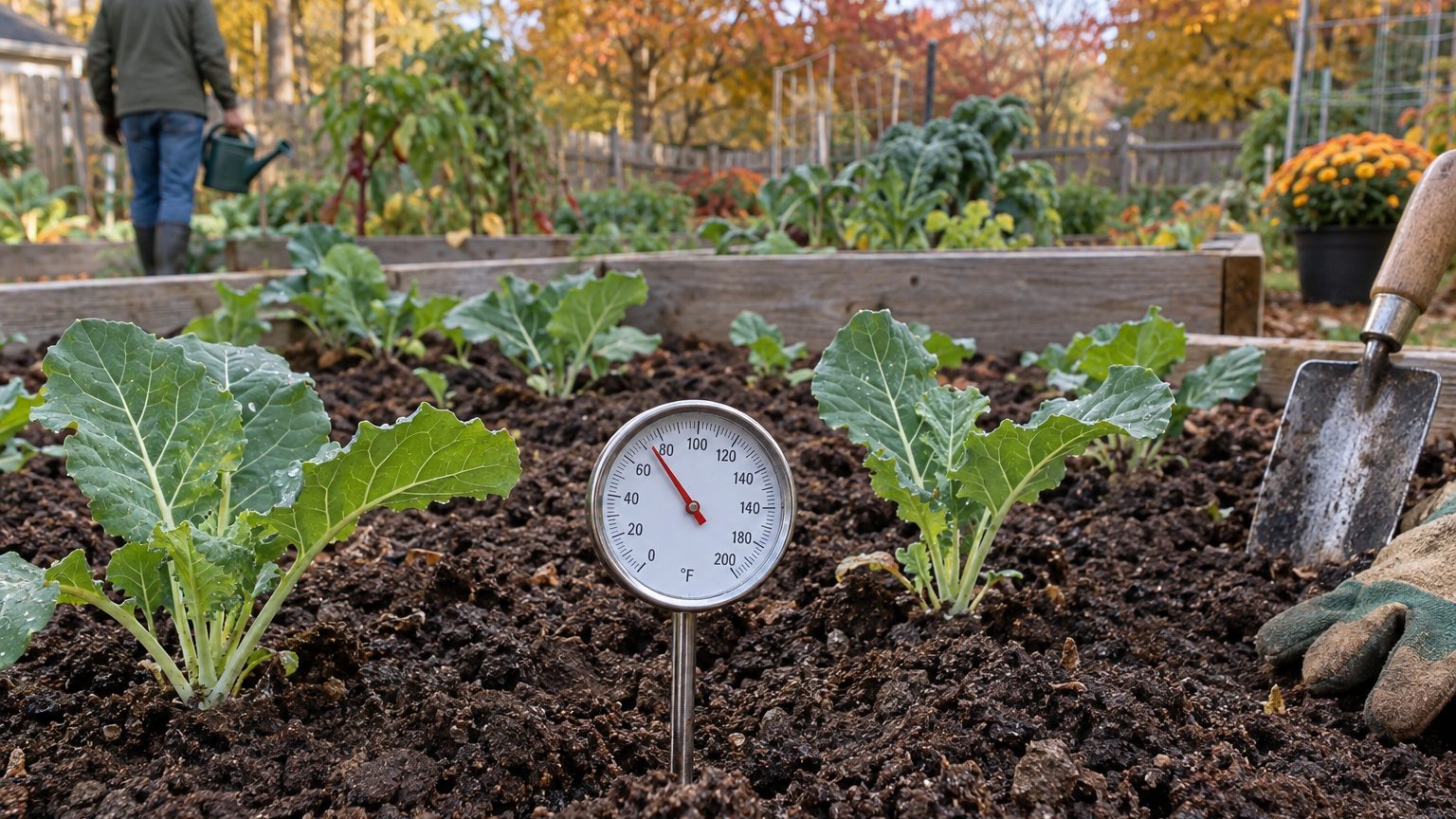

Collards can be grown in Saskatchewan, but not the way they’re grown in the Deep South. Here they behave as a short, intense annual crop planted after the soil warms and pulled before the ground locks up for winter. There’s no picking leaves in January under this sky. The whole rhythm of the crop bends around two dates and one brutal winter minimum.
When the soil is warm enough in Saskatchewan

Gardeners ask for a date, so here it is: the average last spring frost at Saskatoon SRC runs May 18, according to Environment and Climate Change Canada’s 1981-2010 Climate Normals. That’s a mean, not a guarantee. Half the years on record, frost arrived later than that date, sometimes well into the last week of May. Treat May 18 as the midpoint of a window, not a green light.
Frost date and soil temperature are two different things, and collards care about the second one, not the first. Soil takes days, sometimes two or three weeks, to climb out of the low temperatures that stall root growth and seedling vigor, even once the air itself has stopped freezing at night. A calendar can tell you frost risk has dropped. It can’t tell you the top few inches of a raised bed have actually warmed enough for a transplant to take off instead of sitting there sulking.
Reading the soil instead of the calendar
The practical move is to push a soil thermometer a few inches down and wait until it holds steady in workable territory across several mornings, not just one warm afternoon. Gardeners across the prairie provinces who transplant collards a week or two after the mean frost date, rather than exactly on it, generally see sturdier growth than those who rush transplants out the door the moment the thermometer clears freezing overnight.
Because collards are brassicas, the same family as cabbage, kale, mustard, turnip and rutabaga, they share soil-borne diseases and pest pressure with all of them. A bed that grew cabbage or turnip last season isn’t a clean slate for collards this season. Anyone planning where to put this year’s crop should check a rotation guide before deciding which corner of the garden gets the transplants, because rotating collards into a bed that held another brassica the year before is rotating nothing at all.
How long the season lasts here
Run the two dates together and the frost-free window at Saskatoon SRC comes out to 123 days, from the average last spring frost on May 18 to the average first fall frost on September 18 (both figures from the same ECCC 1981-2010 Normals). That’s the number that decides what’s realistic to plant, and it’s tighter than most home gardeners coming from milder regions expect.
A 123-day window is workable for one full run of a fast-maturing brassica crop, but it doesn’t leave generous room for a second sowing behind it the way a five- or six-month season would elsewhere. This changes the decision at planting time: instead of treating the first sowing as a trial run before a bigger fall crop, in Saskatchewan the first sowing usually has to carry the season on its own. That also shifts how transplants are handled, because a gardener who loses three weeks to a slow, root-bound seedling has lost a much larger share of a 123-day window than a gardener working with 200 days would.
Where succession still fits
Succession sowing isn’t entirely off the table, it’s just compressed. Staggering two or three small plantings within the first few weeks of the window, rather than spacing them out over months, can spread the harvest without betting the whole crop on one sowing date. The general logic of staggered plantings, including how to read a short season and decide whether it’s even worth splitting the sowing, is covered in the succession sowing guide on this site.
Heat and water in Saskatchewan

Summer heat isn’t really the story in this territory, and it would be dishonest to write this section as if it were. There’s no meaningful stretch of extreme heat days to work around here the way there is farther south, so mildew from oppressive humidity and bolting from scorching afternoons aren’t the main risks collards face on the prairies. What decides everything is the other end of the thermometer.
The mean daily minimum of the coldest month at the Saskatoon reference station sits at -20.7°C, per the ECCC 1981-2010 Normals, and the hardiness zone for the reference city is 3a on the Canadian system published by Natural Resources Canada. That’s not the same scale as a USDA zone, and NRCan is explicit that the two systems don’t convert cleanly, so it shouldn’t be read against American zone maps at all.
Why this ends the standing-crop question
In territories where the coldest month stays mild, collards can behave as a standing crop, picked leaf by leaf from November into March, getting sweeter after light frost touches the leaves. A mean coldest-month minimum near -21°C rules that out entirely. Here collards are an autumn crop that finishes at the first hard freeze, full stop, and the bed needs to be cleared or covered before that point rather than left standing through winter.
What a cooler, shorter prairie summer does bring is slower ripening and a longer runway for slugs and flea beetles to work on young transplants before the plants get big enough to shrug them off. Floating row cover over the bed for the first few weeks after transplanting protects against both the cool nights and the early pest pressure, without needing to reach for a pesticide at all.
Which collards suit Saskatchewan
The honest answer here is a type, not a name. A 123-day window favors the earliest-maturing types of collards over the longer-season kinds, simply because there isn’t slack in the calendar to spare on a slow grower. Beyond that, since heat stress isn’t the driving pressure in this territory the way it is farther south, airflow and shade-at-the-root matter less here than they would in a hot climate; what matters more is getting transplants established quickly enough to make full use of a short window.
Naming a specific cultivar on this page would be a guess, and a guess is exactly the wrong thing to hand a gardener choosing seed. Seed catalogs list dozens of collard types, and which ones actually perform in a short, cool prairie season is a question Saskatchewan’s provincial extension service is positioned to answer with local trial data, not a general content page. That’s the resource to check: Saskatchewan’s Ministry of Agriculture publishes crop guidance through its agribusiness and agriculture services, and it’s the right place to ask which early types have actually been trialled in this climate.
Refusing to name a variety here isn’t a dodge, it’s the accurate answer. A cultivar that performs well in a 200-day Georgia season tells a Saskatchewan gardener almost nothing about how it will do in a 123-day window bracketed by a -20.7°C winter minimum. Local trial data beats a generic recommendation every time, and for this territory, that data lives with the provincial extension service, not with a general growing guide.