
Collards grow well in Alberta as a spring-planted crop that finishes in autumn. Set them out once the soil has warmed after the last frost, which averages May 21 at Calgary, and harvest until a hard freeze ends the season. Winters are too cold for picking leaf by leaf through the dark months. Early planting, steady water and a clear rotation plan matter most.
When the soil is warm enough in Alberta

At the Calgary Int’l A station (climate ID 3031093), the last spring frost falls on average on May 21, according to Environment and Climate Change Canada’s 1981-2010 normals. That is a midpoint. In one year out of two the last frost comes later, so the date marks the middle of a window and never a safe day to plant. Northern and upland districts run weeks behind Calgary, and a garden in the foothills or near Peace River should add that lag to the date.
Frost is only the first test. Collards wait for warm soil, and soil warms after the frost risk ends. A bed can be frost-free by late May and still be cold and wet a few inches down. Seed sown into that soil sits and rots, and transplants stand still. The days that follow the last frost are when the roots start to work.
How do you tell the soil is warm enough for collards?
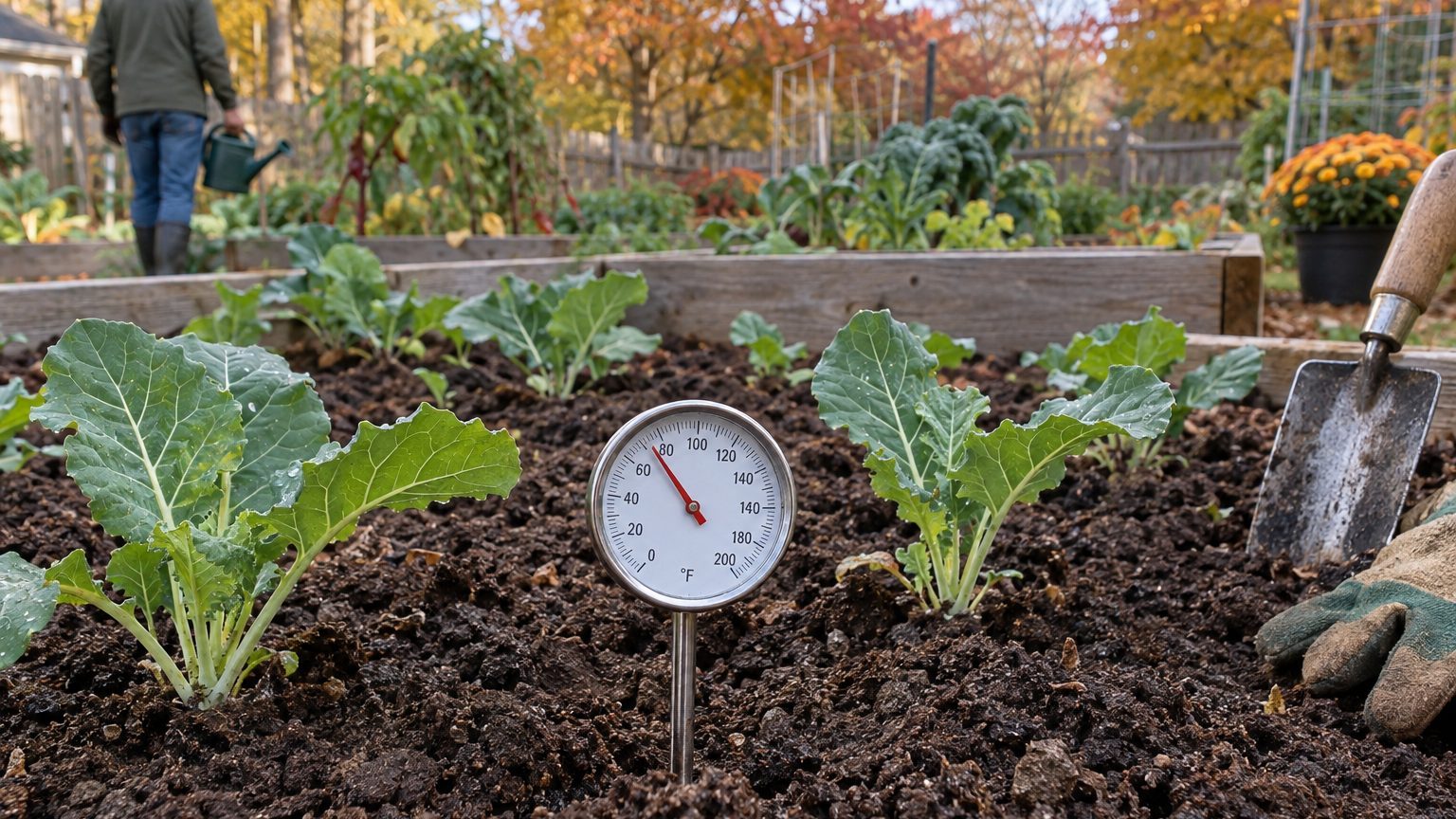
Use a soil thermometer. Push it into the bed and check on several days in a row. Collards grow steadily once the soil has warmed, and they do better as it warms further. A single warm afternoon proves nothing, since Alberta can swing from a sunny weekend to a wet snow within days.
Transplants are the safer bet in a short-season province. Harden them off gradually, with a few hours outdoors at first and then longer stretches in wind and direct sun. A mature collard shrugs off a light frost, but a young transplant set out on a warm spell can be hurt by a hard freeze. Keep a frost cloth or row cover ready through late May and into June.
Gardeners comparing notes with other cold regions can read Growing Collards in Saskatchewan or Growing Collards in New Hampshire. Canadian normals cover 1981-2010, while US figures on this site cover 1991-2020, so a date from one country will not line up exactly with a date from the other.
How long the season lasts here
The Calgary reference station has a mean last spring frost on May 21 and a mean first fall frost on September 16. Both dates are averages, so in half of all years the fall frost arrives earlier than September 16. A gardener who plans to the average date will lose a crop about every other autumn.
A window of roughly four months mostly means one planting. Collards started from transplants in late May have the whole summer to build leaves, and the best flavor comes in September, after cool nights have sweetened them. Direct seeding works, but it uses weeks of the season that transplants spend indoors. For that reason, starting seed indoors before the last frost is worth the trouble in Alberta.
A second sowing is a gamble here. In a long-season climate a gardener can sow again in midsummer and harvest well into winter. In Alberta a later sowing only works if the plants reach a useful size before the first hard frost. To test it, take the days to maturity on the seed packet (counted from sowing for direct-sown seed, and from transplanting for transplants) and count back from September 16. If the count runs out before mid-summer, skip the second sowing and put the effort into the first.
The main Growing Collards: One Planting, Months of Harvest guide covers succession sowing in detail. In a short season the useful version is a staggered start: transplants set out on two dates a couple of weeks apart. That spreads the risk of a late frost, and the later planting gives younger leaves in autumn.
Heat and water in Alberta

Heat is rarely the problem in Alberta. Summers are mild and nights are cool, so collards do not face the stress that bolts and toughens leaves in hot-summer states. Hot spells do happen in the south of the province, and a few days of strong sun can wilt a young transplant. A layer of straw or shredded leaves at the root keeps the soil cooler and slows evaporation. Afternoon shade is a bonus in a heat wave, but in most summers full sun is what the crop wants.
Water is another matter. Much of the province is dry compared with the eastern states, and heavy rain tends to arrive in short bursts. Water from rain and the hose together, applied at the base of the plant in the morning. Even moisture gives tender leaves, while long dry stretches make them tough and bitter. In a cool, damp summer the risks change. Leaves stay wet, growth slows, and mildew and other leaf diseases move in. Give plants room for airflow and avoid overhead watering late in the day.
Do collards survive an Alberta winter?
Winter decides how the bed is planned. At Calgary the mean daily minimum of the coldest month is -13.2 °C (8.2 °F). The city sits in zone 4a of Natural Resources Canada’s plant hardiness system, which uses seven climate variables and does not convert to a USDA zone. In regions where the coldest month stays mild, collards stand in the garden and are picked leaf by leaf from November into March. In Alberta they are an autumn crop. A hard freeze ends the harvest, and the plants do not come back in spring. Plan to pick heavily in the weeks after the first light frosts, then clear the bed.
Collards are brassicas, like cabbage, kale and mustard, and so are turnips and rutabagas. All of them share the same soil diseases and insect pests, including clubroot and cabbage worms. Putting collards where a turnip crop grew has not rotated anything. Keep collards out of any bed that held a brassica for several years, and see the rotation notes in the main collards guide.
Which collards suit Alberta
A short season favors the earliest-maturing types, because the plants must reach harvest size before a September frost. Look for descriptions that stress quick maturity and cold tolerance. Compact, upright types also suit a province where wind can batter tall leaves.
Cool, damp summers make disease resistance the first criterion. Choose types sold as tolerant of leaf spots and other brassica diseases, and give every plant space for airflow. In the occasional hot summer, types with broad, sturdy leaves cope better when given mulch and some midday shade at the root.
Specific variety names are left out on purpose. Alberta runs from the dry south to the cold northern districts, and a type that does well near Lethbridge may behave differently in the Peace Country. The only recommendation worth following comes from local trials, and Alberta Agriculture and Irrigation is the place to ask what has been tested in your area. Local garden clubs and seed companies that grow in the prairies are another good source.
When you shop, read the days to maturity carefully and keep the difference between sowing and transplanting in mind. Pick two or three types rather than one, so a hard spring or a wet summer does not take the whole row.
Common questions
Can I plant collards in Alberta before the last frost?
Mature plants tolerate a light frost, but young transplants and seedlings are easily damaged by a hard one. Wait for the soil to warm, harden off transplants, and keep row cover on hand. A cold, wet bed holds back growth more than a frost does.
When should I start collard seeds indoors in Alberta?
Start about a month before the mean last frost of May 21 at Calgary, and shift that date later in colder districts. The transplants should be sturdy and hardened off by the time the soil is warm.
Do collards need full sun in Alberta?
Full sun gives the best growth in a cool climate. Light afternoon shade helps only during an occasional heat wave, and mulch at the root does most of the same job.
Is Canadian hardiness zone 4a the same as a USDA zone?
No. Natural Resources Canada states there are no simple conversions between the two systems, and Canadian zone 4a overlaps nine USDA zones, from 3a to 7a. Use the Canadian zone for local plant choices and do not try to match it to a US map.