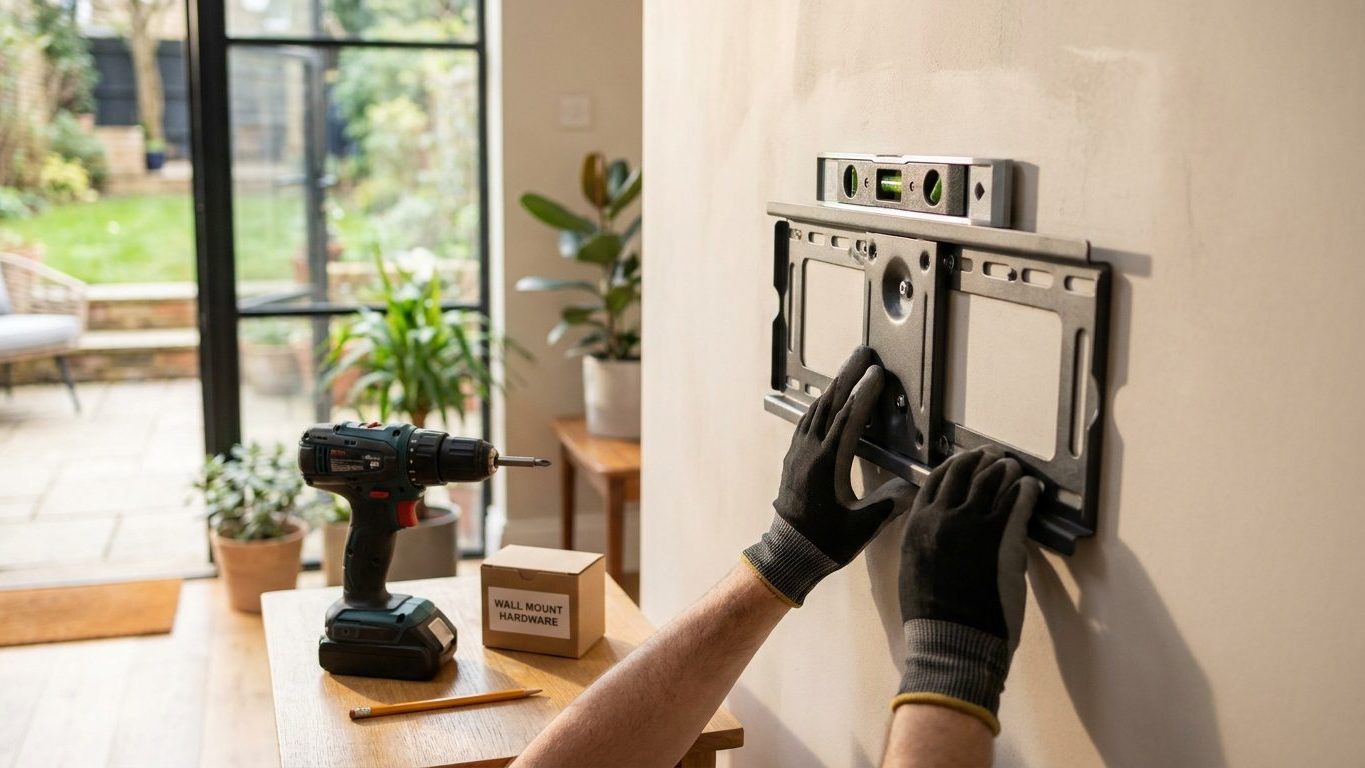

Full-motion TV arms look like the flexible option, the kind that lets a screen swing out from the wall and angle toward the couch. That flexibility is exactly what turns a manageable weight into serious leverage the moment the arm extends, and it is why mounts that seem plenty strong on paper still pull loose within a year. Mount the bracket into solid framing, not into drywall alone, and match the fixing hardware to whatever material is actually behind that drywall before you drill anything.
What is actually going on

The leverage problem
A wall mount does not carry a television’s weight the way a shelf carries a stack of books. It carries a lever. The screen’s weight acts at a distance from the wall, and the farther that distance, the harder the bracket pulls against its fixing points. A fixed, low-profile mount sits close to the wall, so the load stays mostly straight down. A full-motion arm extended well out from the wall turns the same television into a rotational force that works the top fixing loose and drives the bottom one in, over and over, every time the arm moves.
This is why the fixing has to reach solid framing, meaning the wood studs behind drywall or the masonry itself in a brick or block wall, and not just the wallboard skin. Drywall alone, even with a heavy-duty anchor, resists a straight pull reasonably well but does poorly against the twisting, working load a TV mount applies day after day. The anchor slowly enlarges its own hole in the gypsum until it lets go, usually with no warning beyond a slight tilt.
What’s actually inside the wall
Before any drilling starts, you need to know what runs inside that wall. Electrical cable, and in some houses a water or gas line, can run through the stud bays in patterns that follow common trade conventions but are not guaranteed, especially in older construction where a previous owner or contractor ran something off the usual line. A stud finder with cable-detection, or a small inspection camera through an existing outlet or switch opening, tells you more than guesswork. If you cannot confirm what is behind a spot, treat it as off limits and pick another.
None of this includes running new power. If the plan involves moving an outlet behind the television, or adding one so the cables disappear into the wall, that is electrical work, and it goes to a licensed electrician, not a weekend project.
A television is heavy enough, and usually mounted high enough, that a fall causes real injury, not just a broken screen. Any fixing you are not sure about is a fixing to replace before you hang the TV, not one to test by hanging it and watching what happens.
Doing it
The order matters more than any single step. Skipping ahead, especially past the wall check, is where most mounting jobs go wrong later rather than at the moment of installation.
Steps in order
- Find and mark the studs across the area where the mount will sit, not just one. A bracket needs at least two, and if the spacing does not line up with the bracket’s slots, either shift the position or choose a mount built to span uneven stud spacing. Guessing here means drilling extra holes to find out, which weakens the same patch of wall you are relying on.
- Confirm what is inside the wall at each marked point before drilling a pilot hole, the way described above. Skipping this step is how a cable gets nicked or a pipe gets punctured, and neither is a mistake you notice until later.
- Drill pilot holes sized to the screws the mount’s manufacturer specifies, into the framing itself, not just through the drywall face. Oversized pilot holes in wood strip the thread and leave the screw with nothing to grip.
- Attach the wall plate with the fasteners that came with it, driven fully home and level. A plate that sits even slightly off level transfers uneven load to whichever screws end up carrying more than their share, and that is usually the pair that fails first.
- Attach the bracket arms to the back of the television using screws sized for that panel’s mounting holes, following the hole pattern stamped on the back of the set. Wrong screw length is a common error: too long can crack the panel’s internal housing, too short does not seat.
- Lift the television onto the wall plate with a second person supporting the weight, then confirm the locking mechanism has actually engaged before letting go. This is not a step to shortcut for a heavy, top-mounted load.
- Route the cables down the back of the panel, and if using a cable channel or an in-wall low-voltage kit rated for the purpose, keep them clear of anything you could not confirm was safe to drill near.
The logic behind step one is the same one that governs floating shelves: a fixing that looks secure at the moment of installation can still fail slowly if the load never actually reaches framing. A shelf sags. A television on an extended arm swings.
What it looks like when it goes wrong
A mount that is failing rarely announces itself with a bang. It shows up first as small, easy-to-dismiss signs.
Signs to watch for
- A visible gap opening between the wall plate and the wall, sometimes with the drywall bulging slightly around the screws. This is a safety issue, not a cosmetic one, and it means the anchor is working itself loose. Stop using the mount until it is refastened into solid framing.
- The television tilting forward or to one side over weeks, most often on a full-motion arm where the joint has started to slip under sustained torque rather than a fixed load. Safety issue, since the arm’s locking mechanism may no longer be holding at full strength.
- Fine cracks radiating out from the screw heads in the drywall, which usually mean the anchor point has already begun to fail in a straight-pull sense, not just a rotational one. Safety issue.
- A scuffed or scratched wall around the plate from adjusting the television’s position after mounting. Cosmetic only, fixed with paint or filler once the mount itself is confirmed sound.
- Cables visible below the panel where they were meant to be hidden. Cosmetic, and correctable with a cable channel or a properly rated in-wall kit, never a reason to touch anything electrical yourself.
The difference between the first three and the last two is the difference between redo and touch up. A cracked or crumbling anchor point in drywall cannot be reinforced by adding a second screw next to the failing one. The wallboard around it is already compromised, and the fix is to move the mount onto fresh framing, patch the old holes properly, and refasten from scratch. A scuffed wall or a visible cable run, by contrast, is cosmetic work you can address at your own pace without taking the television down.
If a full-motion arm has developed play at the joint where it swings, meaning it wobbles under light hand pressure with no television attached, that is a mechanical failure in the arm itself rather than the wall fixing. That calls for replacing the mount rather than trying to tighten it back to a like-new state.
What to settle first
Wall type
Before you buy a mount or drill a single hole, settle what the wall actually is. Drywall over wood studs, plaster over old lath, and solid masonry each call for a different fixing, and the packaging on that fixing is the only place with a real number for what it can carry in that specific material. A screw rated for solid brick means nothing screwed into hollow block, and a toggle rated for drywall means nothing driven into masonry.
Hidden hazards and scale
Settle, too, what is inside the wall at the exact points you plan to drill; this is the same check any wall-mounted fixing needs before the first hole goes in, and it applies just as much to a television bracket as to a shelf or a mirror. Cable and pipe runs in a house follow conventions, not rules, and an older house may have been rewired or replumbed by someone who did not follow any convention at all. If you cannot confirm what is there with a detector or a look from an accessible cavity, choose a different spot rather than drill on faith.
Settle whether the load even belongs on that wall. A partition wall built only to divide rooms may not have the same framing depth or spacing as an exterior wall, and a very large panel on a full-motion arm asks more of that framing than a small, fixed one does. Scale matters here in a way that is easy to skip past. A screen too large for the wall it sits on, or hung at a height that ignores how the room is actually used, creates the same kind of imbalance that shows up when choosing a lampshade size that fits the room around it.
Where any of this is uncertain, the sturdiest-looking mount will not fix a wall that cannot take it. Bring in a professional installer or a contractor who can confirm the wall’s construction, and treat the fixing’s own printed rating, matched to that wall, as the only figure that actually applies to your house.
Common questions
Can I mount a TV over a fireplace?
You can, but check that the wall above the fireplace is not thin masonry or a heat chase first, since sustained heat above a firebox can shorten the life of the electronics over time. Check the fireplace manufacturer’s clearance guidance and the wall construction before mounting there, and consider a mount that lets the screen pull down and tilt away from rising heat.
How do I know if my wall is drywall, plaster, or masonry?
Tap it. Drywall over studs sounds hollow between studs and solid directly on them, plaster over lath sounds duller and slightly springy, and masonry sounds dense and does not flex at all under a knuckle rap. A magnet held against the wall will also stick faintly to metal lath under some plaster, a further clue you are not dealing with plain drywall.
What if there is no stud where I actually want the TV?
Shift the television a few inches to land on the nearest studs rather than forcing a fixing into open drywall, since most mounting plates have enough slot adjustment to allow a small shift without changing the look much. If the position truly cannot move, a mounting plate designed to bridge between studs, paired with a fixing actually rated for that span, is the option to look for rather than a single oversized drywall anchor.
Do I need two people to hang a TV on a wall mount?
For anything beyond a small screen, yes. Lifting a large panel onto a wall plate one-handed while trying to align a locking bracket is how panels get dropped, and a dropped screen at head height or above is a genuine injury risk, not just an expensive one.