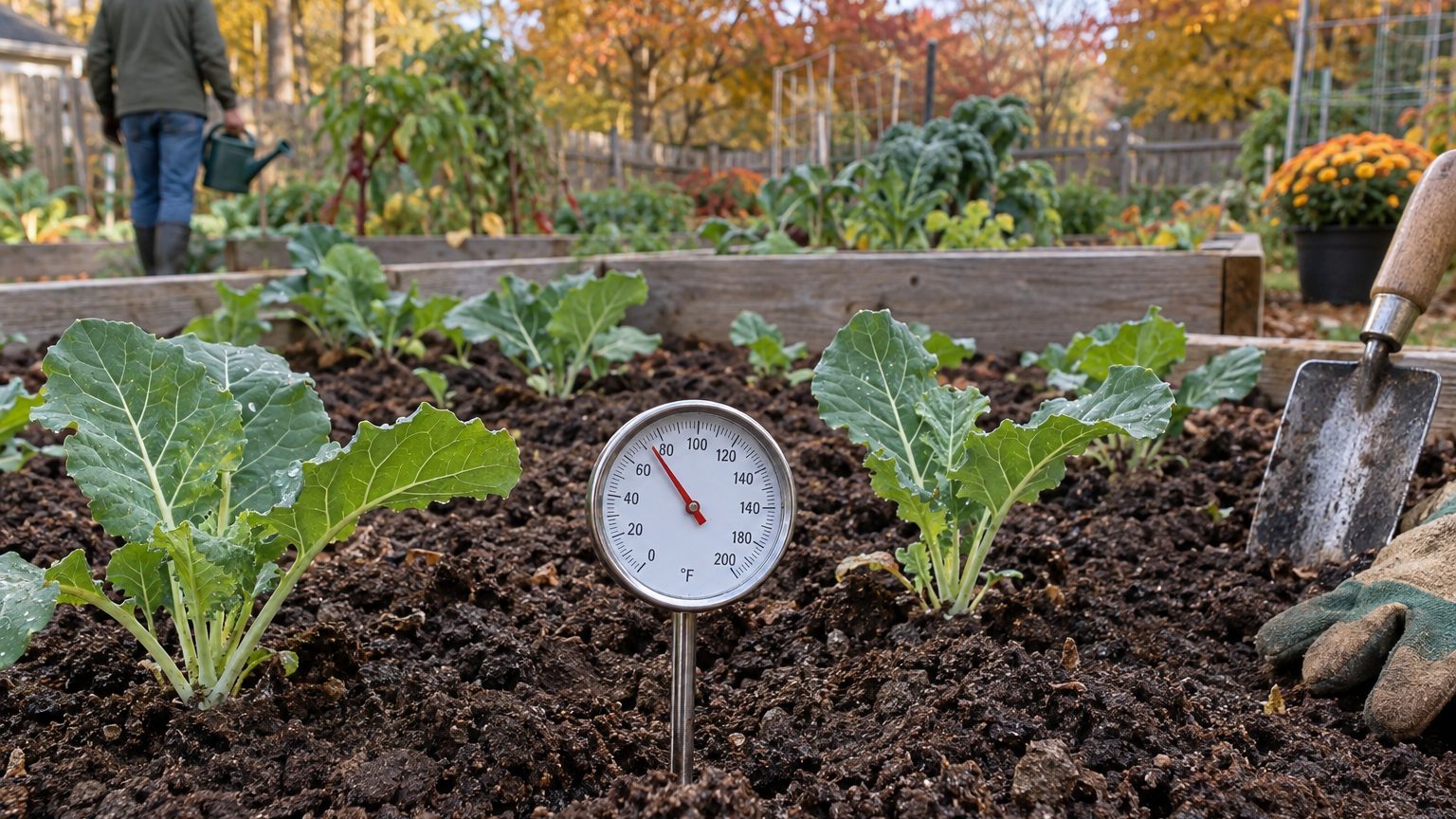

Texas stretches across four USDA hardiness zones, so there’s no single planting date for collards in this state. On the Gulf Coast, mild winters let collards stand as a harvest-anytime crop from fall into spring. Farther north and west, a hard freeze ends the season each winter. The soil, not the calendar, decides when to plant, and your winter low decides how long you’ll be picking leaves.
When the soil is warm enough in Texas

The question every Texas gardener asks first is when to put seed or transplants in the ground. At the Houston area’s reference station, NOAA’s 1991-2020 Climate Normals put the last spring frost between February 4 and March 1 at station USW00012960 (30-70% probability band). That’s the number worth writing down, but it isn’t the number that actually starts the collard season.
Frost dates track air temperature at a given hour, not the ground a seed sits in. Collards germinate and root out once the soil itself has warmed, and that lag behind the air can run a week or two even along the Gulf. Treat the frost date as a marker of risk falling away, not a green light. It’s also a probability built from three decades of weather, not a guarantee: some years bring a freeze after the window closes, and planting the morning the date arrives is playing odds, not a sure thing.
Texas complicates this further than most states. The figures above describe the mild Gulf end of the state. The Panhandle sees its last frost months later and its first fall frost months earlier; Hill Country and North Texas fall somewhere in between. Even inside the Houston metro, Hobby airport runs about two weeks milder than IAH. None of this is a statewide planting calendar. It’s one station’s data, and the only way to translate it to a specific county is through Texas A&M AgriLife Extension, which tracks frost risk and variety performance office by office.
Collards belong to the same brassica family as cabbage, kale, mustard, turnip, and rutabaga, and they share the same soil-borne diseases and root pests. A bed that grew any of those crops last season hasn’t been rested just because this year’s crop wears a different name. The collards growing hub lays out how to sequence a bed so the family actually gets a break.
How long the season lasts here
Subtracting one frost date from the other gives a rough length for the frost-free window, and along the Gulf Coast that subtraction is generous. Using the earliest last spring frost (February 4) against the latest first fall frost (December 19) stretches the window to roughly 319 days. Using the later spring frost (March 1) against the earlier fall frost (December 1) shrinks it to about 275 days. Either way, that’s close to nine or ten months without a hard freeze, one of the longer windows anywhere collards get grown in the country.
A window that long changes the whole planning question. Where other territories get one shot at collards before winter or before heat arrives, the Texas Gulf Coast can fit a spring sowing, let it fade in the worst of summer, then follow with a second sowing timed for a fall and winter harvest. That second sowing tends to be the more reliable one here, since collards improve in flavor after a light frost, and a fall planting skips the disease pressure that builds during a hot, humid spring.
Length also decides whether transplanting is worth the trouble. In a short season, every week saved by starting indoors matters. Along the Texas Gulf Coast, with months to spare on both ends, direct-seeding works fine for either planting, and the head start a transplant buys isn’t as decisive as it would be in a territory working with a four-month window, like Maryland’s shorter frost-free stretch on the Maryland collards page.
| Planting | Typical timing here | Main advantage |
|---|---|---|
| Spring sowing | After last frost risk eases | Earliest harvest of the year |
| Fall sowing | Late summer into early fall | Better flavor, lower disease pressure |
The collards hub covers how to stagger sowings for continuous picking rather than one big harvest window, which matters more here than in territories that only get a single planting a year.
Heat and water in Texas

The number that matters more than any summer high is the winter low. NOAA’s 1991-2020 Normals put Houston’s coldest month mean daily minimum at 43.7°F, well above freezing. That figure, not the summer heat, decides whether a bed of collards gets picked leaf by leaf from November into March or gets planted, harvested hard, and cleared out before a killing freeze.
Along the Gulf Coast, where winters run mild enough that 43.7°F is representative, collards behave as a standing crop. Leaves come off a few at a time through the cool season, the plant keeps producing from the same root system, and a light frost improves flavor rather than ending the harvest. That’s a genuinely different way of managing the crop than gardeners farther north deal with, where the ground freezes hard enough that the whole planting finishes by December no matter what’s left on the stalk. Louisiana’s Gulf Coast collards follow much the same standing-crop pattern, for the same reason, a mild coldest-month minimum.
Move away from the coast into North Texas or the Panhandle, and that math changes. Winters there push well below the Gulf figure, and collards revert to being an autumn crop that ends at the first hard freeze, the same pattern seen in colder territories like Maryland, where the coldest month minimum sits low enough that standing through winter isn’t realistic.
Summer is its own test, even where winter is gentle. Gulf Coast humidity stays high for months, and that combination of heat and moisture in the air favors downy mildew and other fungal disease more than it favors the plant. Spacing for airflow, watering the soil rather than the leaves, and clearing spent plants promptly all matter more here than in a drier territory, where the same summer would simply slow growth rather than invite disease.
Rainfall along the Gulf Coast tends to arrive in bursts rather than steady doses, so the ground can swing between waterlogged and dry within the same week. Raised beds or amended, well-draining soil handle that swing better than the flat clay common across much of the region, which holds water long enough after a heavy storm to rot roots that would otherwise be fine.
Which collards suit Texas
None of this points to a single named variety, because no outside page can responsibly make that call for a specific county. Texas A&M AgriLife Extension runs its own trials county by county, and the types that perform in Gulf Coast humidity aren’t necessarily what a Panhandle garden should plant. The honest answer here is to describe what to look for, then send the reader to that extension office for the name that actually fits their county.
Along the humid Gulf Coast, disease resistance is the first filter, ahead of earliness or leaf size. Downy mildew and other fungal pressure show up reliably in a wet, warm spring, and a resistant type saves more trouble over a season than any other single trait. Right behind that comes airflow: types and spacing that keep leaves open to the air, rather than a tight, low canopy, dry out faster after rain and slow disease at the base of the plant.
Where a garden sits farther from the coast and works with a shorter frost-free window, the earliest-maturing types available regionally become the more useful filter, since there’s less season to spare on a slow one. Ask the local AgriLife office which types were trialled in your county before choosing, rather than picking off a seed rack by reputation alone.
- Humid Gulf Coast gardens: prioritize disease resistance first
- Hot, still summers: prioritize airflow and space at the root
- Shorter-season inland counties: prioritize earliness
| Territory | Winter pattern | First variety criterion |
|---|---|---|
| Texas Gulf Coast (Houston) | Standing crop, picked into March | Disease resistance |
| Louisiana | Standing crop, similarly mild winters | Disease resistance |
| Maryland | Autumn crop, ends at hard freeze | Earliness |
Collards share their pest and disease list with cabbage, kale, mustard, turnip, and rutabaga, all brassicas, so whichever type gets chosen, it belongs in a bed that hasn’t carried a relative of the family in the past few seasons. If turnips or rutabagas share that rotation, check any stored roots at harvest: a soft patch, a weeping spot, or a moldy crown ends the question of whether it’s still good, no matter how sound the rest looks. The collards growing hub ties these choices back to the wider planting calendar for the crop.