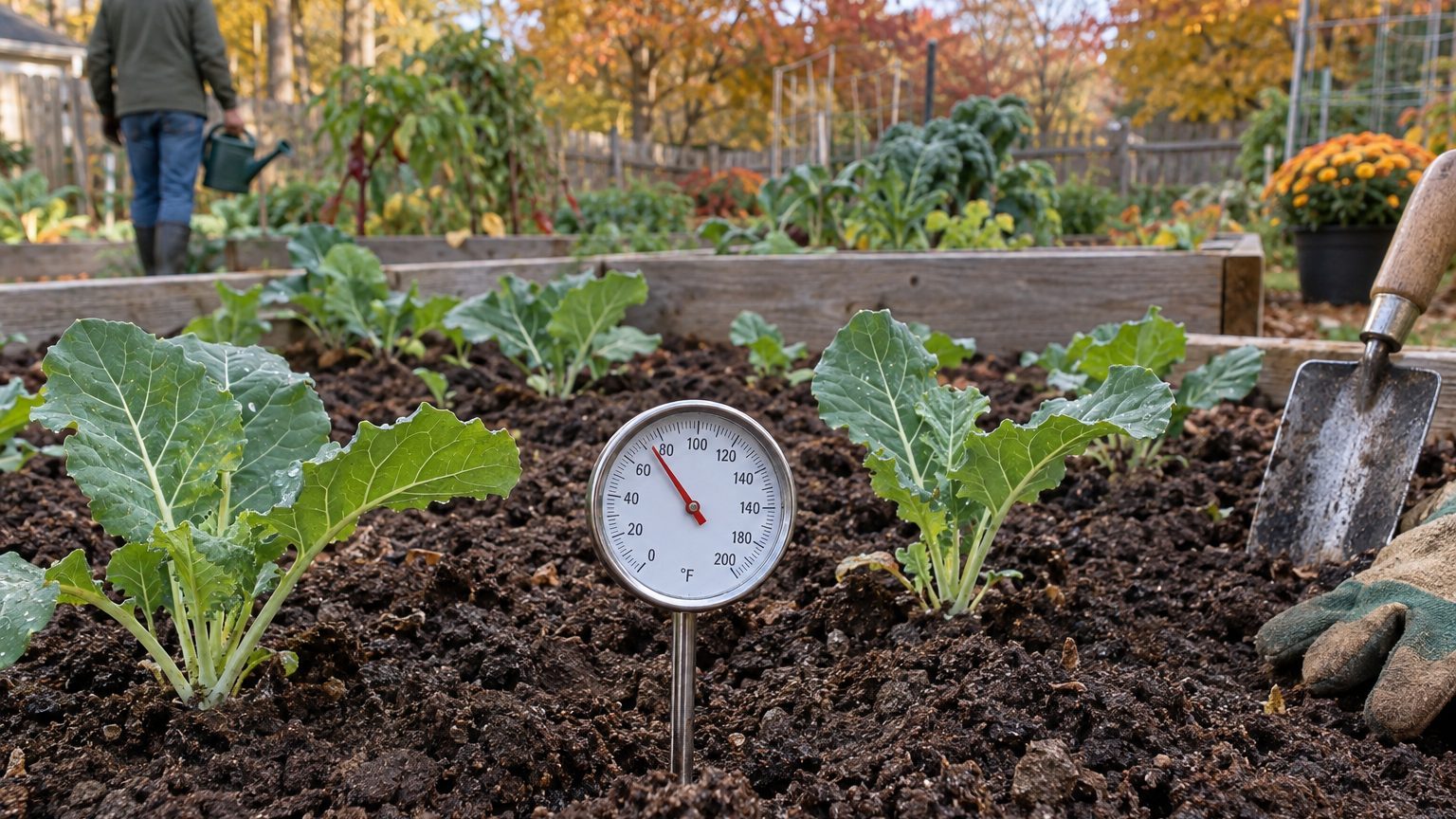

Collards can be grown successfully in Wyoming, but the state’s elevation changes the rules: soil warms up later than a calendar date suggests, the frost-free window runs short, and winter cold (not summer heat) decides whether this is a spring, fall, or single-season crop. Most gardeners here get one good planting rather than two.
When the soil is warm enough in Wyoming

Frost dates get all the attention, but they’re a stand-in for the number that actually matters: soil temperature. Collard roots and transplants stall in cold ground even after the air stops freezing, so the real planting window opens a bit later than the frost calendar implies. For the reporting station covering this area (USW00024018), NOAA’s 1991-2020 Climate Normals put the last spring freeze between May 7 and May 18, based on the 30-70% probability band for a 32°F event. That’s not a promise. It’s a statistical range built from three decades of records, and any given year can fall well outside it.
At the elevations common across Wyoming, that caution matters more than in most places. Around 6,000 feet, the frost-free season runs roughly 130 days total, and frost has been recorded in every month of the year at the higher benches and mountain valleys. That single fact turns season extension from a nice-to-have into a near-requirement: a cold frame, row cover, or wall of water isn’t overkill here, it’s often the difference between a crop and a gap in the bed.
Practically, that means holding off on direct seeding or setting transplants until soil in the top few inches has warmed past the chill collards tolerate poorly, which usually lands ten days to two weeks after the local last-frost window closes rather than right on top of it. Gardeners at lower elevations along river valleys can push earlier; those on high plains or mountain-adjacent ground should wait longer and lean on cover.
Collards are brassicas, the same family as cabbage, kale, mustard, turnip, and rutabaga, and they share the same soil-borne diseases and pest cycles as all of them. A bed that grew cabbage last year, or turnips the year before, hasn’t been rotated just because the crop name changed. Check the crop rotation guide on this site before deciding where in the garden this year’s collards go.
How long the season lasts here
Subtracting the two frost dates from the same NOAA record gives the honest length of the growing window: from a last spring freeze of May 7-18 to a first fall freeze of September 24 to October 5, the frost-free stretch runs roughly four months, and at the shorter end of that range, closer to 130 days once elevation and site are factored in.
That length is short enough to change strategy, not just timing. In a longer-season state, a gardener might sow collards in spring, harvest through early summer, then sow a second round for fall. Wyoming’s window generally doesn’t leave room for that sequence unless the site sits at lower elevation with a later fall frost. For most gardeners here, the practical choice is one planting, timed to mature and produce through the cooler weeks before the first fall freeze rather than split across two sowings.
That also affects whether transplanting is worth the trouble compared with direct seeding. Transplants bought or started indoors gain two to three weeks over direct-seeded collards, which matters a great deal when the total season is measured in weeks rather than months. A gardener choosing transplants should still check root health before setting them out: any transplant with a mushy stem base, discolored roots, or a moldy root ball should be discarded rather than planted, since a compromised start rarely recovers in a short season.
Where local conditions do allow a bit more room (a warmer valley site, floating row cover extending both ends of the season), a second, smaller sowing for a fall-only crop can work. The succession sowing guide on this site walks through how to time that second planting against a fall frost date rather than a spring one, which is the detail most gardeners get backwards.
Heat and water in Wyoming

Wyoming’s elevation keeps extreme heat rare across most of the state, and the 90-degree-day counts that shape planning in warmer states simply aren’t a major factor here for a cool-season crop like collards. That’s worth stating plainly rather than borrowing a hot-climate script that doesn’t apply: this is not a state where collards need afternoon shade to survive July, and it’s not a state where a rain-soaked summer regularly drowns the bed either. The bigger variable is dryness. Irrigation, not drainage, is usually the management job.
The number that actually decides how a Wyoming collard bed gets planned isn’t a summer figure at all. It’s the coldest month’s mean daily minimum, which for the Cheyenne reference station runs 18.1°F. That’s a mean minimum, not a record low and not a monthly average, and it’s well below the range collards tolerate as a living plant in the ground. In territories where the coldest month stays mild, gardeners treat collards as a standing crop, picking leaf by leaf from November into March. Wyoming’s coldest-month figure rules that out for essentially the entire state; this is an autumn crop that ends when a hard freeze arrives, not a winter one that continues past it.
That single number reframes the whole planning question. Instead of asking how to protect collards through winter, the more useful question is how to get the maximum harvest window before the first hard fall freeze shuts the bed down. Floating row cover can buy a week or two past the average first frost date, and a cold frame can buy more, but neither turns Wyoming collards into a true overwintering crop the way they can in milder territories.
The USDA Plant Hardiness Zone Map places Wyoming across a 3a-6a range built from average annual extreme minimum temperatures, a different measurement than the coldest-month figure above but pointing the same direction: this is cold-hardy-plant territory, and any recommendation should be checked against conditions at the reader’s specific elevation and valley position rather than the state range as a whole.
Which collards suit Wyoming
None of this points to a specific variety, and it shouldn’t. This page can talk about types with confidence: given a short season and a cold-dominated winter, the earliest-maturing types generally make more sense here than long-season types bred for regions with six extra weeks of growing time. Given a dry climate rather than a humid one, disease pressure from foliar mildews tends to run lower than in the Southeast, which shifts the priority away from disease resistance and toward cold tolerance and speed to harvest.
What this page won’t do is name a cultivar. The varieties actually trialled for Wyoming conditions, tested against real frost dates and real elevation, live with the University of Wyoming Extension, not with a general gardening article. Naming a specific variety here would mean guessing at seed availability, regional trial results, and disease pressure this page has no way to verify, and a gardener who plants based on a guessed name and gets a poor stand won’t get a second chance that season. Refusing to name one and pointing to the extension service instead is the accurate answer, not a dodge.
The same logic applies to pest and disease management. Collards share cabbage worm, flea beetle, and clubroot pressure with every other brassica in the garden, including turnip and rutabaga, and treating collards as an isolated crop in the rotation plan undoes the point of rotating at all. Cultural practice (row cover timing, spacing for airflow, moving the bed each year) does more work here than any product, and none of it depends on knowing a variety name.
Before buying seed, the one action worth taking is a call or visit to the county extension office, since they can point to the specific type trialled at the elevation and valley closest to a given garden, which matters more in Wyoming than in almost any flatter state.