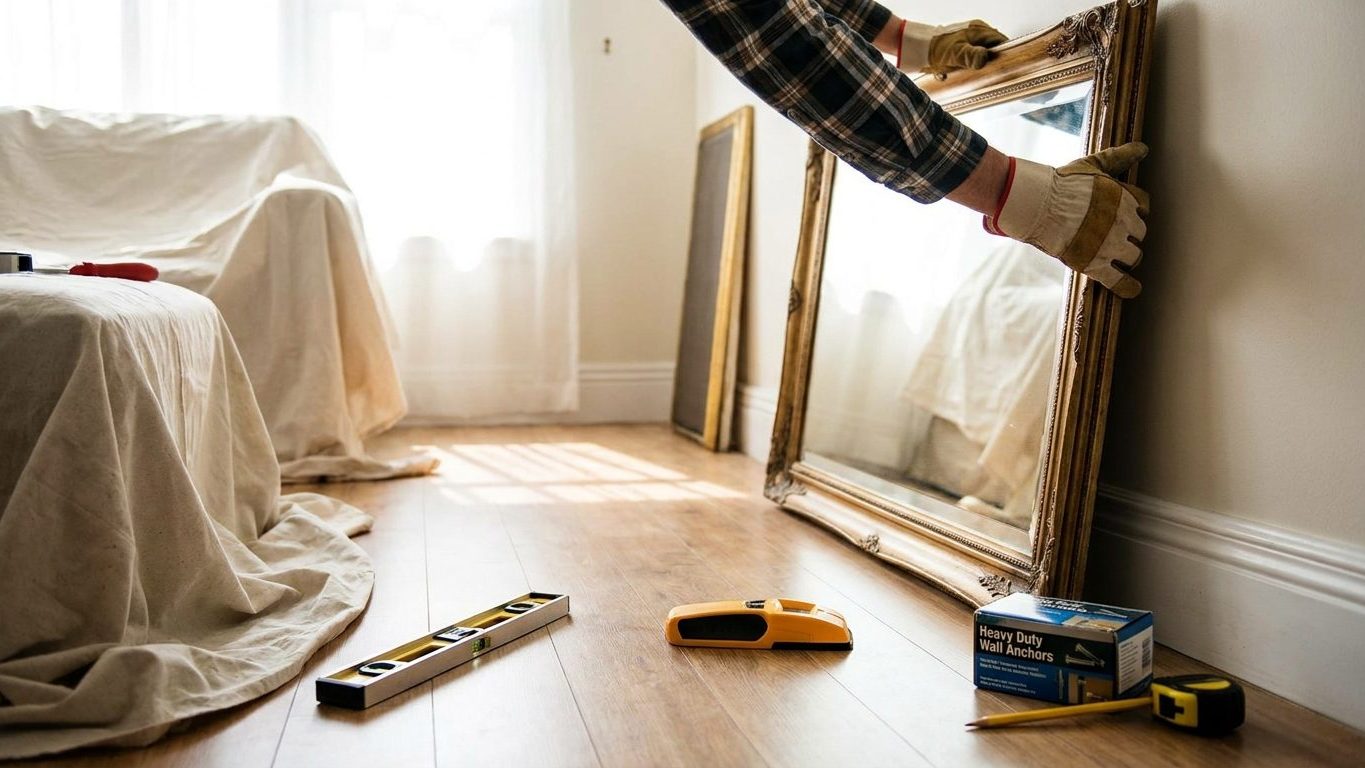

Drywall alone never holds a heavy mirror for long. The board or plaster you see is just a face over framing, and a mirror’s full weight has to reach a stud, a joist, or solid masonry behind that skin to stay put for years, not just on installation day. Find that structure before you drill, then match the fixing to the wall you actually have.
What is actually going on

A mirror is the heaviest thing most people hang on a wall, and it’s also the one made entirely of glass. That combination is what makes this job different from hanging a picture or a shelf. The weight sits on a small fixing area, usually one or two points at the top of the frame, and if that fixing lets go, the mirror doesn’t tip over gently. It drops straight down and shatters at floor level, often where feet and pets are.
The fixing has to hold two kinds of force at once: the constant pull of the mirror’s own weight, and any sideways jolt from a bumped frame, a slammed door nearby, or a house settling over time. A hook that looks secure on the day you hang it can still be marginal, because it was never tested against that second kind of force. A mirror that went up fine is not the same as a mirror that’s sound.
What’s behind the surface matters as much as the fixing
Interior walls are built around vertical studs, wood or metal, spaced at fairly regular intervals, or in older houses hung on solid masonry or lath and plaster with no consistent pattern at all. A fixing driven only into the board or plaster skin, without reaching a stud, joist, or masonry, is holding onto a material that was never designed to carry weight. It will hold a picture. It will not hold a mirror indefinitely.
Before you drill anywhere, remember that walls carry more than framing. Depending on the house and the specific wall, you may find:
- Electrical cable, run vertically or horizontally to switches and outlets
- Water supply or drain lines, especially near kitchens and bathrooms
- Gas piping, in homes with gas heating or gas appliances
- Ductwork, in some stud walls near heating and cooling runs
The usual assumption is that cable and pipe runs stay a certain distance from switches, outlets, and corners, but that’s a convention followed inconsistently even in newer construction, and often not at all in a house that’s been rewired or replumbed over the years. A mirror hung near a light switch raises the same blind spot that trips people up in Dimming Modern Bulbs: Why It Often Fails, where wrong assumptions about what sits behind the switch plate cause a different kind of trouble. If you can’t confirm what’s behind the wall at the exact spot you want to drill, don’t drill there. Move the fixing point, or have someone qualified check first.
None of this is work for a live circuit. If a mirror needs to go near a fixture or switch that would require any rewiring, that’s electrician’s work, and it stops there.
The point that outweighs all the others: a heavy mirror that falls causes real injury, from the glass shattering underfoot to the impact of the frame itself. A fixing you’re unsure about is a fixing to replace, not one to test by leaving it up and hoping.
Doing it
The wall decides more here than technique does, which is the same idea covered in Hanging, Shelving and Fixing: The Wall Decides. Two decisions matter more than anything else: where the load actually lands, and how many points carry it. This is the order that avoids most failures.
- Locate the structure, not just the surface. Use a stud finder, tap the wall for a change in sound, or check from an unfinished space like a basement or attic to confirm where studs, joists, or masonry actually sit. Skipping this step is the single most common reason a heavy mirror comes down, because the fixing was solid in board that was never meant to carry the load.
- Check for cables and pipes at that exact spot before any drilling. Skipping this risks a cut cable or pipe, a different and more urgent problem than a fallen mirror.
- Use two fixing points, not one, spread across the width of the frame. A single central hook concentrates the whole weight on one point and lets the mirror rotate or swing if it’s bumped. Skipping this is fine for a light picture and risky for anything heavy.
- Match the fixing to the wall type, using whatever the packaging specifies for that wall, stud, solid masonry, or hollow block. That figure on the box, tested for that material, is the only load information worth trusting. A fixing rated for one wall type performs differently, often much worse, in another.
- Check the frame’s own hanging hardware, wire, D-rings, or sawtooth brackets, for wear or rust before hanging anything on it. Old wire that looks intact can still have frayed strands under the twist.
- Have the mirror hung, or at least the fixing selected, by someone experienced if the wall is masonry, if you can’t confirm what’s behind it, or if the mirror is large enough that a mistake would be dangerous to fix alone.
This wall-first approach isn’t unique to mirrors. Mounting a television on a wall relies on exactly the same logic, locating structure before anything else, because both jobs put sustained weight on a handful of fixing points instead of spreading it the way a lighter object does.
None of the above amounts to guessing weight limits in pounds or kilograms and hoping a fixing clears the number. What a fixing holds depends on the wall material, the fixing type, how it was installed, and the direction of the load, and the only figure that means anything is the one printed on that fixing’s own packaging for that specific wall type.
What it looks like when it goes wrong
Some failures are cosmetic. Others are safety failures, and the two need to be told apart because the response is completely different.
Cosmetic failures
These show up as a frame sitting slightly crooked because the two fixing points weren’t level, a visible gap or shadow line where the mirror doesn’t sit flush against the wall, or a scuff mark from installation. Annoying, not dangerous. A crooked mirror can be leveled and a gap can be traced to a fixing depth issue, though it’s worth checking the fixing itself while you’re already looking.
Safety failures
These are the ones to react to immediately, not watch and wait on:
- Plaster or drywall crumbling around a fixing point, visible as powder or small cracks radiating from the screw or hook. This means the fixing is chewing through material that can’t take the load, and it gets worse over time, not better.
- The mirror sitting slightly lower than it did when first hung, even a small amount. Often the first visible sign that a fixing is pulling loose.
- A fixing point that moves or feels loose when you press gently on the frame near it. Any give at all means the anchor has failed or is failing, whatever it looked like on installation day.
- A hairline crack in the glass itself, especially near a fixing point or corner. Usually a sign the frame is under uneven stress, often from only one side carrying the weight, and it does not stop on its own.
Any of these means the mirror comes down and the fixing gets replaced, not patched. Re-hanging into the same hole rarely works either, since the hole is now oversized or the material around it is already compromised. The usual fix is to move the fixing point entirely, onto solid structure a few inches away, rather than re-drilling the same spot.
If the wall itself is failing around the fixing, that’s also a sign the load never belonged there in the first place, which is the question to settle before picking up a drill at all.
What to settle first
Before any drilling happens, settle three things: what the wall is actually made of, what’s running through it at that spot, and whether that wall can take this particular load at all.
Wall type comes first. A stud wall, solid masonry, and hollow block behave completely differently under the same fixing, and a fixing rated for one will not perform the same way in another. If you don’t know which you have, don’t guess. This is knowable with a stud finder or a small look at an unfinished section nearby, not with a rule of thumb.
What’s inside the wall comes second. Cable, pipe, and duct runs follow conventions that older houses in particular don’t respect. If you can’t confirm the area is clear, by checking from an accessible space, using a detector, or asking someone who knows the house’s history, move the fixing rather than drill blind.
Whether the load belongs there at all comes third, and it’s the step people skip most. A stud wall can usually take a heavy mirror with the right fixing, but a stud wall already patched, damaged, or thinned by a previous renovation might not, whatever the fixing package promises. Solid masonry generally takes heavy loads well once you use the fixing type built for masonry, but old or crumbling mortar changes that picture. If the wall looks or sounds hollow, damp, or damaged anywhere near where you’d drill, that’s a reason to have someone assess it before you commit a mirror to it.
Where the mirror is large enough, or the wall uncertain enough, that a mistake means broken glass on the floor, paying for an experienced installer to make these three calls is cheaper than the alternative.
Common questions
Can I use the same wall anchor I used for a picture frame?
Usually not. A heavy mirror needs a fixing rated for its wall type and load, and most lightweight picture hooks are built for a fraction of that weight. Check the packaging on the fixing itself rather than assuming a hook that worked for a picture will work for a mirror.
How many fixing points does a heavy mirror actually need?
Two at minimum, spread across the width of the frame rather than centered. A very wide or tall mirror may need more, and the frame’s own hanging hardware, not just the wall fixing, needs to be rated to spread the load across those points.
What if my wall is old lath and plaster, not drywall?
The same rule applies: the fixing needs to reach the wood lath strips or the studs behind them, not just the plaster skin. Lath and plaster is often more brittle than drywall around a drilled hole, so locating structure precisely matters even more here.
Is it safe to hang a heavy mirror above a bed?
It’s a judgment call about consequence, not a rule this article can set for you. A fixing that’s slightly marginal matters more directly overhead than it does elsewhere in the room, simply because of what’s underneath it if it fails, so treat any doubt about that fixing as a reason to move the mirror or upgrade the anchor rather than leave it as is.