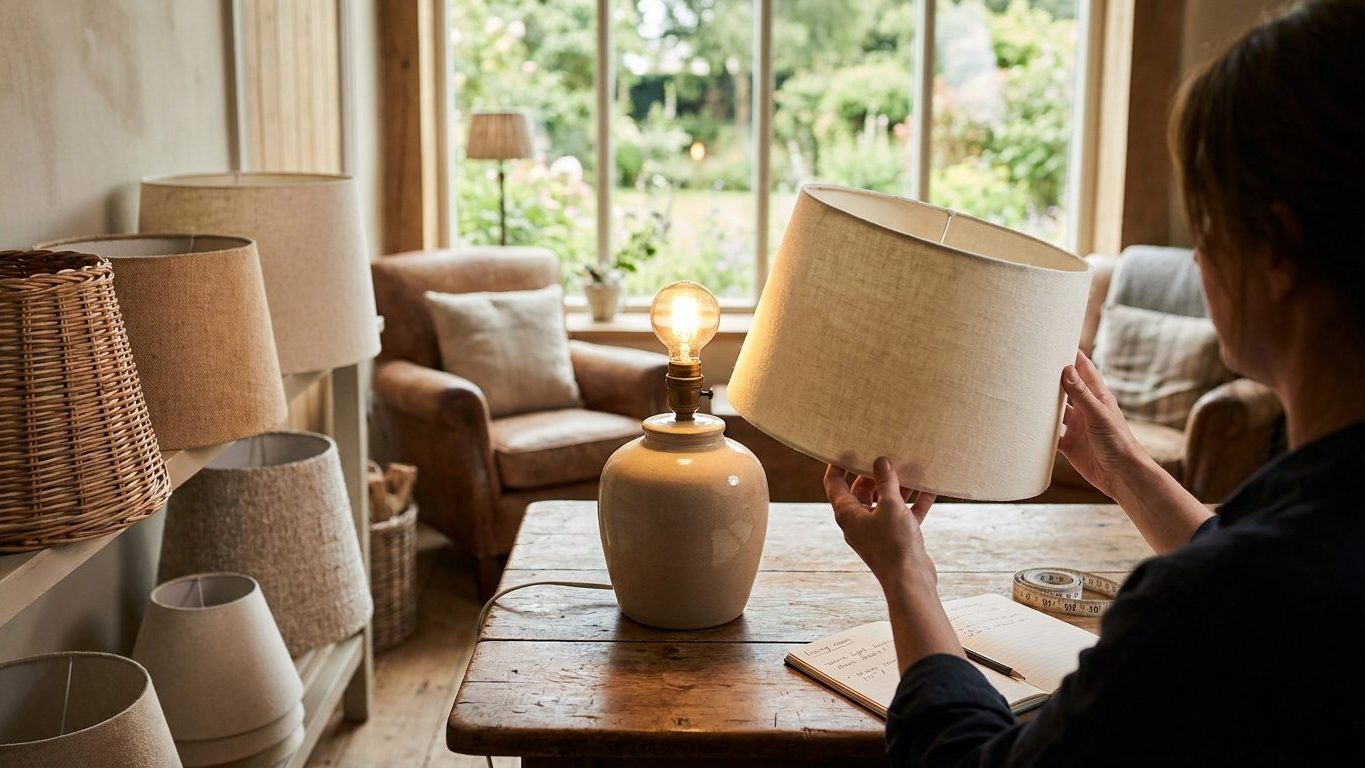

Table lamps and floor lamps follow different shade proportions, and swapping a shade between them is the most common reason a lamp looks off no matter how carefully it was measured. The base sets the shade’s size, not the other way around, so measure the base’s height and widest point before you look at a single shade. Hold the bare bulb and harp up against the base first, to see where the shade’s bottom edge has to sit to hide them from a seated eye level.
What is actually going on

A lampshade has one structural job before it has any decorative one: it has to hide the bulb, the socket, and the metal harp that holds it all together, so nobody sitting in the room sees hardware instead of light. That single requirement decides almost everything else about size. The shade’s depth is set by the height of the fitting it has to cover, and its width is set by the base it has to sit on. Most “sizing rules” you’ll hear in a lamp shop are really just shortcuts for hitting that concealment point without measuring the actual harp.
Eye level is the part nobody explains. A table lamp next to a reading chair is judged from the eye level of someone sitting down, roughly chest to shoulder height when they’re seated near it. A floor lamp is judged mostly from a standing eye level as people walk past it, then again from a seated eye level once someone sits beside it. That’s why a shade that looks fine on a floor lamp viewed from a few feet back while standing can look wrong the moment it goes on a side table, where people look down into it from an armchair.
The harp is the wire loop the shade clips onto, and it comes in a handful of standard heights. A shade bought without checking the harp height first will often sit too high, exposing the socket and the top inch of the bulb, or too low, resting on the bulb itself and yellowing the fabric over time. This is a convention built around fittings, not a fixed measurement, because harps are swappable. A taller harp is often the actual fix for a shade that’s otherwise right for the base but sits wrong on it.
Width works the same way but is governed by the base rather than the fitting. The usual convention is that the shade’s bottom diameter should come close to the widest part of the base, wide enough that the base doesn’t visually poke out past the shade’s edge, narrow enough that the shade doesn’t dwarf a slender base. That proportion is something people have settled on because it reads as balanced, not because a narrower or wider shade is somehow wrong. A lamp with an unusual base, a tall thin column or a wide squat urn, will sit outside that convention no matter what shade goes on it, and that’s fine as long as the fitting is still hidden.
Doing it
Once the concealment logic makes sense, sizing a shade is mostly measuring, in this order.
- Measure the base height, from the surface it sits on to the top of the socket, not to the top of the harp. Skip this and every later measurement is a guess, because shade height gets judged against the base, not against itself.
- Measure the base’s widest point. Skip this and the shade you pick may end up narrower than the base, so the base pokes out past the shade’s bottom edge and catches every shadow in the room.
- Check the harp height and style. Skip this and a shade that measures correctly on paper can still sit too high or too low once it’s clipped on, exposing the bulb or resting against it.
- Choose a shade whose height runs, by the usual convention, to somewhere around two-thirds to three-quarters of the base height, and whose bottom diameter comes close to the base’s widest point. Skip this ratio and the lamp reads as either top-heavy, a large shade on a stubby base, or top-light, a small cap on a tall column.
- Confirm the fitting type on both the shade and the lamp before buying. Skip this and a spider-fitted shade simply won’t clip onto a lamp built for a clip-on shade, no matter how close the size is.
The fitting is the part that actually limits what will physically go on the lamp, and it’s worth knowing the three common types before shopping, since a shade that measures perfectly can still be the wrong fitting.
| Fitting type | How it attaches | What it suits | What goes wrong if mismatched |
|---|---|---|---|
| Spider fitting | A wire spider frame inside the shade clips onto the harp, which screws onto the socket | Most table and floor lamps with a standard harp | Shade sits loose or won’t clip at all if the harp is the wrong height or missing |
| Uno fitting | A wide ring in the shade’s top sits directly over the bulb and screws down against the socket, no harp involved | Lamps built without a harp, common on some vintage and bridge-arm lamps | A spider-fitted shade has nothing to sit on, so it can’t be used at all |
| Clip-on fitting | A spring clip in the shade’s top grips the bulb itself | Small lamps and some wall or clip fixtures without a harp or uno ring | Repeated clipping can crack an older bulb, and the shade can shift or spin as the clip loosens |
What it looks like when it goes wrong
The most common visible failure is the harp or socket showing beneath the shade’s bottom edge from a seated position, sometimes called an “up-skirt” look. It happens when the shade is too shallow for the harp, or when a taller harp was fitted without buying a deeper shade to match. It’s correctable: swapping to a longer or shorter harp usually solves it without replacing the shade at all.
A shade that’s too narrow for its base looks pinched, with the base visibly wider than the shade above it, and it throws a harsh, narrow cone of light straight down rather than spreading it across the room. A shade that’s too wide does the opposite. It swallows the base visually and dumps most of the light downward and outward instead of up toward the ceiling, so the room reads dimmer even with the same bulb in it. Both are proportion problems judged against the base, not wiring problems, and both mean the shade itself needs replacing, since no harp adjustment fixes a width mismatch.
Cosmetic failures versus safety failures
A crooked or off-center shade, one that sits at an angle instead of level, is almost always a bent harp or a loose finial, and it’s a quick fix rather than a reason to buy a new shade.
A shade resting against the bulb, or sitting close enough that the fabric shows scorch marks or a yellow-brown discoloration near the top, is a genuine safety issue and not a cosmetic one. It means the harp is too short or the bulb wattage is too high for the fitting, and it needs correcting right away rather than getting used to as a look, since prolonged heat contact with fabric is a fire risk.
A wide, heavy shade on a narrow or lightweight base is the other safety failure worth naming. It raises the lamp’s center of gravity and makes it easier to tip, especially on a floor lamp standing on soft or uneven flooring, the kind of instability that comes up from the flooring side in Choosing a Rug Size for the Room. That one isn’t solved by adjusting the shade at all. It’s solved by matching shade weight to a base that can actually carry it, or by weighting the base itself.
What to settle first
Before buying a shade, settle what you’re actually working with, since a shade’s fit depends on things the tag on the box doesn’t tell you.
Confirm the fitting type on the lamp itself, spider, uno, or clip-on, by looking at what the current shade, or the bare socket if there is no shade, actually attaches to. Don’t assume from the lamp’s age or style, since older lamps mix fittings more than new ones do.
Check the harp: whether it’s removable, what height it is, and whether a taller or shorter one is available for that base, since swapping the harp is usually cheaper and easier than hunting for one exact shade size.
Check the bulb and socket rating against what the shade material can safely sit near, since a fabric or paper shade sitting close to a high-wattage bulb is the scorch risk described above, and it’s worth checking before the shade goes on rather than after it discolors.
If the lamp is a wall-mounted swing arm rather than a freestanding table or floor lamp, check what’s behind the wall before mounting the bracket that carries it. A swing-arm lamp with a wide shade puts real leverage on its mounting point, the same kind of load-bearing question covered from the wall side in Hanging a Heavy Mirror Safely, and the same logic that governs anything fixed to a wall generally in Hanging, Shelving and Fixing: The Wall Decides. Find the stud, check the wall material, and don’t rely on the mounting hardware that came in the box if the wall behind it is hollow plaster or thin drywall without a stud nearby.
Finally, check the base’s actual footprint and weight against the shade you’re considering. Wide and heavy on a narrow, light base is the tip risk described above, and it’s worth testing by hand, tilting the assembled lamp slightly on a flat, stable surface, before it goes anywhere near a rug or an uneven floor.
Common questions
Can I put a bigger shade on my lamp than the harp is rated for?
Only within a small range. A harp is sized for a shade whose weight and diameter its clips can hold without bending, and pushing well past that tilts the shade or pops it loose. If you want a noticeably bigger shade, look at a taller, sturdier harp rather than forcing the current one to carry more than it’s built for.
Why does my lamp look top-heavy even though the shade is the size the box recommended?
Box sizing usually assumes an average base shape, and a slender or unusually short base won’t match that assumption. Judge the shade against your actual base height and width rather than the size printed on the packaging, since the packaging has no idea what base it’s actually going on.
Does the shade material change what size I should buy?
It changes how forgiving the size is, not the size itself. A translucent shade shows the bulb and harp faintly through the fabric even when the size is technically right, so errors in depth show up more than they would with an opaque or lined shade, which hides a slightly-off fit better.
Can I reuse a shade from an old lamp on a new one?
Only if the fitting type matches and the new base is close in height and width to the old one. A shade sized for one lamp rarely suits a differently proportioned base even when the fitting happens to fit, so treat it as a starting point to test rather than an automatic fit.