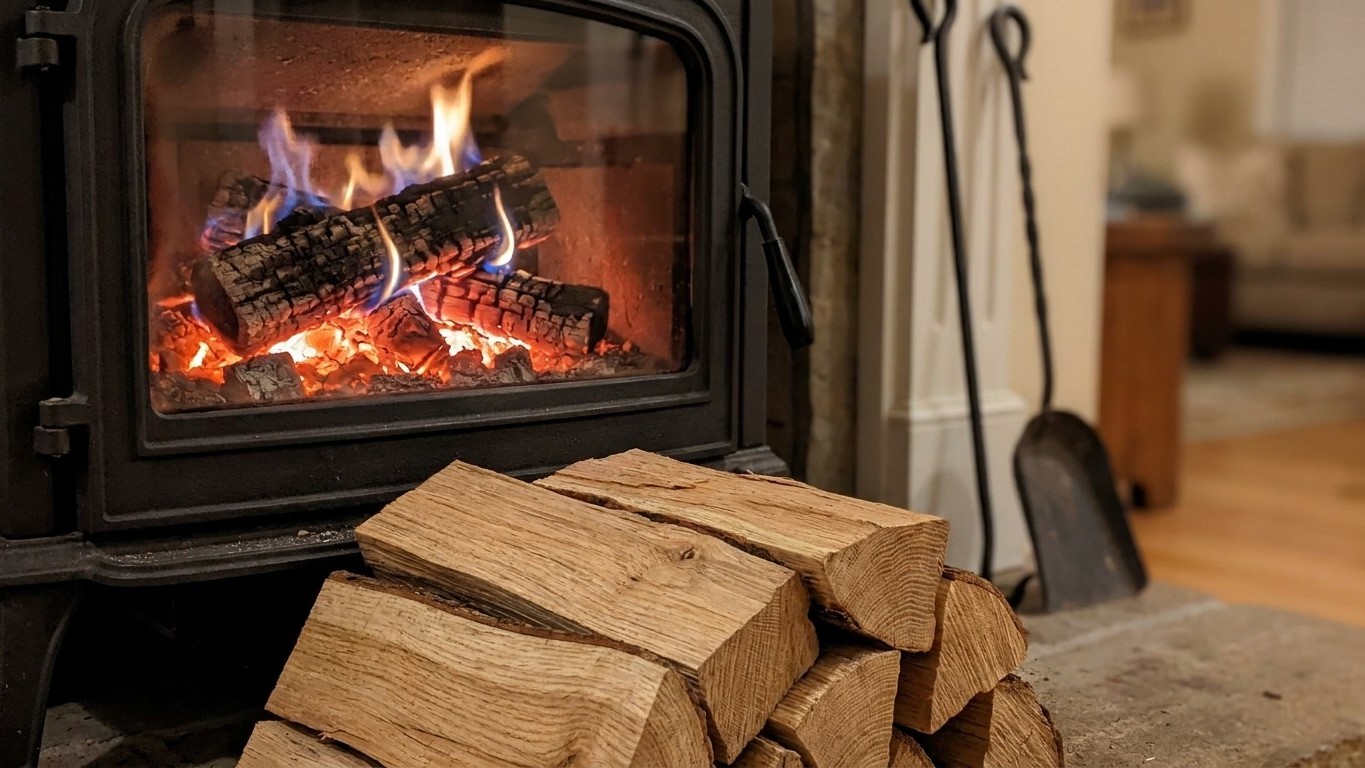

White oak burns hotter and longer than almost any other firewood you’ll find in a typical American woodlot. A properly seasoned cord delivers exactly 27 million BTUs, according to the Missouri Department of Conservation, throws off a clean, low-smoke flame, and leaves behind a bed of coals that can carry a fire through the night. The catch: green white oak needs 12 to 24 months to season properly, thanks to a tight grain structure that locks in moisture far longer than faster-drying species like ash or cherry.
Heat Output and Burn Time

White oak sits near the top of the hardwood heat charts, right alongside hickory and shagbark hickory. Density is the reason. A cubic foot of dry white oak weighs close to 47 pounds, noticeably heavier than red oak and well above softer hardwoods like soft maple or birch. That extra mass means more fuel packed into every split log, which translates directly into longer burn times and a denser bed of coals.
Homeowners running a wood stove or insert tend to notice the difference on cold nights. Load a firebox with dry white oak before bed, damp the air down, and it’s common to find live coals still glowing eight to ten hours later. That coaling behavior makes it a favorite for anyone trying to keep a house warm through a long winter night without getting up to reload at 3 a.m.
Compared to red oak, white oak burns slightly hotter and produces a longer-lasting coal bed, though the difference isn’t dramatic. Both species outperform ash, birch, and soft maple by a wide margin. Hickory edges out white oak on raw BTU numbers, but white oak is more widely available across the Midwest, Appalachians, and much of the eastern half of the country, which makes it the more practical choice for most wood-burning households.
Smoke and Sparks: What to Expect
Dry white oak burns clean. Once moisture content drops below 20 percent, a well-seasoned split produces a steady, low-smoke flame with minimal visible haze coming off the flue. That’s a meaningful difference from green or partially seasoned oak, which smolders, smokes heavily, and deposits creosote inside the chimney at a much faster rate.
Creosote buildup isn’t just an inconvenience. According to the U.S. Consumer Product Safety Commission, chimney fires linked to creosote accumulation are a leading cause of residential fires tied to wood-burning appliances (cpsc.gov). Burning unseasoned oak is one of the fastest ways to load up a flue with the tarry residue that fuels those fires, which is exactly why moisture content matters more with white oak than with faster-drying species.
Sparks are a smaller concern. White oak throws relatively few sparks compared to softwoods like pine or spruce, and even compared to some other hardwoods that trap resin pockets or gas voids in the grain. That makes it a reasonable choice for open fireplaces and fire pits, though any hardwood can still pop occasionally if a log has trapped moisture or bark still attached.
Seasoning White Oak: Why It Takes So Long
Here’s the part that catches a lot of first-time buyers off guard. White oak contains structures called tyloses, small membrane-like growths that block the vessels running through the wood. Botanically, tyloses are part of what makes white oak so rot-resistant and historically valuable for barrel-making and boat hulls. Practically, for firewood, they mean moisture has a much harder time escaping through the wood’s natural pathways.
Red oak lacks the same density of tyloses, which is part of why it typically dries a few months faster than white oak, even though the two species look similar on a woodpile. Green white oak split and stacked in spring won’t be ready to burn well until the following winter at the earliest, and many experienced burners push that to a full 18 to 24 months for logs split into larger rounds.
A few habits speed the process along:
- Split rounds smaller than usual (4 to 6 inches across) to expose more surface area
- Stack off the ground on pallets or rails to keep air moving underneath
- Leave the top covered but the sides open so wind and sun can pull moisture out
- Check with a moisture meter before burning; aim for 20 percent or lower
A cheap pin-style moisture meter, available for well under $20 at most hardware stores, takes the guesswork out of the equation. Splitting a log open and checking the freshly exposed face gives a far more accurate reading than testing the weathered outer surface, which dries faster and can mask a wet core.
Splitting and Handling
Green white oak splits reasonably well, especially straight-grained rounds without much branching or knots. The trouble comes with older, larger-diameter trunk sections, where interlocking grain patterns can make a round twist and resist the maul instead of popping cleanly in half. A hydraulic splitter handles those stubborn rounds far more efficiently than swinging by hand, particularly for anyone processing more than a rick or two per season.
Weight is worth factoring into the physical work involved. A full cord of dry white oak weighs in around 4,200 to 4,500 pounds, meaningfully heavier than a cord of ash or soft maple. That’s good news for heat output and bad news for anyone stacking or hauling it by hand across a yard. Splitting rounds down to a manageable size isn’t just about drying speed. It also makes the wood easier to handle once it’s ready to burn.
Bark on white oak tends to be thick and furrowed, and it holds on tightly even after the wood inside has dried. That’s mostly a cosmetic issue, though thick bark can trap a bit of extra moisture near the surface, which is one more reason smaller splits season faster and more evenly than large, bark-heavy rounds.
Where White Oak Fits in a Firewood Lineup
For anyone stocking a woodshed with more than one species, white oak works best as the backbone fuel rather than the only option. Its long burn time and steady coal bed make it ideal for overnight loads and cold-weather heating, but it’s slower to catch than lighter woods and doesn’t produce the quick, bright flame that’s useful for getting a cold stove up to temperature fast.
A practical approach many burners settle on: start a fire with a faster-igniting wood like ash, birch, or a softwood kindling, then transition to white oak once the firebox and flue are warm. That combination gets quick heat early and steady, long-duration burning once the fire is established, without wasting the oak’s slow-burning qualities on a cold start.
Regional availability plays a role too. White oak grows across most of the eastern and central United States, from the Appalachian ridgelines down through the Ozarks and out into parts of the Midwest, which keeps it reasonably priced and easy to source through local firewood dealers in those regions. In areas where it’s less common, red oak or hickory often serve as the closer substitute, both sharing similar density and heat output even if the seasoning timeline differs slightly.
One detail worth checking before buying a truckload: ask the seller how long the wood has been split and stacked, not just when the tree was cut. A round left whole for a year barely dries at all compared to a split log stacked in open air for the same stretch of time, and with white oak’s slow-drying tendencies, that distinction matters more than it does with almost any other common firewood species.