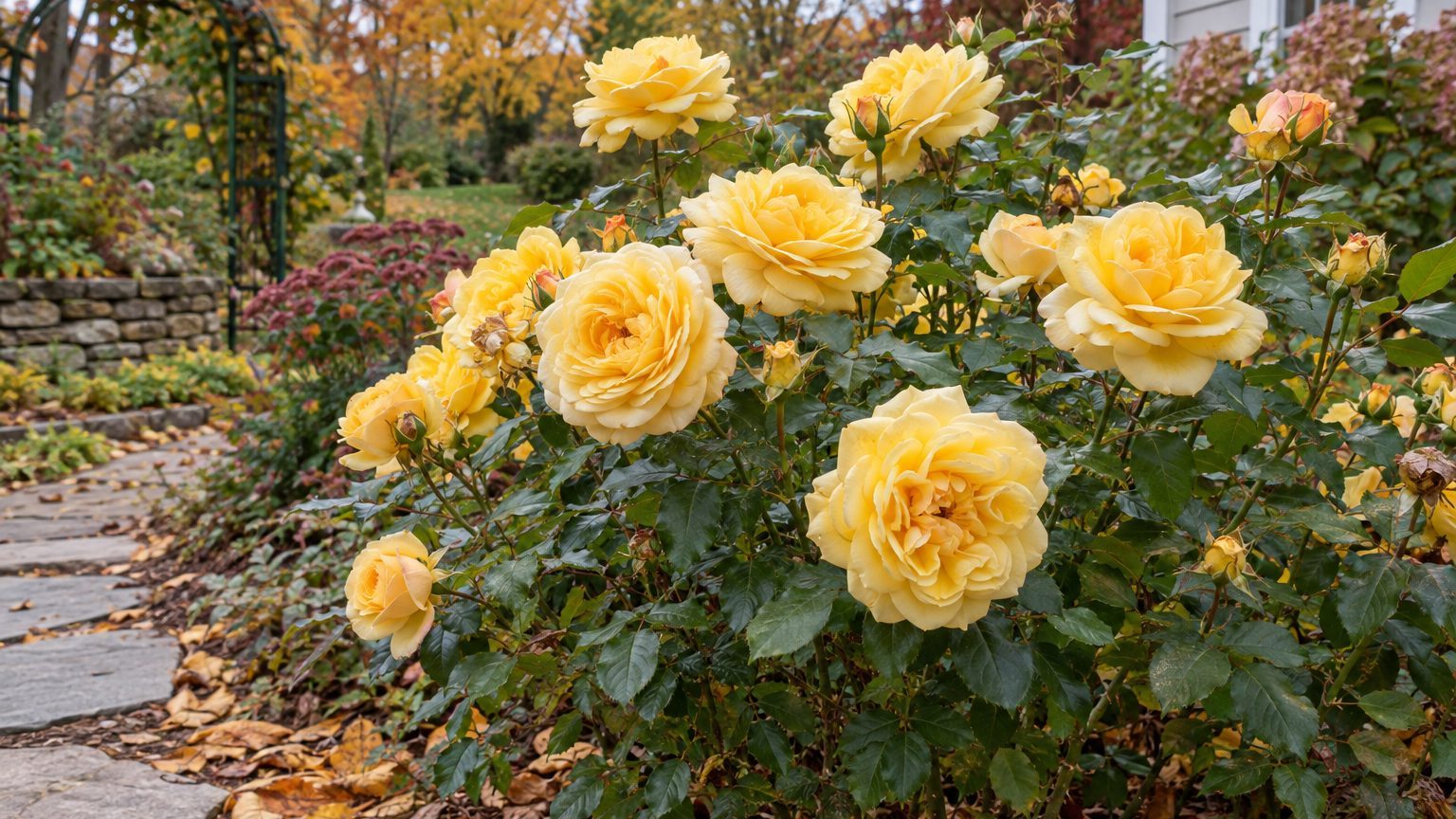

Julia Child is a butter-yellow floribunda rose with very double flowers and a licorice-and-clove scent, and it has no days-to-maturity figure at all. A rose is not timed from transplant to harvest. What matters is how much new wood it grows before cold arrives, because this cultivar flowers on new wood and is cut back hard while dormant. The date for that cut depends on your zone.
What Julia Child actually is
The description on file is short: butter yellow, very double, licorice-clove fragrance. It is a floribunda, and it flowers on new wood. The source is the NC State Extension Gardener Plant Toolbox entry for Rosa, which covers the genus. Everything stated here about this specific plant comes down to those few facts. The rest is genus-level, and I’ll say so each time.
Vegetable catalogues count days to maturity from transplant, so a buyer can do arithmetic against a frost date. The source gives no such number for this rose, and I won’t make one up. The nearest equivalent is the flush of shoots the plant grows after its hard cut. Those shoots carry the flowers, so the whole calendar question shifts from “will it finish?” to “will it grow enough wood before the season turns?”
Habit matters for space and support. The genus runs 1 to 8 feet tall and 1 to 6 feet wide, depending on cultivar. A per-plant figure for Julia Child is not documented here, so take it from the nursery tag before you commit a spot. “Very double” points to a flower well past the 20 petals that the source uses to define a double, against 5 for a single. The sharp structures on the stems are prickles, not true thorns. They grow from the outer skin of the stem, which is why they can be rubbed off.
What Julia Child is good for

This is a flower, so the payoff is bloom and scent. The source description gives licorice-clove fragrance. Beyond that, the flavor of a rose is nobody’s business but the hip’s, and I have no documented note on how this cultivar’s fragrance falls into the five groups the source lists (old rose, fruity, tea, myrrh, musk). Treat the scent as the description states it and no more.
Floribundas are generally grown for a long run of flowers borne in clusters rather than for one show-bench bloom on a stem. That is a category trait, not a measured trait of this plant. It explains why a floribunda tends to suit a bed, a low hedge or a border better than a single-stem cutting patch. Petal count adds to that. More than 20 petals means a full, layered flower, and a layered flower shows up even from across a lawn.
For the vase, timing beats technique. Cut once the sepals have folded back and the first one or two petals are unfurling. A bud cut tighter than that often never opens, which is the usual reason people give up on cut roses.
The plant also makes fruit. The hip is an accessory fruit holding achenes, and it is edible, turning from green to red in fall. Whether this cultivar sets hips freely is not documented here, and it may not matter to you if you deadhead. Every deadheading cut pushes a new shoot, so how you handle spent flowers affects both the vase and the fall calendar.
Other cultivar pages in this series, such as Double Delight Rose: When to Plant the Tomatoes That Ripen All at Once and Tropicana Rose: When to Plant the Tomatoes That Ripen All at Once, carry their own per-plant details. The full list sits under Rose Varieties.
Where it ripens in time, and where it is a gamble
A tomato calendar runs on frost-free days, minus soil warm-up, minus days to maturity, with the remainder as picking time. That subtraction needs a maturity figure, and a rose has none. Nor does this page hold frost dates for named weather stations. They are not published in the data behind it, so I won’t quote a city and a date as if they were. Rather than fake the crossing, here is how the logic changes for a perennial.
The range on paper
The genus is documented for USDA zones 5a through 11b. That is a very wide band, from cold northern winters to frost-free Gulf and southern California gardens. A cultivar-specific hardiness rating for Julia Child is not documented here, so a gardener at the cold end, zone 5a, should read the plant tag and ask the seller before counting on the whole range. I won’t call it impossible anywhere, because the numbers don’t say so.
What replaces the arithmetic
Since Julia Child flowers on new wood, the useful sum is different. Take the dormant hard cut, then the shoots that grow afterward, and the flowers those shoots carry. A hard winter that kills back canes costs less on a new-wood bloomer than on a rose that flowers from old wood, because you are cutting hard anyway. The gamble is not “will it ripen?” but “will winter damage the crown or the union?”
What protects the plant depends on how it was propagated. Hybrid teas, grandifloras and many climbers are budded onto a rootstock, so winter protection covers the union. Most modern landscape shrub roses (Knock Out and Drift among them) are own-root, so protection covers the crown. Which one your Julia Child is, the tag will say. Mounding depth and cut date vary by zone, so use the page for your state.
The two ways a season goes wrong
A long, mild season is not automatically a good one. The tomato version of this warning is about night temperatures and heat-sterile pollen, and I have no documented thresholds for roses, so I won’t borrow those numbers. Two failures are documented for roses, and both are about wood and disease.
The first is soft growth in fall. Every deadheading cut pushes a new shoot, so if you keep cutting spent flowers late, you keep making shoots too soft to ripen in time. Stop the cuts as the season closes, and the wood ripens and the plant hardens on its own. Hips do not trigger this; dormancy follows day length and cold. Not cutting is simply what avoids the late flush.
The second is disease carrying over. Black spot overwinters both in fallen leaves and in lesions on the canes. Powdery mildew overwinters in dormant buds and on stems, not in leaf litter. Raking leaves alone ends neither, so a clean bed does not mean a clean start.
Which matters more for Julia Child? Given that it flowers on new wood and is cut hard while dormant, the soft-growth failure matters less than it would for an old-wood rose that needs its canes to survive. The hard cut also removes many overwintering lesions and buds, which helps with disease carryover, though it doesn’t remove all of it. The bigger risk is the prompt, correct cut at the right time for your zone.
What it resists, and what it does not
Here the record is blank, and I’d rather say it than imply protection. The information on file for this cultivar carries no disease resistance grade, high or intermediate. Resistance is per cultivar, not per group. Knock Out is a shrub rose bred for resistance, while several classic ramblers are mildew-prone. A floribunda label tells you nothing about Julia Child’s defenses.
The source names these diseases for roses: botrytis, blights, powdery mildew, leaf spots and anthracnose. It names these pests: Fuller rose beetle, Japanese beetle, rose chafer, rose thrips, southern red mite and two-spotted mite. Two of those are mites, which are arachnids, not insects. Which of them actually reaches your plants depends on where you garden, and nothing here says this cultivar is spared any of them.
Maintenance for the genus is rated high. Ask the seller for a resistance grade in writing, and if they say “intermediate,” remember that means the plant slows a disease, not that it escapes it.
Growing it without the usual mistakes
The pruning cut is the first decision. Because Julia Child flowers on new wood, it takes a hard cut while dormant. A rose that flowers on old wood, like a rambler, is pruned by a different logic, so mixing them up is the classic mistake. Most roses need yearly pruning in late winter, but the date depends on your zone, so check the page for your state.
Give it full sun, 6 or more hours of direct light a day. The documented soil is clay or loam with pH from acid (below 6.0) to neutral (6.0-8.0). Iron chlorosis shows up on strongly alkaline soil, above about 7.5. Growth is medium and maintenance high, so expect to feed, water and watch it regularly.
Plan space from the tag, since the per-plant size isn’t documented here. Leave room for air movement, because leaf spots, botrytis and powdery mildew are the named diseases and crowding helps them.
Ease off deadheading late in the season, as covered above. And don’t strip every dead stem. Remove what is diseased or unsafe, and leave dead stems cut back to 12-24 inches standing for stem-nesting native bees.
Common questions
How many days does Julia Child take to bloom from planting?
No days-to-maturity figure is documented for this rose, and roses are not scheduled the way vegetables are. The plant blooms on new wood, which grows after the dormant hard cut.
Does Julia Child bloom on old wood or new wood?
New wood. That is why it is cut back hard while dormant. The month depends on your zone, so use the page for your state.
Are rose thorns dangerous on this variety?
They are prickles, not true thorns. They grow from the outer skin of the stem and can be rubbed off. Wear gloves regardless.
Can I grow Julia Child in zone 5?
The genus is documented for zones 5a through 11b, but a cultivar-specific rating is not documented here. Check whether the plant is budded or own-root, and ask the seller about hardiness.