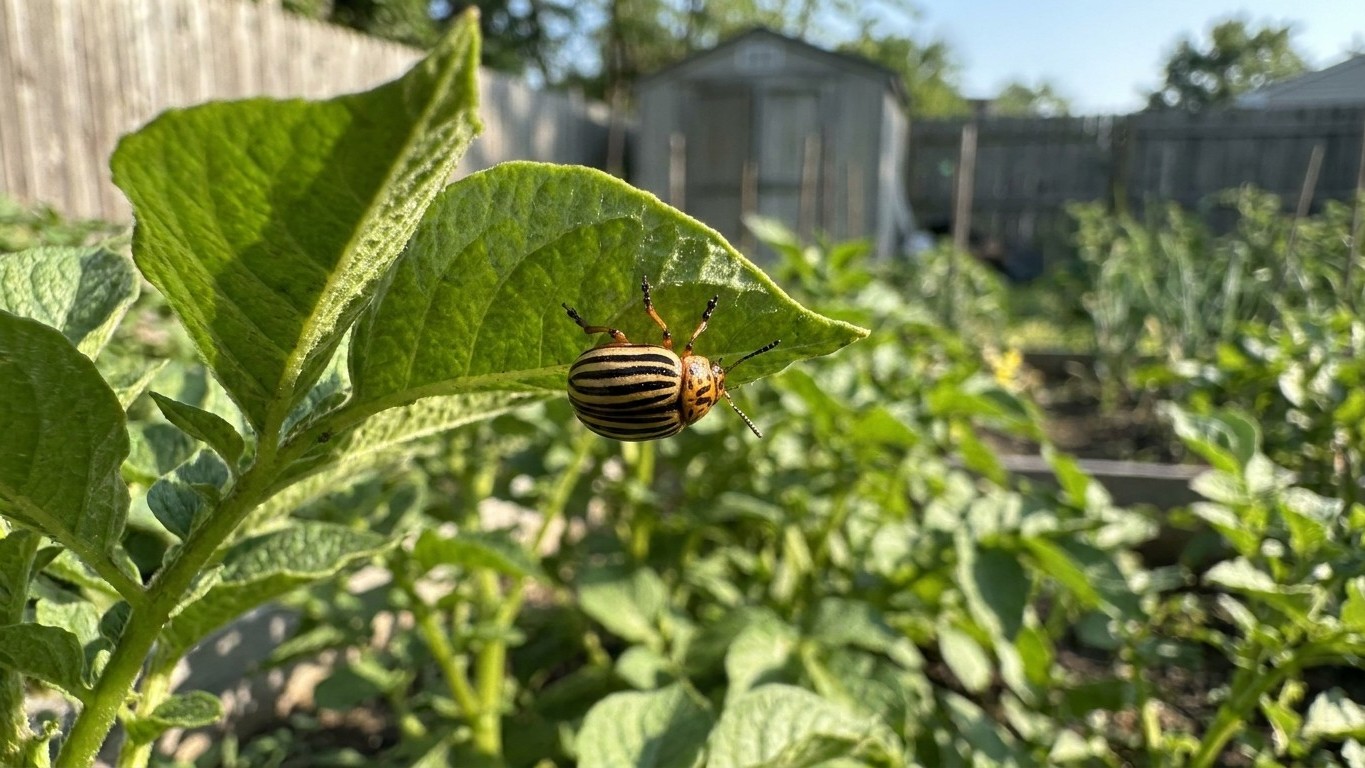

WSU Extension documents fourteen pest entries for Washington gardens, and about half of them go after potato. They show up in a fairly predictable order once the plants are up. What you see first (a stem cut at the soil line, a leaf peppered with holes, a tuber with tunnels) points to different culprits and different timing. West of the Cascades, that order follows a mild, wet spring more than the calendar.
Which pests attack potato in Washington

WSU Extension’s list for Washington reads: aphids, brown marmorated stink bug, cabbage maggot, carrot rust fly, Colorado potato beetle, corn earworm and earwigs, cutworms and armyworms, flea beetles, imported cabbageworm and loopers, onion maggot and onion thrips, slugs, spider mites, western spotted cucumber beetle, and wireworms. That is the whole documented roster, and this page adds nothing to it.
Most of it has no business in a potato patch. Seven of the fourteen entries are real potato pests. The rest are tied to other crops, and a long list is easy to misread as a warning about everything.
Set aside first the crop-specific pests. Cabbage maggot and imported cabbageworm and loopers belong to the cabbage family. Carrot rust fly goes after carrots and their relatives. Onion maggot and onion thrips work on onions and their kin. Western spotted cucumber beetle is mainly a squash and cucumber problem. Corn earworm is named for the crop it eats, and it shares an entry with earwigs, which are scavengers that only nibble foliage now and then. Brown marmorated stink bug is a fruit and vegetable pest that pierces fruit, so it has little to bite on a potato plant, where the crop grows underground.
What remains is the working list:
- Colorado potato beetle, the one pest almost everyone associates with the crop
- Flea beetles, which chew small holes in leaves
- Aphids, which cluster on new growth
- Cutworms and armyworms, which attack seedlings and low stems
- Wireworms, which live in the soil and go for the tubers
- Slugs, which feed on leaves and on tubers
- Spider mites, which build up in dry, hot conditions
These seven overlap in what they damage, so timing and the first visible sign matter more than the name. Two of them (wireworms and slugs) can ruin the tubers themselves, which is the part you eat. The others mostly damage the foliage, and a healthy potato plant tolerates more leaf loss than most gardeners expect.
When each one shows up, and what it does first
For Seattle, the reference city for the frost figures here, the window for the last spring freeze runs from February 27 to March 18. That comes from NOAA NCEI’s Climate Normals, at the 32°F freeze-probability band of 30 to 70 percent, for station USW00024233. This window belongs to western Washington, not the whole state. Eastern Washington sits beyond the Cascades in high desert with a much shorter season, and no comparable window is published here for it.
Also, a mild frost date is not a planting date. Cold, wet soil and low light hold potatoes back well past the last freeze, so the pests below are timed to your plants, not to the frost window. For the planting side, see When to Plant Potatoes in Washington: Counting Back From Your Last Frost.
Around emergence
Cutworms and armyworms are the earliest. The sign is a seedling lying flat, its stem severed at or just below the soil line, often overnight. Flea beetles arrive at about the same stage, and the first sign is a scatter of tiny round holes in young leaves, especially on warm, calm days. Wireworms are already in the soil, and the first sign is a thin or patchy stand when seed pieces have been hollowed out before they sprout.
Once the foliage fills in
Colorado potato beetle adults appear as the plants leaf out. Look under the leaves for clusters of orange-yellow eggs, and then for humpbacked larvae that strip leaves from the edges inward. Aphids favor the soft new growth at the tips and under the leaves, where you may notice a sticky residue before you see the insects. Slugs follow the weather instead of the plant stage: ragged holes with a slimy trail show up after cool, wet stretches, which western Washington supplies generously.
Late in the season and at harvest
Spider mites belong to hot, dry spells later in growth. The first sign is a fine pale stippling on the leaves, sometimes with webbing underneath. The tuber pests reveal themselves last. Wireworm tunnels and slug cavities are usually discovered on the digging fork, not before. The longer tubers stay in the ground, the longer they are exposed, which is one reason season class matters. An early variety is out sooner than a late one. The Potato Varieties That Suit Washington page covers the classes.
Telling the damage apart from everything else
Insects get blamed for a lot they did not do. Dry soil, missing nutrients, disease and a careless shovel all leave marks that look convincing from a lawn chair. The safest habit is to treat the symptom as a clue, not a verdict, and to look for the sign that separates one cause from another.
Symptoms that get misread
| What you see | Possible causes | What helps tell them apart |
|---|---|---|
| Small round holes in leaves | Flea beetles, slugs, hail | Flea beetle holes are tiny and scattered on young leaves. Slug holes are larger and ragged, with a slime trail. Hail damage appears on every plant right after a storm. |
| Seedling cut off at the base | Cutworms, mechanical damage, rodents | Cutworms leave the top lying nearby, often uneaten. A curled grub in the top layer of soil near the cut supports insects. Gnawed stems with missing tissue suggest something larger. |
| Pale stippling or bronzing on leaves | Spider mites, drought stress, nutrient shortage | Mites leave fine webbing on the underside. Drought stress affects the whole plant evenly and improves after watering. |
| Yellowing, curling leaves | Aphids, nutrient shortage, disease, uneven watering | Aphids are visible on the underside and leave sticky residue. Yellowing without insects points elsewhere. |
| Tunnels or cavities in tubers | Wireworms, slugs, fork or shovel damage | Wireworm holes are narrow and round. Slug damage is shallow and scooped. A clean straight slice with fresh flesh is your own tool. |
The tie-breakers
Time of day helps. Cutworms and slugs feed at night, so a flashlight visit after dark answers questions that daylight cannot. Pattern helps too. Insects tend to spread from a starting point, while nutrient and water problems show up evenly or follow the low spots and dry corners of a bed.
Whatever you find, bring a sample or a clear photo to your county WSU Extension office before you treat anything. A guess made from the fence line is exactly how gardeners end up fighting the wrong problem.
What actually works here, and what is a waste of time
On a season that starts slowly and stays damp, timing does more than any product. A physical barrier in place before the pests arrive beats any treatment applied after the damage appears. A row cover laid over the bed at planting keeps flea beetles and Colorado potato beetle adults off the young plants, provided the edges are sealed and the cover has not trapped insects already in the soil. Rotation helps for the same reason. Beetles that overwinter in the ground emerge right where last year’s crop stood, so moving potatoes to a new bed makes them walk to find food.
What to lean on
Hand-picking works better than its reputation, especially on Colorado potato beetle. Adults, egg clusters and larvae are all easy to see, and crushing egg clusters early prevents the larval stage that does the heavy leaf damage. For slugs, tidy edges and cleared debris remove daytime hiding places, and boards laid on the soil let you collect them each morning. Wireworms respond to soil history. Beds recently converted from sod or heavy grass are the classic trouble spots, so a bed with a different history is the better starting point.
Certified seed belongs on this list too. Uncertified seed potatoes can carry virus, and aphids move virus from plant to plant. Buying clean seed removes the reservoir before the first aphid arrives.
What wastes your time
Waiting for damage to become obvious before acting is the most common mistake, because most of the harm happens under the soil or on the undersides of leaves. Cosmetic leaf loss on a vigorous plant also rarely justifies a response, and spraying over it can leave you with more problems than you started with. Blanket spraying of unidentified pests is the third. It misses the wireworms and slugs entirely, and it treats a diagnosis you have not made. This site does not recommend specific pesticides. Which products are registered for home use in Washington is a question for WSU Extension, which knows what is currently approved in the state.
Where to check this for your own county
Who to contact
WSU Extension is the source behind the pest list on this page, and its county offices are the right place for a specific question. Each office can identify a sample, tell you which of these pests are active in your area, and explain what is approved for home use in the state. Look up the office for your county through WSU Extension and ask for the gardening or horticulture contact.
What a state-wide list cannot tell you
Pest presence varies inside a territory. A list that covers the whole state does not say what is in your garden, and Washington has an unusually wide range of conditions. The wet, mild lowlands west of the Cascades favor slugs in a way that the drier country east of them does not. The frost window on this page belongs to Seattle. Eastern Washington sits beyond the Cascades in high desert, where the season is far shorter, so a gardener there should not treat the western timing as a schedule. The Growing Potatoes in Washington page covers the wider picture.
Before your next trip out, note where the damage sits on the plant, what time you noticed it, and how the weather has been. Take photos of both sides of a damaged leaf, and if you can, save a damaged tuber. Then call or visit your county WSU Extension office with those in hand.
Common questions
Are Colorado potato beetles a problem in western Washington?
WSU Extension documents Colorado potato beetle for Washington, and it is one of the seven pests on the working list above. How much pressure your garden sees depends on your county and your neighborhood, so your local extension office is the place to ask.
Do the cabbage maggot and onion maggot attack potatoes?
They appear on the same state list, but they are tied to cabbage-family crops and onions. They are not potato pests, so their presence in the neighborhood is not a reason to worry about your potato bed.
How do I know if it is wireworms and not slugs in my tubers?
Wireworm damage usually shows as narrow, round tunnels, while slug damage is shallow and scooped out. Because both can occur in the same garden, bring a damaged tuber to your county WSU Extension office for a definite answer.
Does a mild last-frost date mean I can plant early and avoid pests?
No. In Seattle, the last-freeze window of February 27 to March 18 says nothing about soil conditions. Cold, wet soil and low light slow potatoes well past the freeze date, and pests such as cutworms, flea beetles and slugs are timed to your plants and the weather, not to the frost window.