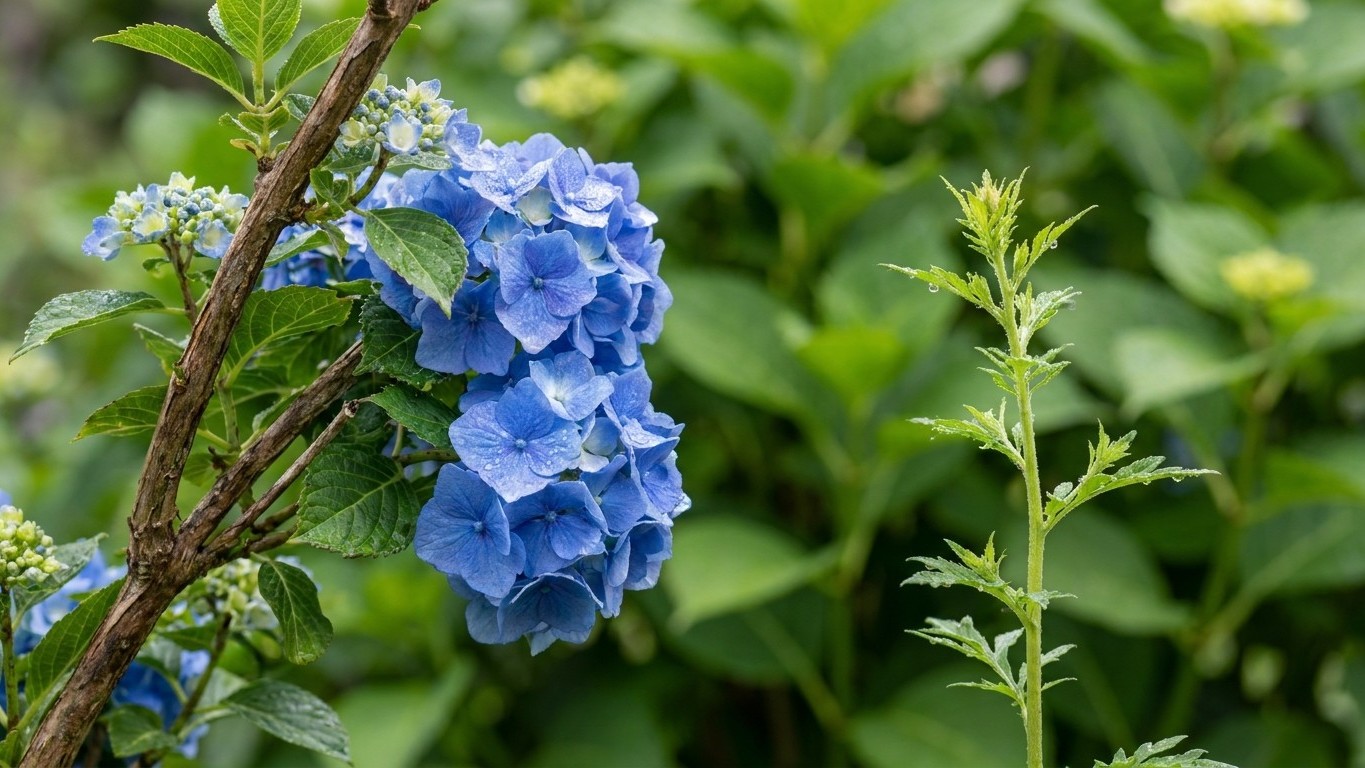

Bigleaf hydrangeas turn pink when the soil locks aluminum out of reach of the roots, and blue when the roots can absorb it. Soil pH works as the switch: blue at the low end, pink at the high end, and a muddy purple in between. To move a pink shrub toward blue, lower the pH, keep phosphorus low, and supply aluminum if the soil is short of it. Only bigleaf and mountain hydrangeas respond, and the change takes most of a growing season.
What this comes down to in Washington

In Seattle, the reference city for western Washington, the last spring freeze falls between February 27 and March 18 and the first fall freeze between November 13 and November 30, according to the NOAA NCEI 1991-2020 Climate Normals. That is a long, mild season, so a bigleaf hydrangea on the wet side of the state has plenty of time to open flowers in either color, and soil chemistry decides which one you get. East of the Cascades the season is much shorter and the soil behaves differently, so the Seattle numbers do not carry across the state.
The pigment in a bigleaf bloom is the same in pink and blue flowers. When aluminum is dissolved in the soil water, the plant pulls it up and binds it to the pigment, and the sepals (the showy petal-like parts) turn blue. When aluminum is locked up, the same pigment stays pink or red. Aluminum dissolves in acidic soil and locks up as pH climbs toward neutral.
That makes pink flowers a little surprising on the wet side of the state, where rain and conifer needles push native soils toward acid. The usual causes are things gardeners add. Lime spread on lawns washes into neighboring beds, and concrete foundations and walkways leach lime into the soil beside them. Compost-rich beds and bagged garden soil often sit closer to neutral than the ground around them. Hard irrigation water raises pH over the years, and a fertilizer with a high middle number (phosphorus) binds aluminum in the root zone and tips flowers toward pink.
East of the Cascades, pink is the default. Low rainfall leaves lime in the soil instead of washing it out, so pH commonly runs neutral to alkaline, and aluminum stays locked up from the start.
Not every hydrangea plays along. Bigleaf types (Hydrangea macrophylla, both mopheads and lacecaps) and mountain hydrangeas (H. serrata) shift color with soil. Smooth, panicle, and oakleaf hydrangeas keep their white, cream, or green flowers whatever the pH. White bigleaf varieties stay white too, and a shrub that is already blue by the end of the season shows it in the first flush of blooms.
Working it out for your own garden
Start with a number instead of a guess. A home pH kit or a sample sent to a commercial soil lab tells you where the bed sits. Take the sample from the root zone, not from the top inch where fertilizer and mulch skew the reading. Then compare it to the target. A reading of 6.8 means a drop of more than a full point to reach 5.5, which is a real change in soil chemistry and not a quick fix.
Next, work out the calendar by counting back from bloom. Bigleaf flowers typically open in summer. Aluminum sulfate works best as a drench, dissolved in water and poured on moist soil starting when the leaf buds swell. Repeated doses that finish a few weeks before the blooms open mean starting well ahead. In Seattle the last spring freeze falls between February 27 and March 18, so the first dose goes on in March once the buds swell and the hardest cold is past. April and May doses follow. Soak the soil with plain water first, because dry roots take up a strong solution too fast and burn.
Now take a real example. A mophead is a bigleaf type that flowers on old wood, meaning the buds formed the previous summer. Planted in a bed at pH 6.8, it opens pink or a washed-out purple. Treat that bed in March, April, and May, drop the pH toward 5.5, and cut the phosphorus, and the bloom that opens in June or July comes in bluer. Some pink may remain the first year and the color often deepens in the second, because soil pH changes slowly. The bloom is finished well before the first fall freeze of November 13 to November 30, so the season never cuts the process short.
Then see where the line falls. A smooth hydrangea will get the same aluminum, the same acid soil, and the same March start, and it will stay white. Color change is a bigleaf and mountain hydrangea trait, so check the plant tag before you buy aluminum sulfate.
To work out why your own shrub is pink, check three things. Test the soil pH. Read the fertilizer bag, where a high middle number is the problem. And look at the site: lime from a lawn, a concrete edge, or hard water. Purple blooms on one shrub, or blue flowers on one side and pink on the other, point to pH that varies across the bed.
What changes across the state
Western Washington, the Puget Sound lowlands and the coast, gets heavy rain that leaches calcium and keeps native soils acidic. A gardener there is mostly fighting the lime and compost they added, and often gets blue flowers with little work. The Olympic Peninsula and the coast are wetter still, and rain can wash a drench of aluminum sulfate through the root zone fast, so smaller, more frequent doses hold better than one big one.
East of the Cascades the picture flips. The climate is high desert, with low rainfall and soils that hold lime close to the surface. Irrigation water is often hard, and every watering nudges pH a little higher. Blue flowers there take steady effort: repeated acidifying treatments or, more practically, growing the shrub in a large container with an acidic potting mix, where you control the chemistry.
Cold decides whether the color question comes up at all. On the 2023 USDA map, Washington spans roughly hardiness zones 4b to 9a, a system built on the average annual extreme minimum temperature. Bigleaf hydrangeas flower on old wood, so a hard winter or a late freeze after the buds swell can kill the flower buds, and then there is nothing to color. The mild maritime lowlands rarely lose buds that way. Colder interior and mountain valleys do so often, and gardeners there often get leaves with few flowers. Reblooming bigleaf types, which also flower on new growth, give a second chance there, but you still need to get the soil right before the flowers form.
Elevation works the same way on the west side. A garden in the Cascade foothills sits colder than one at sea level, with a later spring and a shorter safe season for buds, even though its soil is just as acidic.
The mistakes this state punishes

One costly mistake is acting on a warm spell. A mild February can push buds open on the west side, and then a freeze in the last-frost window of February 27 to March 18 burns them. Wait to start treatments, and to remove any winter protection, until the window is nearly closed, and keep a sheet or frost cloth handy for a cold night after buds swell.
Adding aluminum sulfate to alkaline soil without addressing pH is another. Where the soil sits near neutral, the aluminum locks up again and the plant gets nothing, so lower the pH first with elemental sulfur. Apply it when the soil is workable, and it will not move the pH overnight. Mixing the two methods works better than either alone, and the sulfur does the slow work while the drenches do the quick work.
Overdosing is another. Strong or frequent drenches burn roots, and scorched leaf edges after treatment are a sign the shrub may have got too much. Stick to a tablespoon per gallon and spread the doses out.
Feeding the wrong fertilizer undoes the work. A bloom booster with a high phosphorus number ties up aluminum and turns blue flowers pink again. Choose a fertilizer with a low middle number.
Cutting at the wrong time also costs flowers. Bigleaf buds form on last year’s stems, so pruning in late winter removes the blooms you are trying to color. Read When to Prune Hydrangeas in Washington before you cut anything on a bigleaf. And do not expect a white variety, or a smooth or panicle hydrangea, to change at all.
Checking this against your county
A soil reading from one bed does not describe the next county, and sometimes not the next yard. Your county’s Washington State University Extension office can tell you how local soil and water usually run and what is practical for your site. For the general picture of siting, soil, and care, the guide to growing hydrangeas in Washington covers the rest.
Common questions
These are common questions once a gardener decides to change a hydrangea’s color.
How long does it take to turn a pink hydrangea blue?
Expect a visible shift only after the soil has had time to change, and often only a partial shift the first year. Starting treatments in March gives the best chance of a bluer bloom the same summer, but a deeper blue often takes a second season.
Can a white hydrangea be turned blue?
No. White bigleaf varieties lack the pigment that reacts to aluminum, and smooth, panicle, and oakleaf hydrangeas do not respond to soil pH at all. Only pink or blue bigleaf and mountain hydrangeas change.
Does eastern Washington make blue harder than western Washington?
Yes. East of the Cascades, alkaline soil and hard irrigation water keep pH high, so blue takes repeated acidifying or a container with acidic potting mix. On the wet west side, native soil is often acidic, and pink usually traces back to lime, concrete, compost, or phosphorus fertilizer.
Can I keep a hydrangea blue in a pot?
A pot is the easiest place to do it. Fill it with an acidic, peat-based potting mix, water with rainwater when you can, and use a low-phosphorus fertilizer. Check the pH of the mix every few months and use a diluted aluminum sulfate drench (weaker than the in-ground tablespoon per gallon, so follow the product label) if the flowers start drifting toward purple.