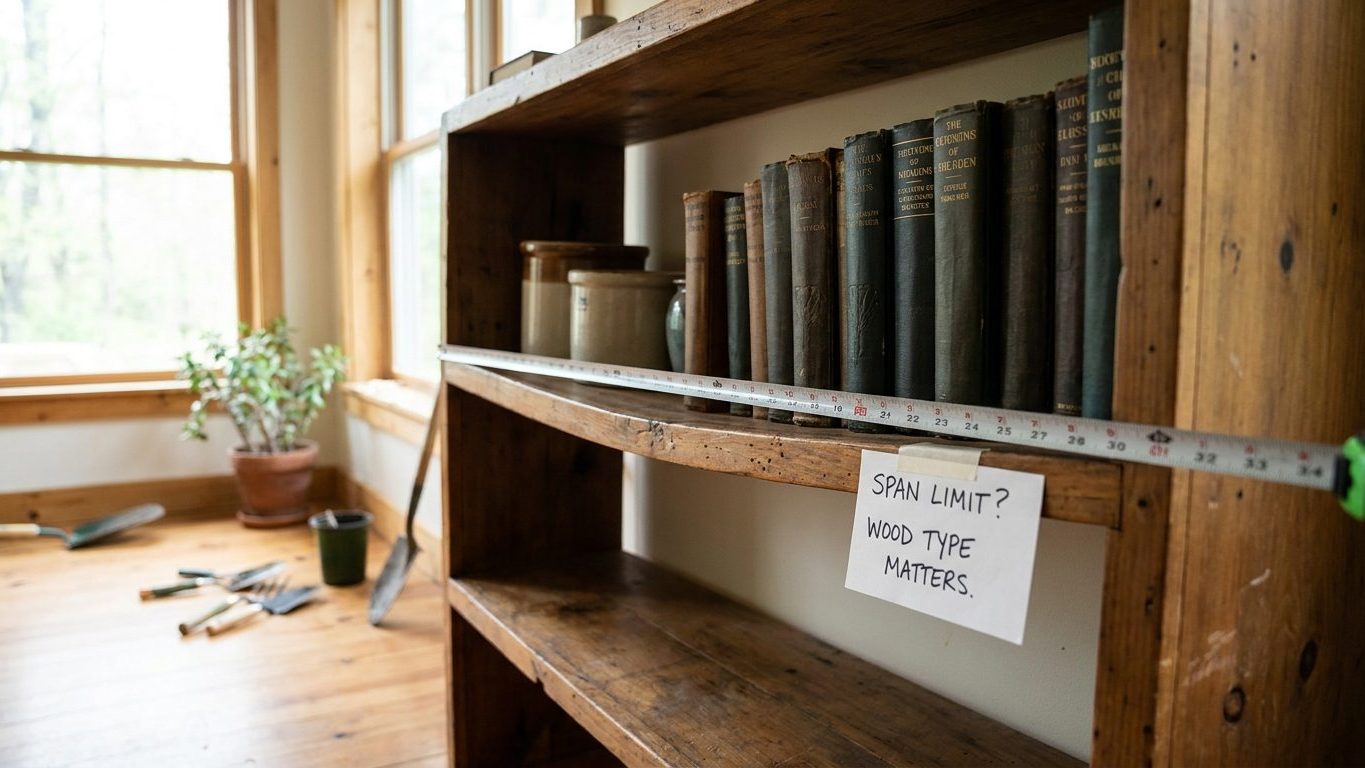

That plank across the alcove that dips in the middle, the one where the paperbacks have started sliding toward the center on their own, sagged because it was asked to span further than its thickness could carry, and wood under sustained load like that does not spring back flat once you unload it. Pull everything off the shelf and measure the actual distance between its supports against its thickness before deciding whether to shorten the span, thicken the material, or add a support underneath.
What is actually going on

A shelf bends because the load pulls the middle down while the two ends stay pinned at the brackets or the wall. The amount it bends for a given load does not rise gently as the span grows. It rises very sharply, because bending deflection in a beam scales with roughly the cube of the unsupported span. That means a shelf that spans a third further than the one next to it does not sag a third more. It can sag several times more, for the exact same thickness, material and load. This is the single fact that makes shelf sag so easy to underestimate at the planning stage: a few extra inches of open wall look harmless until the shelf is loaded and the middle drops.
Thickness works the other way. Doubling a shelf’s thickness does far more for stiffness than doubling its width or its support count, because resistance to bending increases with roughly the cube of thickness too. A shelf that flexes visibly at three-quarter inch can become rock steady at an inch and a half, using the same span and the same brackets. This is why the cheap fix of “just add another bracket” only goes so far: it shortens the effective span between supports, which helps, but it does nothing about a shelf that is already too thin for the material it is made from.
Why some shelves keep sagging after the load comes off
Wood-based sheet materials, particularly particleboard and MDF, do not just deflect under load. They creep. Under a sustained load held for weeks or months, the fibers slowly give way even without the load ever increasing, and the shelf takes a permanent set. Remove the books and the shelf stays bowed. Solid hardwood and good plywood resist this far better because their fibers run continuously along the span rather than being pressed and glued in short strands. A shelf that has crept this way is not going to pull back flat on its own, whatever you take off it.
A shelf that fails is not always just a cosmetic problem. If the sag is severe enough to crack the material or to load the fixing at an angle it was never designed for, the whole assembly can let go. A loaded shelf that comes off the wall drops everything on it straight down, and a shelf full of books or crockery is genuinely heavy enough to hurt someone underneath it. Any fixing you are unsure about is a fixing to replace, not one to test by loading it further.
Doing it
The material decides how far a shelf can span before it needs a middle support, more than any other single choice you make. Solid hardwood and cabinet-grade plywood at a nominal three-quarter inch thickness are the stiffest common options and tolerate the longest unsupported runs. MDF of the same nominal thickness flexes noticeably more and creeps under sustained load. Particleboard and melamine-faced board, the material behind most flat-pack furniture, is the weakest of the four and shows sag fastest, especially with anything dense like books stacked spine-out.
| Material | Relative stiffness at equal thickness | Behavior under sustained load |
|---|---|---|
| Solid hardwood | Highest | Resists creep well |
| Cabinet-grade plywood | High | Resists creep well |
| MDF | Moderate | Creeps under long-term load |
| Particleboard or melamine | Lowest | Creeps fastest, sets permanently |
Two ways to stiffen a shelf that already sags
You have two real options once a shelf is up and bowing, and they solve different problems.
- Add a support under the middle of the span. A center bracket, an upright, or a cleat fixed to the wall below the sag effectively splits one long span into two shorter ones, and because deflection rises so steeply with span, cutting it in half does far more than it sounds like. Skip this and the shelf keeps sagging at the same rate regardless of what else you do to it.
- Stiffen the shelf itself with an edge. Fixing a batten or a solid nosing along the front edge, standing proud below the shelf, adds depth exactly where bending resistance matters most, similar to how a steel I-beam puts most of its material at the top and bottom rather than in the middle. Skip this and a shelf that looks thicker from the front is still flexing the same amount, because the added material was in the wrong place to help.
If you’re putting a new shelf up rather than rescuing an old one, deciding the span and the fixing type together is worth doing before you drill, and the fuller run-through of putting up a shelf on brackets covers how bracket spacing and shelf thickness need to be chosen together rather than one after the other.
What it looks like when it goes wrong
Not every visible fault means the same thing, and telling them apart decides whether you can fix what’s there or need to start over.
- A smooth bow along the whole length with no cracking is straightforward sag from an under-sized span. Cosmetic if the material hasn’t creeped permanently, correctable by adding a center support or reducing the span.
- A bow that stays after the shelf is emptied means the material has crept, most common in particleboard and MDF under long-term load. This does not reverse. The shelf needs replacing or shortening, not just unloading.
- Cracking or splitting at the shelf itself, often near a fixing point or a knot, is a structural failure rather than a cosmetic one. It will not improve and the shelf should come down.
- The shelf pulling away from the wall, or visible crumbling around a fixing, is a safety failure, separate from ordinary sag. The load can come down with it, and the fixing needs inspecting and very likely replacing, not tightening and hoping.
- One end noticeably lower than the other without any bow in the middle usually means uneven bracket height rather than a span problem, and is corrected by re-leveling the fixings.
The visual effect of a sagging run of shelves is also a proportion problem, not only a structural one. A shelf that dips pulls the eye down the wrong way in a room, in much the same way an undersized rug placed wrong throws off the balance of a seating area even when nothing about it is actually broken. Fixing the structural sag usually fixes the visual one at the same time.
What to settle first
Before any of the above, settle what the wall actually is. A stud or joist wall, solid masonry, and hollow drywall between studs all take a fixing differently, and the fixing you choose has to match the wall you actually have rather than the one you assumed. This is exactly the decision covered in how the wall decides the fixing, and it comes before span or material every time, because a perfectly stiff shelf on a poor fixing fails at the wall, not in the middle.
Check before you drill
Find out what’s inside the wall in the area you plan to fix into. Pipework and cable runs are common near switches, sockets and in kitchens and bathrooms, and a stud detector or a look at the wall from the other side can save a genuinely dangerous mistake.
Then ask whether the load actually belongs on that wall at all. A run of shelving meant to carry a lot of weight, especially books, needs a wall that can take a sustained load without the fixing slowly working loose, and that is not automatically true of every partition wall in a house. The only number that means anything for a given fixing is the one printed on its own packaging, tested for that specific wall type, and it is not something to guess at or scale up from a different job. Where the fixing feels at all uncertain, whether from the wall crumbling slightly on install or a screw that turned without real resistance, replace it before loading the shelf rather than testing it with a full load and seeing what happens.
Common questions
Can I fix a sagging shelf without taking it down?
Often yes, if the sag is straightforward deflection rather than permanent creep. Adding a center support underneath, fixed into the wall, usually stops further sag without removing the shelf at all. If the material has already taken a permanent set, though, no amount of extra support pulls it back flat.
Does making a shelf thicker fix the sag for good?
It helps a great deal, because stiffness rises steeply with thickness, but it only helps if the span stays the same. A thicker shelf hung across a longer run can still sag if the extra span outweighs the extra thickness, so the two need checking together rather than assuming thickness alone solves it.
Why is my melamine shelf sagging with almost nothing on it?
Melamine-faced particleboard is the weakest of the common shelf materials and creeps under load faster than plywood or solid wood. A shelf that’s been holding even a modest load for months can show sag that looks disproportionate to what’s on it, because the bending happened slowly over time rather than all at once.
How many brackets does a long shelf need?
More than you’d guess from looking at it, because sag rises so sharply with span. Rather than picking a bracket count by eye, work backward from the material’s stiffness at your chosen thickness and add supports until no unsupported section is long enough to show visible deflection under the load you actually plan to put on it.