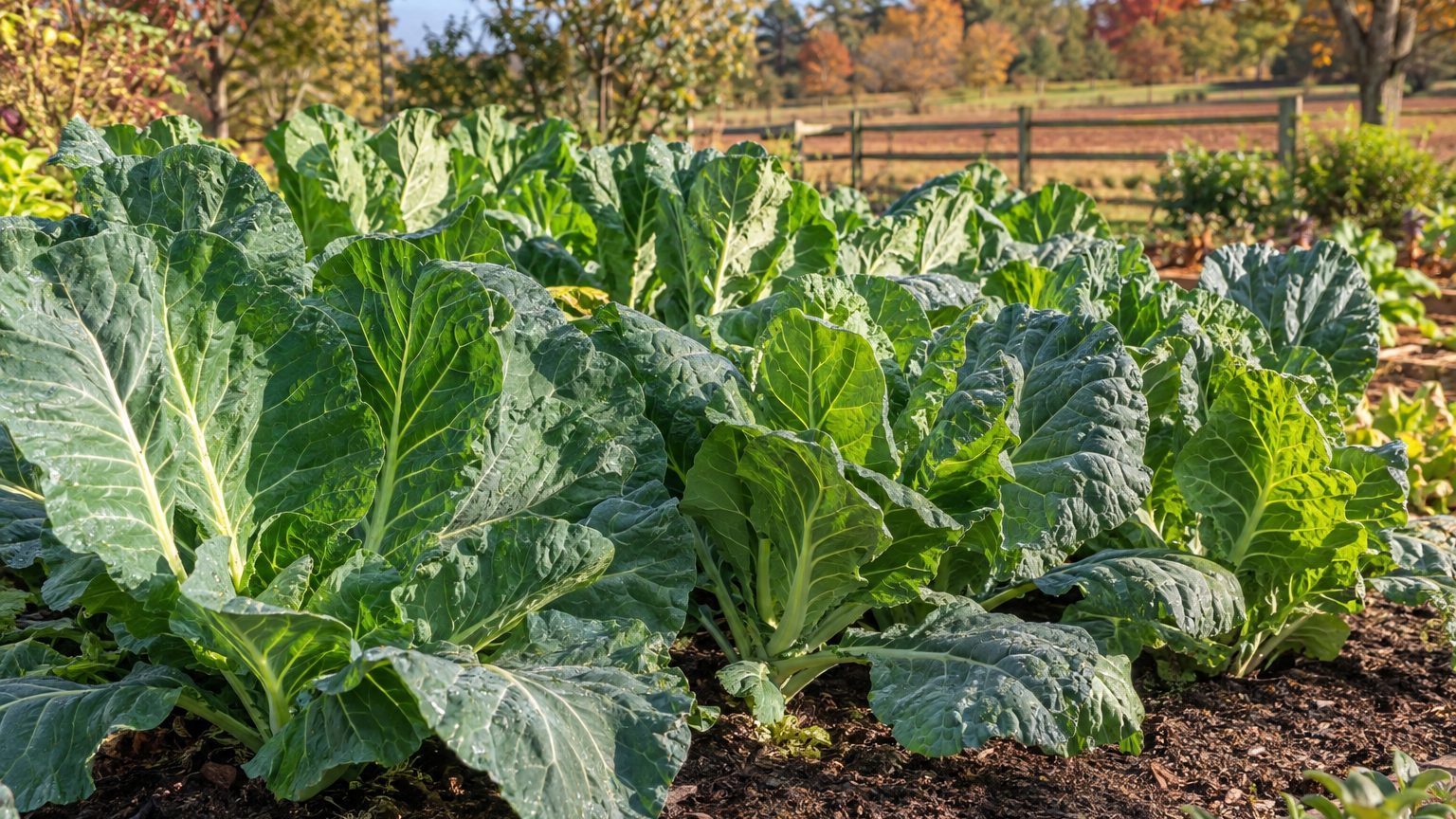

In Yukon, the best collards are compact, quick-maturing types started indoors. The best greens overall are the ones that shrug off frost: kale, chard, spinach, and mustard. Whitehorse averages only about 81 days between its last spring frost and its first fall frost, so the big long-season Southern types rarely finish. Below, varieties are sorted by type, the failures are named, and the answer is stretched across the territory.
The short answer for Yukon
Grow compact, early collards from transplants, and plant kale, chard, and spinach beside them as insurance. The arithmetic drives that decision. The Whitehorse A station, the one this page relies on, records a mean last spring frost of June 5 and a mean first fall frost of August 25. That leaves roughly 81 days between the two.
Both dates are means from Environment and Climate Change Canada’s 1981-2010 normals, not safe dates. In about half of all years the last spring frost lands after June 5, and in about half the fall frost arrives before August 25. Sister pages for US states use 1991-2020 normals, so the periods do not match exactly.
For a plant that likes a long, warm runway, 81 days is thin. A collard set out on the mean date still has to grow from seedling to a harvestable plant before the first hard frost. Type therefore matters more than any brand name on a seed packet. This page has no Yukon variety trial data, so the table below reasons from plant type and season length, not from local trial results.
| Type | Examples | Fit for Yukon |
|---|---|---|
| Compact, non-heading collards | Vates-type varieties | Best bet. Smaller plants, good cold tolerance, and you can harvest leaves young. |
| Loose-heading collards | Morris Heading | Worth a small trial in the warmest, most sheltered bed. Slower to finish. |
| Large Southern collards | Georgia Southern | Poor fit. Built for long seasons, and it will likely run out of summer. |
The greens that carry the garden
Kale is the natural partner. It generally tolerates cold better than collards and gives you leaves from a smaller plant. Chard, spinach, mustard greens, and tatsoi are quick enough to finish well inside an 81-day gap, and several can be sown more than once. If you want a Southern-style pot of greens, a mixed harvest of young collard, kale, and mustard leaves gets you there. Exact sowing dates live on When to Plant Collards in Yukon.
What will not work here
Direct-seeding collards outdoors is the first thing to drop. The mean last frost is June 5, and soil stays cold for a while after the air turns friendly. Seeds sown into it sit, or germinate unevenly, and you burn days you do not have. Indoor-started transplants skip that stall.
Big Southern varieties come next. Guides written for Georgia or the Carolinas assume months of warm growing weather. Here, a plant of that type is still adding leaf when the frost that ends the season arrives. You end up with a tall, spindly stalk and a modest harvest, which is a poor trade for the bed space. Our fuller how-to, Growing Collards in Yukon, covers the growing side.
Planting on the mean date and trusting it is the quietest mistake. June 5 is a midpoint. In roughly half of years a frost still comes after it, and tender transplants that were not hardened off can be lost overnight. Collards handle light frost well once they are established, but a small, soft seedling that just left the windowsill is a different animal.
Counting on late fall is the last trap. Because the mean first fall frost is August 25, any variety that needs September or October to size up is a gamble. Half of years, the frost comes earlier than that date, and you have no cushion.
The winter question
Southern advice often says to leave collards standing all winter and pick them in January. That does not translate. The mean daily minimum of Whitehorse’s coldest month is -19.2 °C (-2.6 °F), and that is an average of nightly lows, so real nights run colder. The territory sits in Canadian hardiness zone 1b at the Whitehorse reference point. Plan on collards as an annual, harvested before the ground freezes, and do not count on any overwintering.
What changes across Yukon
Yukon is not one garden. The only hardiness figure this page has is for the reference city, Whitehorse, which sits in Canada’s zone 1b. That is the Canadian system from Natural Resources Canada, not a USDA zone, and the two do not convert. Natural Resources Canada itself says there are no simple conversions: Canadian zone 4a, for example, overlaps nine USDA zones, from 3a to 7a. The Canadian system uses seven climate variables, and USDA uses one.
The page does not have zone figures for other Yukon communities, so it cannot give you a spread. The honest answer is that there is no single one for the territory. Northern and upland districts run weeks behind Whitehorse, and elevation and slope can shift a garden’s season within a few kilometers.
If you garden north of Whitehorse or at altitude, shift toward the fastest options. Lean harder on kale, chard, spinach, and mustard, treat collards as a small experiment, and set larger, well-hardened transplants out later than you would in Whitehorse. Expect the fall frost sooner and give yourself margin at both ends.
Do not guess your zone from a neighbor’s or from a US map. Open the Canada plant hardiness map from Natural Resources Canada and look up your own community. Read the zone there, and remember it describes winter survival, not how many summer days you get.
Where to check this for your own county
Yukon has no counties, so the local unit is your community or district. The principle is the same one American gardeners follow with a county extension office: a local recommendation beats a territorial one, and this page is the territorial one. It is built from a single Whitehorse station.
The government address this page can vouch for is Agriculture and Agri-Food Canada at agriculture.canada.ca/en. The territorial department’s own site refused our automated checks, so the federal site is given instead. A working link beats one we could not confirm. From there you can find your way to territorial agriculture contacts.
When you reach a local source, ask for two things: the local planting calendar and the varieties trialled near you. A calendar built for your community will beat any date on this page. A list of what has actually been grown in nearby soil is worth more than our type-based reasoning. Local garden clubs and community greenhouses are also worth a question, since somebody nearby has likely already run the experiment.
Note that the address above is a starting point, not a Yukon-specific collard calendar. This page does not have one and will not pretend otherwise.
Checking this against your own garden
Your own observations outrank every date here. Three are worth watching.
First, feel the soil. Grab a handful a few inches down. If it is cold, clammy, and clumps into a wet lump, transplants will stall. Compare a sunny south-facing bed with a shaded corner and a low spot. Cold pools in hollows, and the difference can be days. That tells you which bed to plant first and which to leave for kale.
Second, watch your seedlings. The first true leaves are the ones that appear after the initial seed leaves. Once seedlings have a couple of true leaves, they are ready to start hardening off. How fast they get there under your window tells you how much light and warmth your setup provides, and whether to start earlier next year.
Third, keep a frost diary. Write the dates down for the last frost that damages anything in your garden in spring and the first one in fall. Compare them with June 5 and August 25. If your frost keeps landing a week or two off, you have found your own microclimate, and you can plant by your record instead of by Whitehorse’s.
Common questions
Can collards survive a Yukon winter outdoors?
Not reliably. The mean daily minimum of the coldest month at Whitehorse is -19.2 °C (-2.6 °F), and the hardiness zone is 1b in the Canadian system. Treat collards as annuals and harvest before hard freeze.
Is kale a better choice than collards in Yukon?
For reliability, usually yes. Kale generally handles cold better and gives usable leaves from a smaller plant. Growing both lets you compare in your own bed.
Should I direct-seed collards?
Transplants are the safer choice. With a mean last frost of June 5 and about 81 days to the mean first fall frost, starting seeds indoors saves the time cold soil would waste.
Are June 5 and August 25 safe dates?
No. They are mean dates from 1981-2010 at the Whitehorse A station. Frost can come after the first in about half of years and before the second in about half. Your community may run weeks behind.