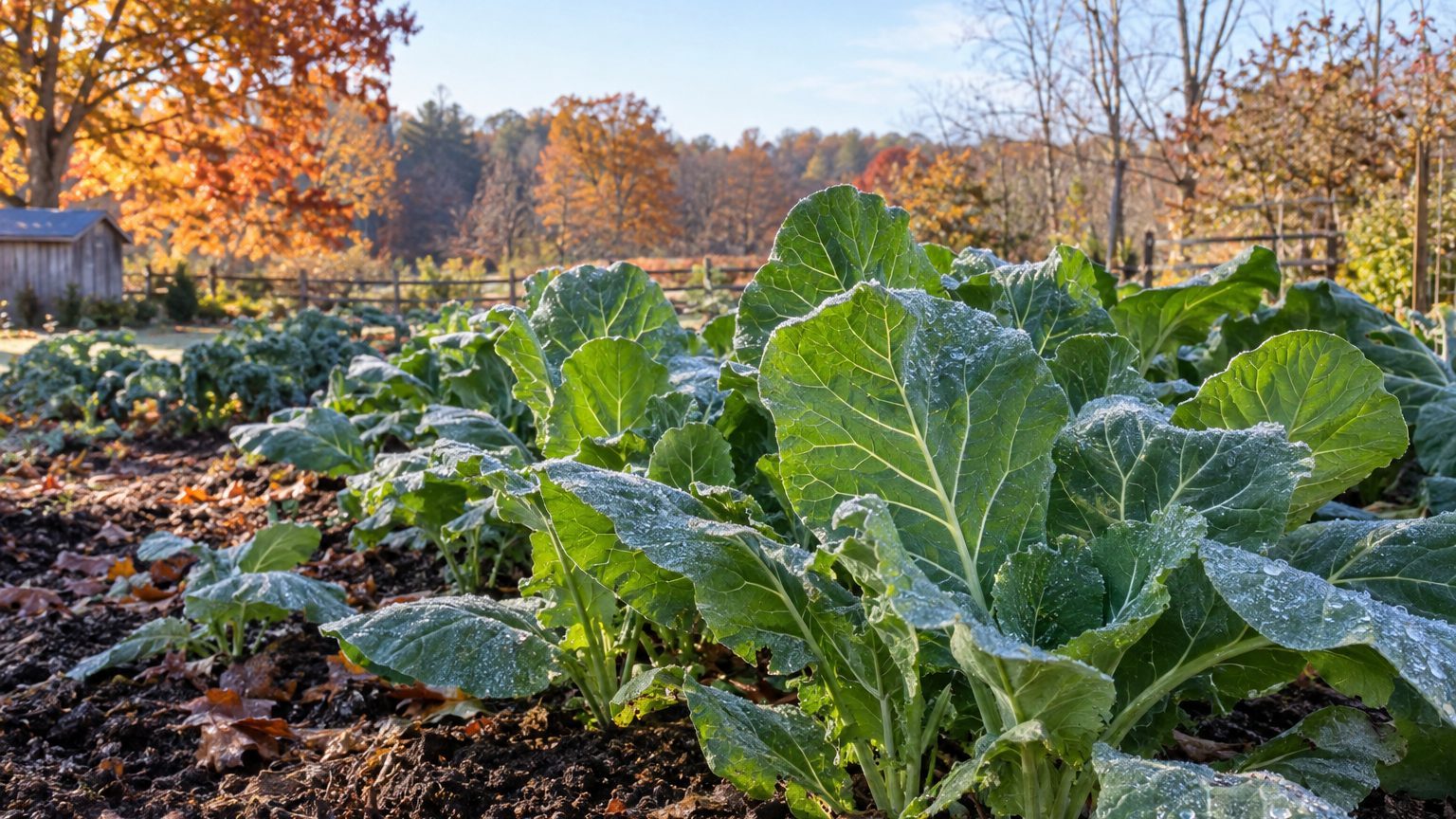

Start collards indoors and set the transplants outside on or after June 5, the average last spring frost at Whitehorse A. Direct seeding leaves too little season. The average first fall frost lands on August 25, so the growing window is short, and any plan that ignores it ends up with tough, stunted plants and a garden full of good intentions.
The short answer for Yukon
The frost-free window at the Whitehorse station runs June 5 to August 25, which is 81 days between two average dates. Collards go in as transplants once June 5 has passed, and the seed gets started indoors beforehand. Sowing outdoors that same week wastes the first stretch of the season on germination.
What the two dates actually measure
Both figures come from Environment and Climate Change Canada’s Canadian Climate Normals for 1981-2010, station WHITEHORSE A. They are mean dates, not safety dates. In one year out of two, the last spring frost falls later than June 5. In one year out of two, the first fall frost arrives before August 25. Think of each date as the midpoint of a window, with the edges reaching weeks either way.
Two more cautions. This is one station, and northern or upland districts of Yukon run weeks behind it. And the Canadian normals cover 1981-2010, while the US figures elsewhere on this site cover 1991-2020, so the numbers don’t line up neatly across the border.
Turning the window into a sowing calendar
Work backward from the transplant date. Find the days to maturity on your seed packet, and treat the transplant date as day one of that count, since a seedling raised indoors arrives in the garden with a head start. Then sow seed indoors far enough ahead that the plants are sturdy and hardened off by early June. Collards tolerate light frost better than most vegetables, so a cool night after transplanting is less of a threat than a hard freeze, but a cover on hand is cheap insurance.
This page does not have a Yukon-specific trial date for collards, so the calendar above is built from the frost normals alone. For the growing side of the story, see Growing Collards in Yukon.
What will not work here
Direct seeding in open ground is the first casualty. Seed sown outdoors in early June starts its clock from zero, and it has roughly 81 days before the average first frost. Collards are a leafy crop, so a small plant is a small harvest. The same seed started indoors is already a working plant on transplant day.
Slow varieties lose the arithmetic
The slowest, largest collards were bred for long Southern seasons. Take a variety’s days to maturity, add germination time and a week or so for transplant recovery, and compare the total to the window. If it doesn’t fit, the plant is still small when autumn frost ends growth. Before buying, hold any packet to a simple test: any collard needing more than 81 days from transplant is a gamble here. The faster types are covered in The Best Collards and Greens for Yukon.
Half of all years, the frost also arrives before August 25. A plan that needs every day of the window, with no slack at the end, fails in about half of seasons by definition.
Planting on June 5 and hoping
Putting transplants out on the average last frost date means that in one year out of two, a frost still lies ahead. Young, unhardened plants take more damage from that than established ones. Waiting a few days, or planting on June 5 with a cover ready, costs little. Losing a tray of transplants and restarting costs weeks, and weeks are the one thing this season does not have.
Counting on winter survival
The mean daily minimum of the coldest month at Whitehorse is -19.2 °C (-2.6 °F, for readers comparing with US stations). This page has no trial showing collards standing through that. Plan them as a one-season crop, harvested before winter, and treat any plant that returns in spring as a bonus rather than a plan.
Southern gardeners sometimes wait for frost to sweeten the leaves. In Yukon, the sweetening frost and the end of growth arrive close together. Harvest steadily from midsummer instead of holding everything for one big autumn picking.
What changes across Yukon
Yukon is not one garden. The reference city for this page, Whitehorse, sits in hardiness zone 1b in the Canadian system, from Natural Resources Canada’s Plant Hardiness Site (1991-2020 normals). That is a Canadian zone, not a USDA zone. The Canadian system is built on seven climate variables, the USDA system on one, and NRCan itself says there are no simple conversions: Canadian zone 4a overlaps nine USDA zones, from 3a to 7a.
The zone belongs to the reference city, not to the territory. This page does not have the spread across all of Yukon, so there is no single answer to give. What the frost fact does say is that northern and upland districts run weeks behind Whitehorse. A garden at altitude or in the north loses time at both ends of the season, and it has little time to give up.
A reader in those districts should shift three things. Move the transplant date later than June 5, and expect the first fall frost earlier than August 25. Choose the fastest-maturing greens over the biggest ones. And plan for shelter, because a south-facing wall, a windbreak or a low tunnel can add days that no calendar will.
Nobody can tell you your zone from a distance. Natural Resources Canada publishes a map with a lookup by municipality at Canada’s Plant Hardiness Site. Look up your own community there, and remember it describes long-term climate, not the cold pocket at the bottom of your yard.
Where to check this for your own county
A recommendation written for your own locality beats one written for a whole territory, and this page is the territorial one, built on a single station. For a local planting calendar and for the varieties actually trialled near you, go to the source. The address the facts give is the federal department, agriculture.canada.ca/en. The territorial department’s own site refuses automated checks, so it isn’t given here, since a link that works is better than one we cannot prove.
Once you’re there, look for two things. First, ask for the last and first frost dates for your own community, not for Whitehorse. Second, look for any variety trials or growing guides for leafy brassicas in your region. Collards belong to that family, and a result for kale or similar greens near you tells you more than a Southern seed catalog does.
The page does not have a Yukon collard trial to point to, and it will not pretend otherwise. If the local answer and this page disagree, believe the local answer. It rests on measurements taken closer to your soil, and the difference can be a week or more in either direction.
Checking this against your own garden
Your own observations outrank every date above. Three are worth watching, and none needs an instrument.
- Soil warmth by feel. Push your hand into the bed. If the soil feels cold and clammy, roots will sulk, so wait. Where it warms first tells you which corner of the yard is your early microclimate.
- The first true leaves on your seedlings. The first pair are seed leaves. When the next set appears, the plant is establishing itself, and how fast that happens indoors tells you whether your setup is giving enough light and warmth.
- Where frost whitens the ground first in autumn, and where it lingers in spring. The spots that stay green longest are your warmest pockets, and the spots that frost first are where you plant the hardiest crops.
Write down the date of the last frost in your own yard each spring, and the first in fall. A few years of those notes will tell you more than a station’s normals from 1981-2010, a period that ended more than a decade ago.
Common questions
Can I sow collards directly in the garden in Yukon?
It is a poor bet. Between the average last spring frost on June 5 and the average first fall frost on August 25 there are 81 days, and seed sown outdoors uses part of that just to grow to transplant size. Starting seed indoors is the safer route.
Is June 5 a safe date to transplant?
No. It is the average last spring frost at Whitehorse A, so in one year out of two the last frost comes later. Treat it as the middle of a window, keep a cover handy, and add time if you garden in the north or at altitude.
Is zone 1b the same as a USDA zone?
No. Zone 1b is from the Canadian hardiness system, which uses seven climate variables, and it does not convert to a USDA zone. It also belongs to Whitehorse as the reference city, not to all of Yukon.
Will collards come back after winter?
This page has no trial showing that. The mean daily minimum of the coldest month at Whitehorse is -19.2 °C, so plan collards as a one-season crop and harvest before winter.