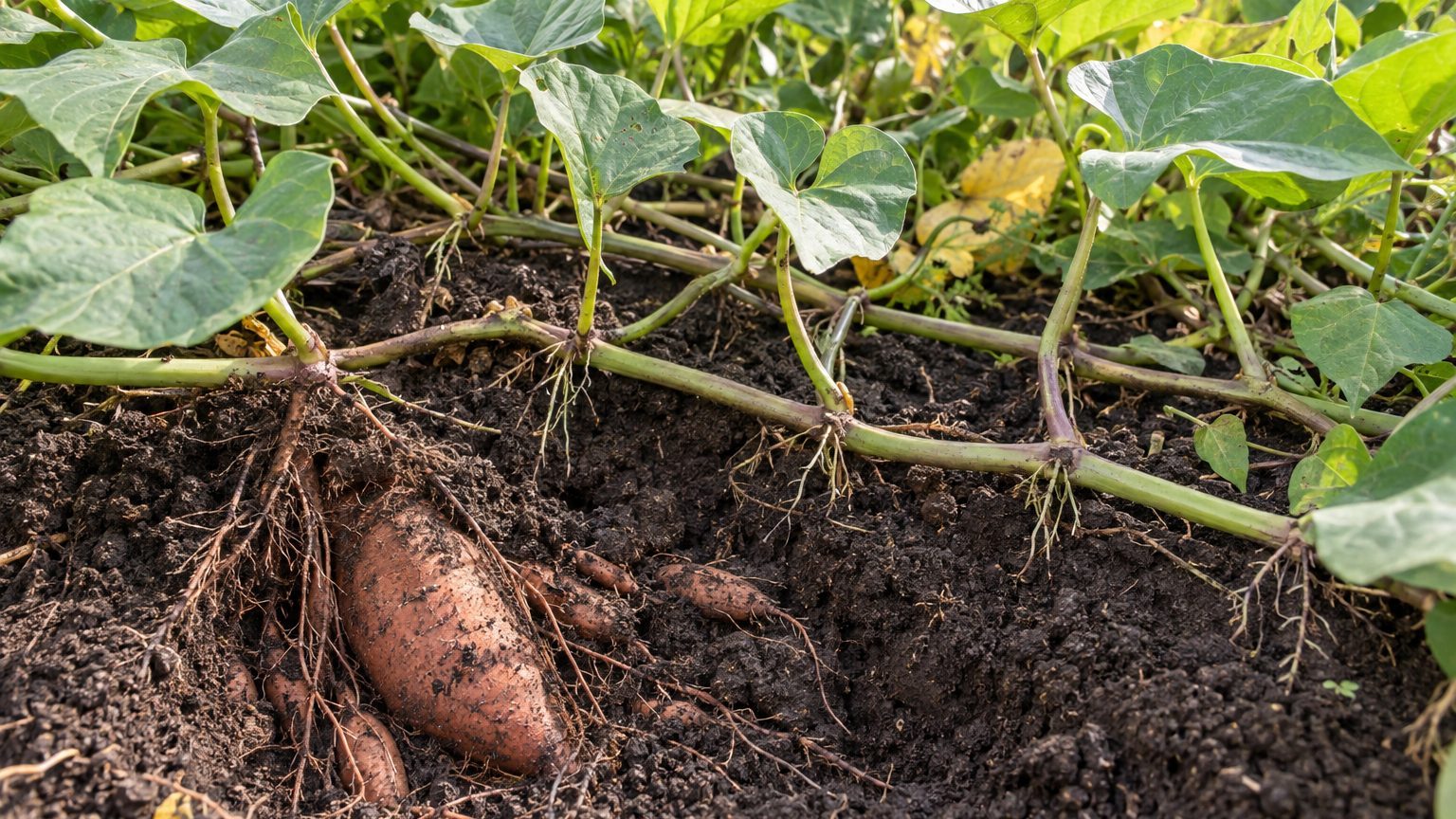

Leave most of them. The vines are the plant’s solar panels, and cutting them back costs the roots underneath. The one job worth doing is keeping stems from anchoring themselves in the soil, and only where that is a real problem in your bed. Lifting is light tidying. Pruning helps nothing. How much any of it matters depends on how far your vines run and how wet your summer is.
What is actually going on
The thing to understand is adventitious rooting. Wherever a node on a stem sits in contact with moist soil, it can send out roots of its own. Those new roots feed from the same leaves as the original plant, so the vine ends up dividing a fixed supply of sugar among more places to store it.
That is the whole reason anyone bothers with vines. The main storage roots form at the buried base of the planted slip. Stem roots at distant nodes may stay thin and stringy, or they may swell into small roots of their own. Either way they draw on the same pool. A hill with a few well-fed roots can turn into a hill with a crowd of undersized ones, and a scatter of small roots strung along the vines is easy to miss at digging time.
Leaf area is the other half of the picture. Sugar comes from the leaves and travels down to the roots, so anything that removes a lot of foliage removes the source. Adventitious rooting takes energy from the plant, and heavy pruning takes away the way the plant makes it. That is why lifting can be worth a look and pruning almost never is.
A quick clarification, because the grocery store muddies it. A sweet potato is not a yam and not a potato. It is a relative of morning glory (the flowers give it away), not a nightshade, and it does not share rotation rules with potatoes or tomatoes. If you want the details, What Sweet Potatoes Rotate With covers them. For the whole season from slips to cure, start with Growing Sweet Potatoes: Slips, Heat, and a Careful Cure.
Two things change how much rooting you get. Type is one: long, sprawling vining types cover ground and root at many nodes, while compact or bush types stay near the hill and give you little to manage. Your state extension service can tell you which varieties have been trialled where you live, so ask there instead of guessing. Soil contact is the other. Loose, moist ground and organic mulch invite rooting, while firm, dry soil or a barrier such as plastic mulch discourages it.
If you grow sweet potatoes partly for the leaves, the calculation changes. The tips and young leaves are edible greens, and taking a modest handful from the ends of long vines leaves most of the foliage in place.
In the garden
Most decisions come down to timing and how much you disturb. This table pairs each situation with what to do and what goes wrong if you get it backward.
| Situation | What to do | What goes wrong if you don’t |
|---|---|---|
| Midseason, stems rooting into mulch or loose soil | Lift the rooted stems gently and lay them back on top of the ground, without pulling hard on the hill | Left alone, side roots build up and split the sugar supply. Yanked hard, the stem tears and you can damage feeder roots near the main plant |
| Vines running into paths or lawn | Turn the ends back toward the bed and pin them in place | Cut hard, you lose leaf area and the plant spends energy regrowing instead of filling roots |
| Wet, humid stretch with a dense canopy | Open a few gaps in the canopy by shifting stems, so air moves through | A thick, damp mat stays wet, encourages rooting at every node and gives disease a comfortable home |
| A few weeks before digging | Stop lifting and stop fussing; let the leaves work | Late disturbance means damaged stems and stress just as the roots are bulking up |
| Frost in the forecast or vines blackened by it | Cut the vines, then dig promptly on a dry day | Blackened vines can carry decay toward the roots, and roots left in cold, wet soil can suffer chilling injury that shows up in storage |
A few notes on the table. Lifting is a low-stakes job: a walk through the bed every couple of weeks, moving stems that have set down roots, is plenty. Skip it if the vines are staying put, which is common with compact types or in a cool summer. The goal is to break the contact between node and soil, so setting a stem back on the surface does the job without ripping anything.
Cutting the vines a day or two before harvest makes the hills easy to find and dig around, and it clears the tangle. Handle the roots gently when you dig, since the skin is thin and scrapes are entry points for rot.
Storage comes up here because the mistakes stack. Cure the roots in warmth and humidity as described in the main guide, and never put sweet potatoes in a refrigerator or a cold cellar. Cold injury below the storage range is real and irreversible, and it is one of the most common ways a good crop is ruined after harvest. Before you store any root, look it over. A soft patch or a weeping spot ends the question, and that root should be eaten right away or discarded. A root that looks sound is not a guarantee, so keep checking.
What it depends on where you are
Two parts of this page travel everywhere. The mechanism is national: nodes root on contact with moist soil, and rooting draws from the same leaves. So is the rule about pruning, since leaves make the sugar that fills the roots. Frost blackens vines the same way in every state.
The rest is local, and this page cannot see your garden. Season length changes how much time the vines have to sprawl. In a long, hot summer they can run many feet and root at nearly every node, and lifting becomes a recurring chore. In a short or cool one they may stay modest, and lifting can be a waste of your time.
Summer heat and summer rain matter next. A wet summer keeps the soil surface moist, which is what nodes need to root, and it keeps the canopy damp too. A dry summer or a bed on drip irrigation gives nodes less encouragement. Soil texture plays in as well, because loose, sandy ground lets stems settle in easily while heavy, crusty clay can shed them. Your watering routine adds to this, and Watering Sweet Potatoes: Steady, Then Dry explains how to ease off late in the season.
For frost timing and digging windows, use the state pages in this guide as a starting point, then check with your own state’s cooperative extension service. It can tell you which types have been trialled nearby, how local growers handle vines, and when frost tends to arrive. If your garden’s conditions differ from the state average (a low spot, a warm south wall, a raised bed), trust what you see in your own beds over any general schedule.
The mistake that costs the most
Cutting the vines back hard in the middle of the season because they look out of control. It feels responsible, like trimming a hedge. It is the one move that reliably works against you.
The reasoning follows from the mechanism. The vines and leaves are how the plant earns the sugar that swells the roots. Take off a big share of that foliage in midsummer and you cut the income, and the plant answers by putting energy into new shoots and leaves to replace what you removed. The roots wait. A vine that has been sheared can look neater and produce less, and you will not see the cost until you dig.
The urge is understandable. Long stems cross the path, climb into neighboring beds and cover the tomatoes. But every one of those problems has a gentler fix. Turn the ends back toward the bed. Pin them with a bent piece of wire or a landscape staple. If the vines are truly invading another crop, trim only the outermost tips, and eat the greens rather than composting them. Give the bed more room the next time you plant it, since spacing is easier to fix in spring than in August.
If you have already cut hard, do not panic. The plant will grow leaves back if the season has time left. Stop pruning, keep watering steadily, and leave the remaining foliage alone until it is time to cut before harvest. A late-season cut before digging is a different act altogether. By then the roots are made, and the vines have finished most of their work.
Common questions
Can I eat sweet potato leaves?
Yes, the young leaves and tender tips are edible greens. Pick modestly from the ends of long vines and leave most of the foliage, since the leaves are feeding the roots.
Should I cut the vines before harvest?
Cutting a day or two ahead makes the hills easier to locate and dig around. Do it near harvest time, not weeks earlier, and dig gently so you do not scrape the skins.
Does growing vines on a trellis solve rooting?
It reduces node contact with the soil, which is the point. Sweet potato vines can get heavy, so the support needs to be sturdy, and the vertical canopy needs airflow. Plenty of gardeners simply lift stems instead.
What if frost hits the vines before I harvest?
Cut the blackened vines and dig soon, on a dry day. Cure the roots warm as described in the main guide, and keep them out of the refrigerator and any cold cellar, because cold injury can’t be undone. Inspect every root, and discard any with a soft patch or a weeping spot.