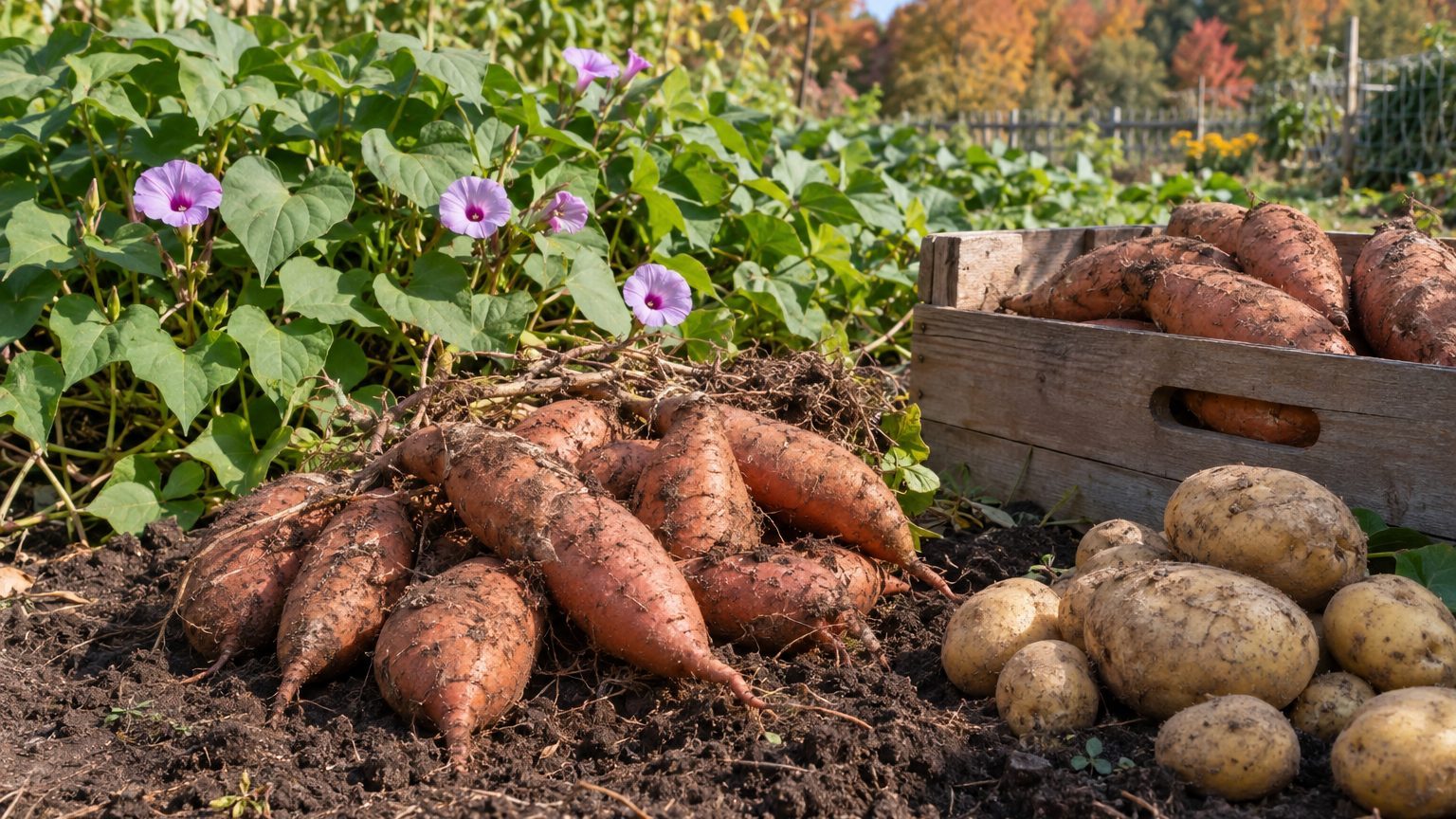

Sweet potatoes start from rooted cuttings called slips, not from a tuber. They want a long run of warm soil and warm nights, then about a week of curing in warmth and humidity before they go into storage. Miss the season and you get thin roots. Skip the cure and you get bland ones. Store them cold and you lose the crop. How hard that is depends on your state.
A sweet potato is not a potato
Plenty of gardeners assume the sweet potato is just a potato with a sweet tooth. That guess changes real decisions. A sweet potato belongs to the morning-glory family, and the flowers on a healthy vine show the kinship if you know where to look. Potatoes, tomatoes, peppers and eggplant are nightshades, a separate family entirely. So the two crops share no diseases, no rotation logic and no planting method.
One more correction, said once: the “yam” on many American supermarket labels is a sweet potato, usually one of the moist, deep orange types. A true yam is a different plant from the tropics, and it is not what you are growing in a backyard bed.
| Feature | Sweet potato | Potato |
|---|---|---|
| Family | Morning glory | Nightshade |
| How it is planted | Rooted cuttings (slips) set out in warm soil | Seed potatoes, cut pieces of tuber, planted in cool soil |
| What it rotates with | Crops outside the morning-glory family, with a multi-year gap before the same bed is used again | Kept apart from tomatoes, peppers and eggplant |
| How it is stored | Cured warm first, then kept at moderate room temperature, never cold | Cool and dark |
Where slips come from
A slip is a leafy shoot that sprouts from a mature sweet potato root. Nurseries and mail-order suppliers sell them in spring, and you can also sprout your own by bedding a root in warm, damp medium until shoots grow several inches long. The rule to write down: plant slips, not tubers. Burying a whole root in the garden gets you a tangle of small, crowded roots at best.
Certified slips are the cleaner choice. Roots from the produce aisle are often treated to resist sprouting and can carry disease into your soil, and some Southern states restrict how plants and roots move because of sweet potato weevil. Buy from a source your state approves.
Disease management here is mostly a set of habits, not a spray schedule. Start with clean slips. Cut them from the sprouting root above the soil line instead of pulling them up with the root attached. Give each bed a long break before sweet potatoes return, and don’t follow them with another morning-glory relative.
Variety choice comes down to types. Some are moist and orange-fleshed, others drier with pale flesh. Some sprawl for many feet, and others stay compact enough for a small bed. Which ones have been trialled in your area is a question for your state cooperative extension service, and its answer beats any national list.
The season it needs, and what happens without it
Sweet potatoes come from the tropics, and they behave like it. When the soil is cool, the plant sits there. It doesn’t sulk gracefully or grow slowly. It just stops.
What a short season produces
Give the plant too little warmth and it puts its energy into vines while the roots stay thin, sometimes pencil-thin and stringy. They are edible but disappointing, and nobody wants to spend a summer watering a bed for a handful of them. A frost that blackens the vines ends whatever bulking was left, which is why the count from planting day to your first fall frost matters more than any label on a slip tray.
Night temperature deserves as much attention as the daytime high, and most gardeners only watch the day. A stretch of 85°F afternoons followed by nights in the low 50s never lets the soil hold its heat, and roots bulk up slowly in those conditions. A cheap soil thermometer and a min/max thermometer on the porch tell you more than the calendar does. Set slips out only once the soil at 4 inches is 65°F or warmer and nights stay above 55°F, and keep them covered if a cold snap is forecast after transplanting.
What changes the outcome
Gardeners in cooler places have several levers, and they stack:
- Choose types bred to size up in a shorter season, and ask your extension office which ones have done well locally.
- Lay black plastic over the bed a couple of weeks before planting so the soil warms a few degrees, then cut holes and plant the slips through it.
- Add low tunnels or row cover in the first weeks, and vent them on hot afternoons so the plants don’t cook.
- Build ridges or raised beds, which drain and warm faster than flat ground.
- Pick the most sheltered spot you have, such as a south-facing wall or a bed shielded from wind.
None of these turns a cold climate into a warm one. They buy you a few degrees and a few weeks, and sometimes that is exactly the difference between thin roots and a real harvest. Your state’s extension page will say how many gardeners in your region pull it off and by what method.
Curing is what makes them sweet
Dig a sweet potato and taste it that afternoon, and it will be starchy, a little dull, nothing like the roots you know. The sweetness is built after harvest. During curing, starch converts to sugars and the skin heals over the small wounds from digging. It takes warmth and humidity, not a cellar. Three stages, three different conditions: harvest, cure, store.
Harvest
The skin is tender at this point, and bruises and cuts become entry points for rot. Dig on a dry day, working well out from the plant with a fork so you don’t spear the roots. Lift them gently, brush off loose soil with your hands and don’t wash them. Don’t leave them lying in the sun for long either, because sun scald damages them. Handle them roughly and they will let you know later.
Cure
The target is 80 to 85°F with 85 to 90 percent humidity for roughly a week. Commercial growers use dedicated rooms. At home, a warm room with the roots in loosely covered boxes and a pan of water or a humidifier nearby can approximate it. A garage in early fall is a poor stand-in, because nights can drop into the danger zone. Keep a thermometer with the roots.
Store
After curing, move the roots somewhere dark, ventilated and moderately warm, in the range of 55 to 60°F. This is where the crop is most often ruined. Sweet potatoes suffer cold injury below that range, and the damage is irreversible. That means never the refrigerator, never a cold cellar, and not an unheated garage in November either. Chilled roots can develop a hard core, off flavors and early decay, and the harm may not show until you cook one.
Check stored roots regularly. A soft patch or a weeping spot ends the question for that root: discard it rather than trimming around the spot, and check its neighbors. A root that looks sound isn’t proof it is fine, and I won’t give a keeping time because it varies with conditions, type and how the crop was handled.
Why the answer changes with where you garden
Few garden crops swing as widely from state to state. In the South, sweet potatoes are routine. Summers are long, soil warms early and nights stay mild. North Carolina leads the country in production, and Louisiana, Mississippi and California grow them commercially as well. A home gardener there mostly needs good slips, loose soil and a plan for curing.
Three zones, three levels of effort
Move north into the Midwest, Mid-Atlantic and parts of the Northeast, and it becomes a project. Black plastic, row cover, short-season types and a sheltered bed stop being optional extras and become the plan. Plenty of gardeners do it well, but the margin is thinner, and a cool summer shows up in the roots.
In the coldest zones, including high mountain valleys and much of Alaska, the season is generally too short and the nights too cool. There, I would spend the bed on something that likes the climate. If you are close to the line, your extension office will say whether local gardeners have made it work.
Where to look next
Start by learning your local frost timing: find your average first fall frost date and count back from it to see how much warm season you can honestly expect. Then check your state’s cooperative extension service for the types trialled in your area, the planting window and any restrictions on moving slips or roots. The state pages in this series cover the regional details.
Wherever you garden, the storage rule is the same: cure warm, store moderately warm, and never put sweet potatoes in the cold.
Common questions
Can I grow sweet potatoes from a grocery-store root?
You can sprout one, but the results are a gamble. Store roots are often treated to resist sprouting and may carry disease into your soil. Certified slips from a source approved in your state are the safer route, and they arrive ready to plant.
Do I rotate sweet potatoes with potatoes?
No, because they are unrelated and share no diseases. Rotate them away from the bed they used before, give the bed a multi-year break, and avoid following them with another morning-glory relative.
Can I refrigerate cured sweet potatoes?
No. Cold injury below the storage range is irreversible, and the refrigerator and a cold cellar are both too cold. Keep them dark, ventilated and at moderate room temperature, and discard any root with a soft patch or a weeping spot.
When do I dig?
Before frost, if you can. A light frost blackens the vines, and roots sitting in cold soil can suffer afterward. If the vines are hit, dig within a few days on a dry day, handle the roots gently and move straight to curing. Your extension service can tell you the local window.