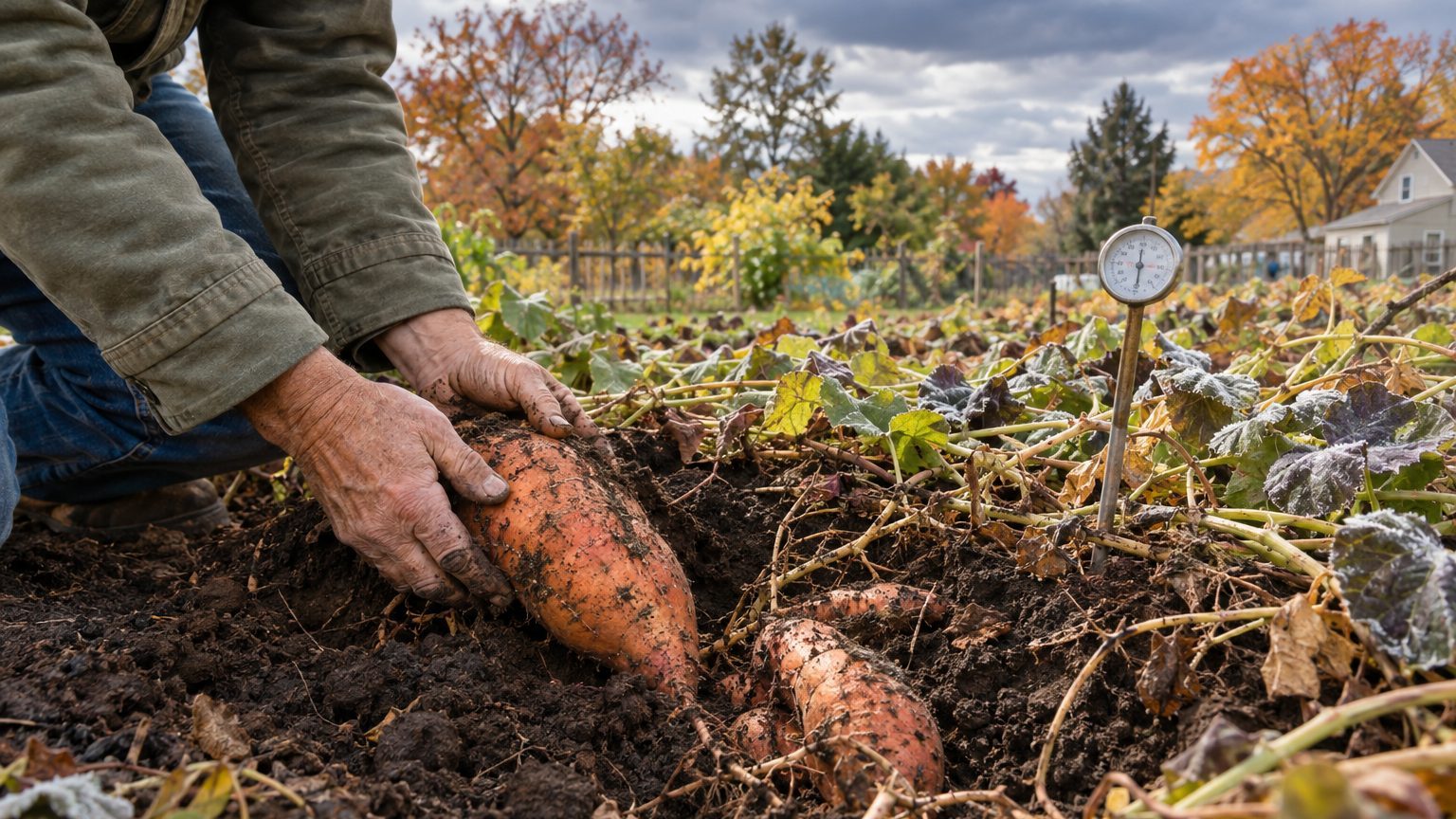

Sweet potatoes give no ripeness signal above ground. Harvest is set by the weather, not the plant: lift the roots before the soil turns cold, or promptly after a frost blackens the vines. Test-dig one hill as the season winds down, and let the forecast set your deadline.
What is actually going on
A potato plant dies back and tells you it’s finished. A sweet potato vine does nothing of the kind. It keeps growing and keeps feeding its roots until something stops it, and that something is cold. So you’re not waiting for a signal. You’re racing a deadline.
Two kinds of cold matter, and they work differently. The first is chill in the soil. Sweet potatoes are a tropical-origin crop, and the roots are hurt by prolonged cold ground even when no frost ever touches the leaves. Chilling injury shows up later as hard, off-tasting flesh and roots that rot in storage. You can’t see it on the day you dig, which is what makes it nasty.
The second is frost on the vines. A hard frost blackens the foliage, and from that moment a clock starts on what’s underneath. The damaged vine turns to mush, and decay can travel down the stem toward the crown and into the roots. Soil insulates, so a light frost that only scorches a few leaf tips is a warning rather than an emergency. A frost that collapses the whole vine is the emergency version.
This is why sweet potatoes are not managed like potatoes. Botanically they’re morning glory relatives, not nightshades, and they have nothing to do with the tubers in your potato bed. The supermarket habit of labeling orange-fleshed roots “yams” is wrong too, as Sweet Potatoes and Yams Are Not the Same Thing explains. Potato habits (wait for the tops to die, then dig) will steer you wrong here.
There’s another quirk. Fresh-dug roots are not at their sweetest. Much of the sweetness develops afterward, during curing, which is covered in Curing Sweet Potatoes: Where the Sweetness Comes From. So “ready” in the garden means only “big enough, and out before the cold does damage.” Roots keep sizing as long as the weather stays warm, which pulls you toward waiting. The cold pulls the other way. Your job is to find the point between them, and that point moves with your climate and your summer.
In the garden
Test-dig, then decide
Pick one hill on the edge of the bed, where losing a plant costs least. Loosen the soil a foot or more out from the crown so you don’t spear the roots, and lift gently. Look at size, and look at the skin. If the roots are a usable size, you have a harvest in hand. If they’re small and the forecast is mild, you can wait a bit, but only against a written-down weather deadline, not a hunch.
The table below walks through the sequence and what goes wrong at each step.
| Step | What to do | What happens when it goes wrong |
|---|---|---|
| Test-dig one hill | Dig a sample well away from the crown as the season winds down, and check size and skin. | Skip it and you’re guessing. You may dig a whole bed of pencil-thin roots, or leave good ones in cooling soil for no reason. |
| Watch the forecast | Plan the lift around the first frost forecast and around soil turning cold. | Miss it and chilled roots look fine on the day, then turn hard-cored or rot in storage. |
| After a vine-killing frost | Cut the dead vines off and dig soon, not weeks later. | Vine rot creeps toward the crown, and the roots nearest it spoil first. |
| Pick a dry spell | Lift when the soil is workable, not sodden. | Wet soil clings, roots are harder to clean without scuffing, and muddy roots start curing in poor shape. |
| Lift with a fork | Start well outside the hill, loosen, and lift the whole cluster from below. | A fork through the middle slices roots. Cut roots ooze and don’t heal into good storage roots. |
| Handle like eggs | Brush off loose soil by hand. Don’t wash, and don’t toss them into a bucket. | Skinned or bruised roots invite rot. Wet roots carry moisture into curing. |
Sort as you go
Set aside anything cut, gouged, or bruised and eat it first. Those roots are poor candidates for keeping. Don’t leave the freshly dug crop lying in the sun, because sun scald and drying hurt the skins, and get it into a place for curing without delay.
Inspect every root. A soft patch, a sunken spot, or anything weeping moisture ends the question for that root, no matter how good the rest of it looks. Sound-looking skin does not make a root safe or fit to keep. And when storage comes up, keep them out of the refrigerator and out of a cold cellar. Cold injury below the storage range is real and irreversible, and it’s the most common way a good harvest gets ruined afterward.
What it depends on where you are
Some of this is true everywhere. Roots are hurt by cold soil. A frost that kills the vines starts a clock. You can’t read ripeness off the leaves. There’s a test-dig, a careful lift, and a hard rule about handling. None of that changes at a state line.
What changes is the calendar, and this page doesn’t know yours. Season length decides how much time the plants get between planting out and the first cold snap. Summer heat matters because sweet potatoes want warm weather to bulk up, so a cool summer means smaller roots at the same point on the calendar. Summer rainfall matters too. A wet late season leaves soil heavy and cold, makes digging messier, and can crack roots that swell fast after a dry spell.
Two gardeners a few hundred miles apart can run the whole season on different clocks. One is worrying about a frost while the other still has weeks of growing weather. Anyone giving you a single national date is guessing.
So use the general rule as a frame and get the local numbers from people who track them. Your state’s cooperative extension service, run through your land-grant university, publishes local frost timing and knows which types of sweet potato have been trialled for your soil and season. That also settles the variety question better than any national list can. Ask what performs where you garden, and whether short-season types make sense for you.
Start with the state pages on this site for regional context, and read Growing Sweet Potatoes: Slips, Heat, and a Careful Cure for the full season, from slips to the cure. Then write down your own first-frost window from a local source and work backward from it. That date, not any figure on this page, is your deadline.
The mistake that costs the most
Waiting for the plant to tell you it’s done. It’s the potato habit carried over, and it’s the single error that costs gardeners the most.
The vines look great in autumn. They’re green, sprawling, still setting leaves. The gardener reasons that if the top is still growing, the roots are still gaining, and there’s no reason to dig. That logic holds right up until soil temperatures fall. Then the roots below are sitting in chilling ground, taking damage that shows nothing on the surface. By the time a frost blackens the vines, the harm may already be done, and the crop that looked fine at digging turns hard, bitter, or rotten weeks later in storage. It’s a slow disaster, and it looks like bad luck.
Instead, work from the cold, not the vine. Find your local frost expectations from your extension service. Test-dig a hill ahead of that window. If the roots are a usable size, plan the harvest for a dry day before the soil chills, or immediately after the first vine-killing frost if it arrives early. A slightly smaller root lifted in good condition beats a bigger one that spent a cold week in the ground.
Mark the date on the calendar, and let the forecast move it earlier, never later. Then treat the roots gently, cure them as described in the curing guide, and keep the finished crop out of the refrigerator and out of a cold cellar. The same cold that ruins roots in the ground ruins them on the shelf.
Common questions
Do yellowing leaves mean sweet potatoes are ready?
Not reliably. Yellowing can come from heat stress, poor drainage, pests, or plain age. It’s not a maturity signal the way dying tops are for potatoes. Test-dig a hill and check the roots directly.
Frost already killed my vines. Is the crop lost?
Often not, but don’t wait. Cut off the dead vines and dig soon, since rot can travel down from damaged stems to the crown. Inspect every root, eat the marginal ones first, and discard anything soft or weeping.
Can I dig early and just eat small roots?
Yes, roots are edible at a small size, and early digging is a fair way to learn what’s under the plants. Small roots dug and eaten right away are for the kitchen, not for keeping. Freshly dug roots also haven’t developed their full sweetness, which comes with curing.
Should I store the harvest in the refrigerator?
No. A refrigerator, like a cold cellar, is below the range sweet potatoes tolerate. Cold injury there is irreversible, and it can leave roots hard in the center or prone to decay. Cure them first, then keep them somewhere that stays comfortably above refrigerator temperatures, and check them regularly for soft or weeping spots.