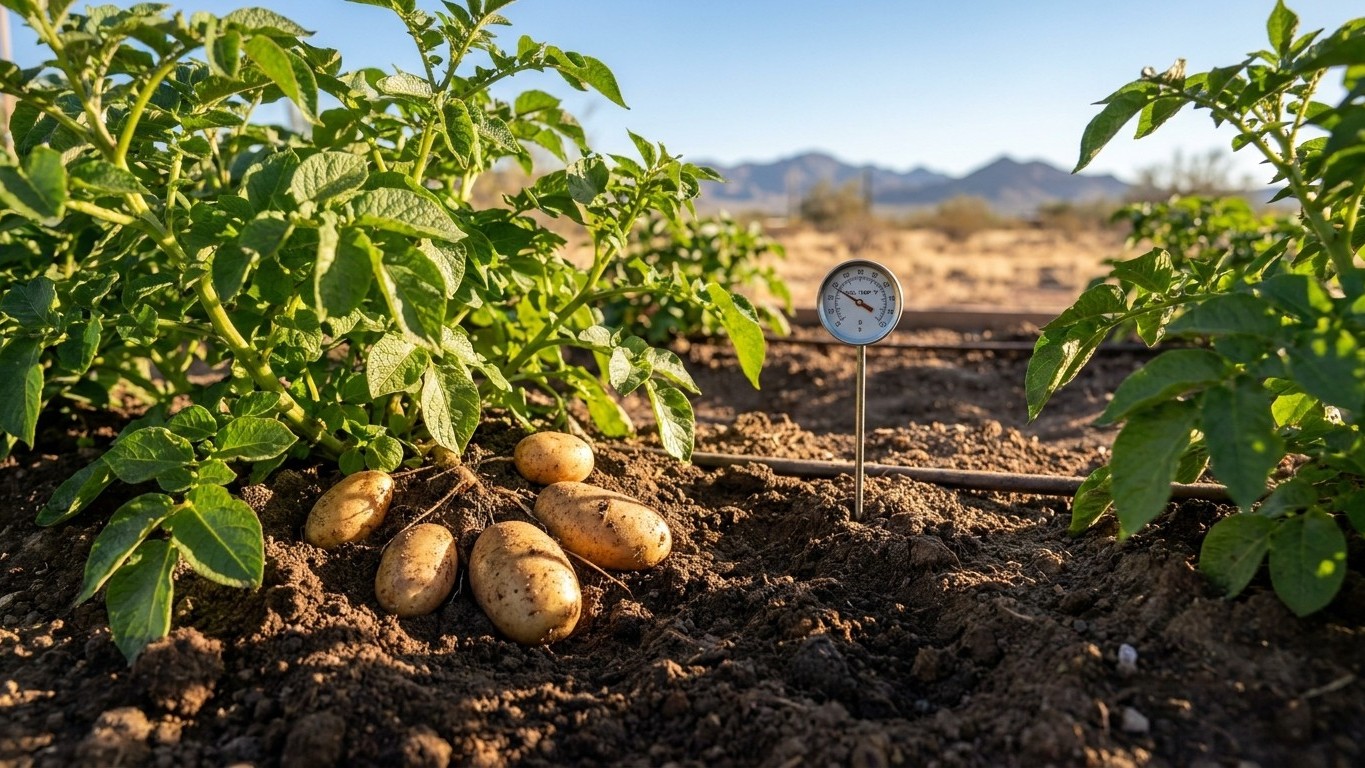

Sweet potatoes suit Kansas. Wichita gets plenty of summer heat, and the growing window is long enough for one full crop. The decisions that matter are when to set out the slips (rooted cuttings, not seed), how to keep water even through July, and how to handle the roots after digging. Get those three right and the rest is routine garden work.
When the soil is warm enough in Kansas
At the Wichita airport station, NOAA’s 1991-2020 Climate Normals put the last spring 32 F freeze between April 4 and April 18, the band where the probability of a freeze runs from 30 to 70 percent (NOAA NCEI data for station USW00003928). That is a probability, not a promise, and a late cold snap can still land after the band closes.
Treat the date as a proxy, though. Sweet potatoes are tropical in origin, and they do not care about the calendar. They wait for warm soil. Soil lags the air by weeks, so it warms after the frost risk ends, not with it. Slips set into cold ground sit and stall, and a stalled slip is a target for rot. Planting on the frost date gains you nothing.
Those figures also come from an airport, and airports run mild. Suburban and rural gardens often see the last frost one to two weeks later than the reference city, and more at elevation. Check your own county’s normals before you mark a calendar, and stick a soil thermometer into the bed rather than trusting the date alone. Your state extension office can tell you what soil reading counts as ready in your area.
Two habits make a cool spring less risky. Black plastic laid over the bed a couple of weeks ahead of planting warms the soil faster than bare dirt. And slips can wait, in a bright spot with their bases in water, until the ground is ready. Ridged or raised rows drain and warm quicker than flat beds, which matters on the heavier clay soils common in parts of the state.
A note on the name. The orange or purple-skinned root sold as a “yam” in most supermarkets is a sweet potato, and true yams are a different plant altogether. A sweet potato is not a potato, either. It is not a nightshade and belongs to the morning glory family, so it does not rotate with tomatoes or potatoes the way those crops rotate with each other.
For the general method, from slips to curing, the Growing Sweet Potatoes: Slips, Heat, and a Careful Cure guide covers the steps that apply everywhere. Which types have been trialled near you is a local question, and the place to ask it is the extension service, covered below.
How long the season lasts here
The same station gives the other end of the year. The first fall 32 F freeze falls between October 23 and November 2, on the same probability band. Count from the two ends of the bands and the frost-free stretch at Wichita runs from 188 to 212 days. The short figure is April 18 to October 23. The long one is April 4 to November 2.
That is a roomy number, but it is a ceiling, not your real season. A rural garden loses a week or two at each end, going by the airport caveat above. Then take out the weeks between the last frost and warm soil, when slips should stay in their pots. What is left is the time the vines have to bulk up roots, and it is still comfortably more than a northern gardener gets.
Length matters because of what it allows. A short window makes the first planting the only planting, and it turns every decision into a bet on the calendar. Kansas is not in that position. It has room to stagger plantings a couple of weeks apart, which spreads the harvest and hedges against a bad week of weather. A later planting has less time, so treat it as insurance, not a copy of the first. The succession sowing guide on this site covers the spacing logic for staggered plantings in general, with one difference: sweet potatoes go in as slips, not seed.
The fall end deserves a plan too. Frost blackens the vines, and cold soil can injure roots still in the ground, so watch the forecast in late October and dig before a hard freeze rather than after. What happens once the roots are out matters as much: they need curing in warm, humid conditions, and your extension office has the procedure. Do not put them in a refrigerator or a cold cellar. Cold injury below the storage range is irreversible and shows up later as hard centers, off flavor and rot, and it is the most common way a good crop is ruined after harvest.
Gardeners in other climates run a different playbook. In a far shorter season, as in Growing Sweet Potatoes in Quebec, the crop depends on plastic and the earliest types. In Kentucky, covered in Growing Sweet Potatoes in Kentucky, the climate is more humid, and the concerns lean toward disease.
Heat and water in Kansas
Wichita averages 57.6 days a year at 90 F or more, according to NOAA’s 1991-2020 normals. That is a count at one reference station, not a description of the entire state, but it says something plain. Summer heat here is not an occasional bonus. It is the baseline, and sweet potatoes respond to it. They put on growth when days are hot and nights stay warm, and a climate with many hot days is one where the crop is routine rather than a project.
Warm nights are the piece a day-high count cannot capture. A garden on high ground or open plains may cool off faster after sundown than a city bed with paving around it, and the vines slow accordingly. If your site is exposed, the practical fixes are mulch to hold heat in the soil and a spot with full sun and shelter from wind.
Heat pulls water out of the ground just as fast. The normals for the reference station show about 13.2 inches of rain across June, July and August, out of 34.3 inches for the year. Month by month, June brings 4.93 inches, July 3.98 (the driest of the three) and August 4.3. Those are what the region can usually expect over 1991-2020, not a forecast, and a summer that ignores them is not unusual.
Averages hide how the rain arrives. A single thunderstorm can drop an inch or more and mostly run off hard, dry soil instead of soaking in. On clay, the surface holds that water for days. On sandy ground, it drains within the day and the bed can need water again within a couple of days. Which soil you have changes the schedule more than the monthly total does.
What the crop wants is steady moisture while the roots are sizing up. Long dry spells followed by a heavy soaking are the classic setup for cracked, split roots at the end of the season. Drip lines or a soaker hose, laid under a layer of mulch, keep the supply even. Ask your extension office when to taper off watering near harvest, since the timing affects how roots hold up after digging. A cheap rain gauge on your own plot settles what the station figures cannot, because slopes, tree lines and neighboring buildings all change what your bed actually gets.
Which sweet potatoes suit Kansas
This page names no varieties, and that is deliberate. The only recommendation worth following is one from trials run in Kansas soil and Kansas weather, and this page does not have that data. A name pulled from a national catalog might be right for your county or might be a poor fit. K-State Research and Extension is the state’s land-grant extension service, and it is where to ask which types have been trialled near you.
What I can offer is a way to sort the options by type, using what this state’s numbers say.
| Kansas condition | What to favor |
|---|---|
| A frost-free window of 188 to 212 days at the airport, shorter on rural ground | Earlier-maturing types, especially for a second or late planting |
| 57.6 days a year at 90 F or more | Vigorous vining types that shade the root zone, with spacing that gives airflow |
| Summer rain that arrives in bursts | Types listed as disease resistant, and clean, certified slips |
In practice, the earliest types give a margin of safety. A rural garden loses days at both ends, and a fast type finishes ahead of a hard freeze even after a cold spring. Full-length types can do well here too, provided they go in early enough.
In hot conditions, look for types with dense vine cover that shades the soil over the roots, which helps keep the ground from baking. Give rows room so air moves through the leaves. Compact bush types take less room but leave more bare soil, so mulch matters more with them.
Disease resistance is worth asking about even in a moderate-rain state. Buy certified disease-free slips from a reputable source instead of growing from supermarket roots, which can carry disease and may have been treated to stop sprouting. Extension publications also list the pests that give Kansas growers trouble, and the practices that keep them down, such as crop rotation with unrelated plants and clean tools. Chemical control is a question for local advice, matched to the product label, never to a guess.
Once dug, the roots need curing and careful storage. Inspect each one. A soft patch, a weeping spot or a sour smell ends the question, and that root does not go in storage or on the table. A sound-looking skin proves nothing about the inside.
Common questions
Can I plant sweet potatoes in Kansas in May?
Late spring is the usual pattern, but the soil decides, not the month. At Wichita the last freeze falls between April 4 and April 18, and rural gardens run later. Plant when a soil thermometer says the bed is warm, and check with K-State Research and Extension for the reading it recommends.
Can I grow slips from a grocery store sweet potato?
It will sprout, but supermarket roots may carry disease and may have been treated to stop sprouting. Certified disease-free slips are the safer start. And whatever the label says, that root is a sweet potato, not a yam and not a potato.
Do sweet potatoes need extra water in Kansas summers?
Usually some. Wichita’s June through August rainfall normals total about 13.2 inches, but it often comes in short storms that run off. Drip or soaker lines under mulch keep moisture steady and help prevent splitting. A rain gauge in your own bed shows what actually arrived.
How should I store sweet potatoes after harvest?
Cure them first, following extension guidance, and never put them in a refrigerator or cold cellar, which causes irreversible chill injury. Check them regularly, and discard any root with a soft patch or a weeping spot. Firm skin alone does not make a root safe to eat.