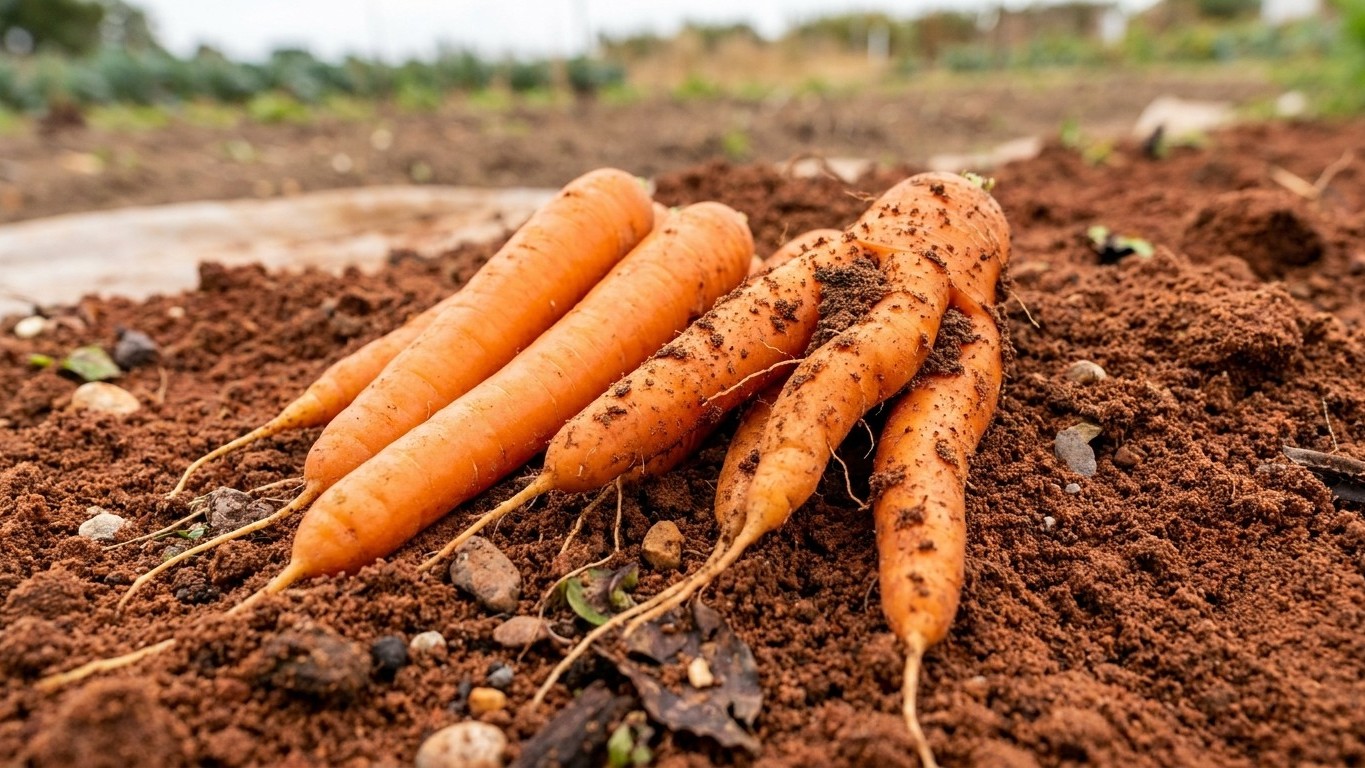

Mostly the ground and the weather, going by what this page can back up. Saskatchewan’s typical soil is forgiving to carrots, yet hard lumps, a hot seedbed and feast-or-famine watering still ruin roots. A dated calendar of insect pests is not published here, so this page covers the failures that soil and climate cause, from the ground up. For the wider picture, start with Growing Carrots in Saskatchewan.
The short answer
Saskatchewan has no official soil series the way a US state does, so there is no single named series to point to. What Agriculture and Agri-Food Canada’s Canadian Soil Information Service does offer is a dominant profile. Across 3,675 mapped surface horizons in the province’s agricultural regions, the commonest soil order is Chernozem, the deep, dark grassland soil of the prairies, rich in organic matter and naturally fertile. It covers 68 percent of the mapped surface, with Solonetzic next.
The median surface of that mapped ground is loam to silt: 43 percent sand, 22 percent clay and 35 percent silt. Organic matter sits at about 4.0 percent, the median surface pH is about 6.8 (near neutral), and the drainage class is well drained. The survey covers farming country only, so the far north of the province is not represented.
One warning belongs right here. A province spans hundreds of soil series, and this profile is a starting point, not a diagnosis. River bottoms, muskeg, and any lot a builder has scraped or filled will behave nothing like the median. The 6.8 is the median of a survey, not your pH. Only a soil test gives you that number.
Will a carrot fork in it?
Utah State University Extension describes what carrots want: deep, sandy, well-drained soil rich in organic matter. Heavy or rocky soil makes the root fork. Set that against the typical Saskatchewan profile. Sand is the biggest share at 43 percent, clay at 22 percent is not a high-clay figure, the drainage class is well drained, and organic matter is about 4.0 percent. The two usual triggers for forking, high clay and poor drainage, are not what the median ground looks like.
So in typical prairie loam, texture alone should not fork your carrots. Trouble comes from patches: a stony corner, a compacted layer under the surface, a pocket of heavy clay. Where your test shows that, Utah State University Extension’s answer is plenty of compost and double digging. If the ground is heavy and drains poorly, build a raised bed instead. A different variety won’t fix it, and the source names none.
Carrots are sown in place, with no transplanting, so a root that meets a stone at the wrong depth cannot be moved. The 70 to 100 days to harvest run from seeding. For timing the sowing itself, see When to Sow Carrots in Saskatchewan: Counting Back From the Last Frost. For more on the soil side, Will Carrots Fork in Saskatchewan Soil? goes deeper.
The test that settles it in your own garden
The province’s median tells you what the region’s ground tends to do. Your bed is what counts, and it takes an afternoon with a spade to learn about it. Do this where the carrots will actually grow, not in the easy corner. No measurements are needed, just attention.
- Dig a hole with a spade, wide enough to see the side wall clearly. Pick the exact spot where the row will go, and dig when the soil is workable, not sopping or baked hard.
- Look at the depth. Check the wall of the hole. Does loose, dark soil run down as far as a full-length carrot root would need, or does it stop at a hard, pale or packed layer? A sharp change in color or firmness marks where a root will bend or split.
- Count the stones. Sift a few spadefuls through your fingers. Rocks, gravel and chunks of old construction debris are what make the root fork. A handful is manageable. A bed full of them is a raised-bed candidate.
- Feel the texture. Take a pinch of moist soil and rub it between your fingers. Gritty means sand, smooth and floury means silt, sticky and slick means clay. Squeeze a moist handful and see whether it crumbles or holds together in a tight, shiny lump. A lump that holds and polishes under your thumb points to heavy ground.
- Watch the water. Fill the hole with water, let it soak away, then fill it again and watch. Water that vanishes steadily says well-drained. Water still standing long after you expected it gone says poor drainage, which Utah State University Extension links to forking and which calls for a raised bed.
- Send a sample to a lab. Texture and drainage you can judge by hand. Your pH and organic matter you can’t, and the province’s 6.8 and 4.0 percent medians are not a substitute. Test the bed itself.
Write down what you found before you amend anything. Stony but loose calls for raking out rocks and adding compost. Deep and crumbly needs little. Sticky, slow-draining and shallow is where double digging or a raised bed earns its keep.
What goes wrong here
Prairie loam forgives a lot, but the climate does not. Four failures come up most in this ground and weather, each with a fix you can apply.
- Forked, stubby or twisted roots. Heavy clay patches, stones and compacted layers force the root to split around an obstacle. Work in plenty of compost and double dig, as Utah State University Extension advises for heavy soil, or move to a raised bed if the water test showed poor drainage. Pull stones out of the top of the bed before seeding, since there is no moving a carrot once it is sown.
- Patchy or failed germination in a hot spell. Carrot seed is slow to come up, and a seedbed that dries out during a warm stretch can leave a row with big gaps. Keep the surface evenly damp until seedlings show. A board or sheet of burlap laid over the row, lifted daily to check for sprouts, holds moisture in. Sow again in the gaps if the row stays thin. The figures on soil temperature are not published here, so judge by the feel of the bed: if it crusts and dries within hours, water it.
- Splitting from uneven water. A long dry stretch followed by a soaking rain or a heavy watering can crack roots lengthwise. The remedy is steady moisture, a little and often rather than a flood after a drought. A layer of mulch over the soil evens out the swings. Compost helps too, since organic matter holds water, and the province’s typical ground already carries about 4.0 percent.
- Chewed roots and tops. Insects and other animals do eat carrots here, but a pest-by-pest calendar with dates is not published in the sources behind this page, and naming dates without a source would be guessing. Lift a damaged carrot and look at the damage: tunnels in the root point one direction, nibbled foliage another. Ask a local garden center or extension office what is active in your area this season.
Common questions
Will carrots fork in Saskatchewan soil?
In the province’s typical profile, loam with 22 percent clay, 43 percent sand and good drainage, texture alone is unlikely to fork them. Stones, hard layers and heavy or poorly drained patches will. Dig a test hole in your own bed to find out which you have.
How long do carrots take from sowing to harvest?
Count 70 to 100 days from seeding. Carrots are sown in place and never transplanted, so there is no transplant date to count from. Working backward from your last frost is covered in the sowing dates guide.
Does rich prairie soil still need compost?
The typical surface holds about 4.0 percent organic matter, which is a healthy start, but that figure is a survey median. If your bed is heavy, Utah State University Extension says it needs plenty of compost and double digging. If your test shows loose, deep and well-drained ground, you may need much less.
How do I store carrots after harvest?
Clemson Cooperative Extension says to store them at 33 °F and high humidity to prevent wilting. That is just above freezing, not cellar temperature, and a carrot kept at 50 °F sprouts and softens far faster. Cut the tops off first. The leaves keep drawing moisture out of the root, which is why bunched carrots with their tops on keep only about 10 to 14 days, while trimmed ones keep for months. Clemson’s full fact sheet is at hgic.clemson.edu.