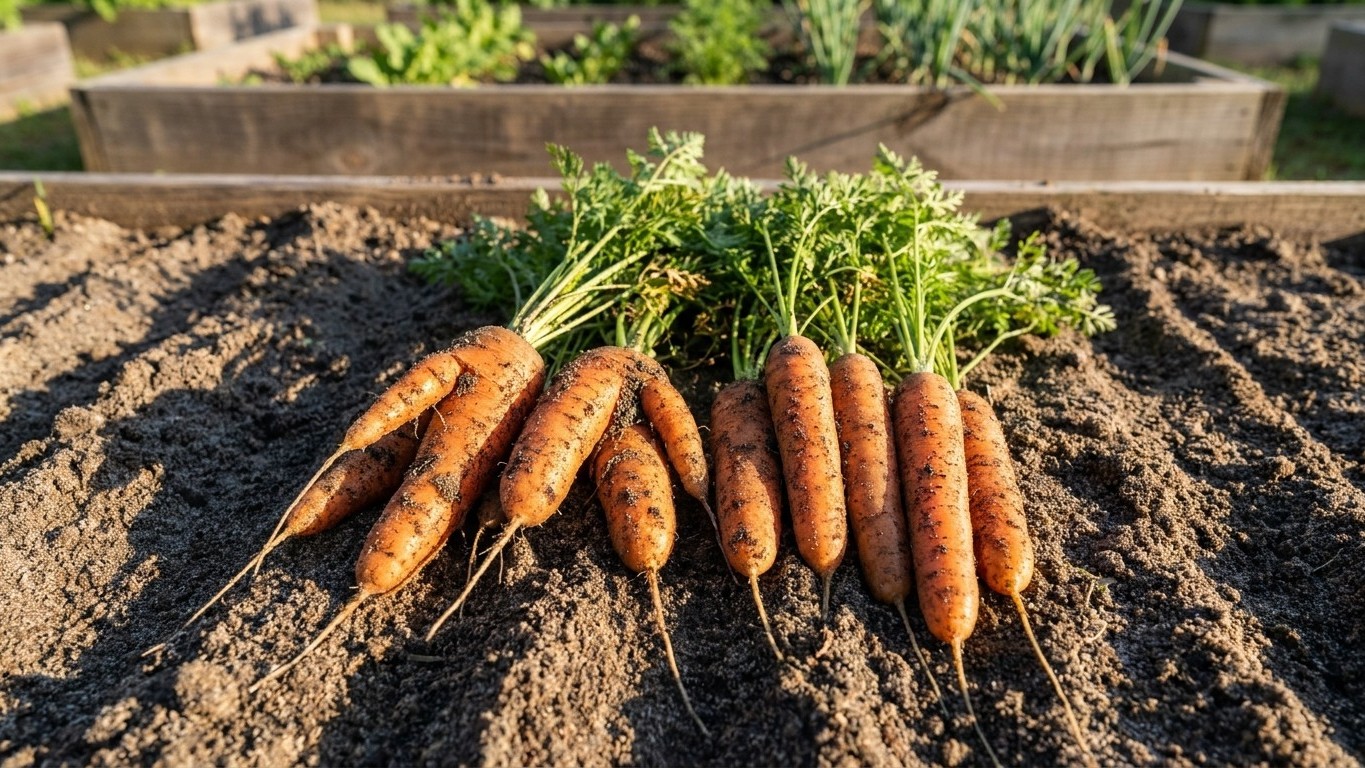

This page carries no pest calendar, and saying so up front beats guessing. The verified facts here cover what Tennessee ground does to a carrot and what happens to the root after harvest. The state’s representative soil leans toward forked, stunted roots unless you loosen it first. Insect and animal timing for your county isn’t published here, so treat it as a question for your local Extension office. The rest of this page covers what we can back up. For the wider picture, start with Growing Carrots in Tennessee.
The short answer
The soil USDA lists as representative of Tennessee is the Dickson series, and the numbers for its surface layer are worth reading slowly. It runs 11 percent sand, 20 percent clay and 68 percent silt, which puts it in the loam-to-silt range. Organic matter sits at about 1.5 percent. Drainage is moderately well drained, meaning water does leave, but not briskly. Surface pH is about 5.0, which is strongly acid. Dickson is an Ultisol, an old, heavily weathered and leached soil that is naturally acid and low in nutrients. Those values come from USDA NRCS Soil Data Access, averaged across 115 mapped components of the series.
Now set that beside what a carrot wants. Utah State University Extension describes the crop’s ideal as deep, sandy, well-drained soil rich in organic matter, and it says heavy or rocky soil makes the root fork. Dickson has only 11 percent sand, a lot of silt, modest organic matter and middling drainage. So yes, a carrot is likely to fork in ground like this if you seed it straight into untouched soil. The fix is the one Utah State gives for heavy ground: plenty of compost and double digging. A raised bed filled with loose, amended soil gets you to the same place by a different route. A fancier seed packet doesn’t.
A starting point, not a diagnosis
Tennessee spans hundreds of soil series. River bottoms, ridge tops, the limestone-influenced ground of the central basin and any lot a builder has scraped or filled will all behave differently from Dickson. The figures above describe the mapped surface layer of one series, not a worked garden bed, and certainly not yours. Above all, the pH of about 5.0 is the series’ value, not the pH of your plot. The Utah State source names no pH target for carrots, and nobody should hand you one without a test of your own soil. The Will Carrots Fork in Tennessee Soil? page goes deeper on the forking question. The next section shows how to get your own answer in an afternoon.
The test that settles it in your own garden
You don’t need a lab for the first pass. You need a spade, a bucket of water and a few minutes at the spot where the carrots would go. Do this when the ground is moist but not soaked, and never when it’s wet enough to smear.
- Dig a hole as deep as the carrot you hope to grow. Go down a full spade, then keep loosening below that with a garden fork. Note how hard each layer fights you. A layer where the fork bounces back is a layer where a root will bend.
- Look at the walls of the hole. Count the stones and notice where they sit. Rocks, clods or a hard layer in the path of the root are what turn one straight taproot into two or three legs.
- Take a moist handful from the depth where the roots will live and squeeze it. Sandy soil falls apart. Clay holds a tight shape and, when you press it between thumb and finger, slides into a shiny ribbon. Silt feels smooth, almost floury, and packs when pressed.
- Fill the hole with water and let it drain. Then fill it again and watch. If the water vanishes at a steady pace, drainage is helping you. If it is still standing long after you’d expect, the ground holds water, and carrots in it will struggle.
- Send a sample for a real soil test through your county Extension office. Squeezing and watching tell you about texture and drainage. Only a lab report gives you the pH and nutrient numbers that belong to your garden.
Reading what you found
If the soil crumbled, drained and dug easily to full depth, you’re close to what carrots like, and compost will still help. If it packed, ribboned or pooled, treat it as heavy ground. Work in compost, double dig, or build a raised bed and fill it with loose material. Whichever way you go, do it before seeding. Carrots are sown in place and never moved, so you only get one chance to prepare the spot where the root will grow.
What goes wrong here
Dickson-type ground, plus a Tennessee summer, produces a predictable list of failures. Most trace back to the soil, the weather or the watering, and each has a fix you can apply before the next sowing.
- Forking in heavy ground. Clay, silt that has packed down, and stones all split the root. Remedy: add plenty of compost and double dig, or grow in a raised bed. The Utah State guidance points to soil preparation here, not a change of variety.
- Stony or hard-layered spots. Even in loose topsoil, one buried rock or compacted layer bends a root. Remedy: pull the stones out while you dig, and keep loosening with a fork until nothing resists.
- Poor germination in a hot spell. Carrot seed sits in the ground for a while before it shows, and a crusted, dry surface can stop it. Remedy: keep the seedbed evenly damp until the rows come up, and time the sowing so the seedlings don’t meet the worst heat. The When to Sow Carrots in Tennessee: Counting Back From the Last Frost page walks through that timing.
- Splitting from uneven water. A root that stalls in dry weather and then gets a soaking tends to crack. Remedy: water on a steady schedule instead of in bursts, and mulch to even out the swings. Soil with more organic matter holds moisture more evenly, which is one more reason to add compost.
- Thin, acid, low-nutrient ground. Dickson’s weathered character means fertility doesn’t come free, and organic matter near 1.5 percent is low. Remedy: build it up with compost, and test before you add anything else, since your pH may not match the series’ value.
- Insect and animal damage. This is the part the title asks about, and the honest answer is that no verified pest list or timing is published here. Remedy: check the rows often, and take a damaged root to your county Extension office for a positive identification before you treat anything.
When the crop is in, the clock keeps running
Losses don’t stop at harvest. Clemson Cooperative Extension advises harvesting carrots about 65 to 75 days after planting, and for a carrot that means after seeding, since there’s no other planting date. Elsewhere you’ll see a wider window of 70 to 100 days from seeding, which depends on the variety you grow. The seed packet’s number beats either range.
Storage is where good roots go soft. Clemson says to hold them at 33 °F with high humidity to prevent wilting. That is just above freezing, colder than most garage or cellar corners, and a reader who stores carrots at 50 °F loses them to sprouting and softening in a fraction of the time. The tops are the catch. Leaves keep drawing moisture out of the root, which is why bunched carrots, tops still on, keep only about 10 to 14 days, while trimmed ones keep for months. Cut the tops off first.
Common questions
Do I need a special carrot variety for Tennessee soil?
The sources used here name no variety, and the soil guidance points elsewhere. If the ground is heavy, the answer is compost and double digging, or a raised bed. Changing the seed doesn’t loosen clay.
How long from seeding to harvest?
Count 70 to 100 days from seeding, since carrots are sown in place and never moved. Clemson Extension gives about 65 to 75 days after planting for harvest. Your variety’s packet will narrow it down.
How long do harvested carrots keep?
Clemson says bunched carrots with tops on keep about 10 to 14 days at 33 °F and high humidity. Cut the tops first if you want them to last, because leaves keep pulling moisture from the root and trimmed carrots keep for months.
Is the state soil’s pH the pH of my garden?
No. The pH of about 5.0 is the representative value for the surface layer of the Dickson series as mapped. Your yard may be a different series entirely, or fill dirt. A soil test through your county Extension office is the only way to get your own number.