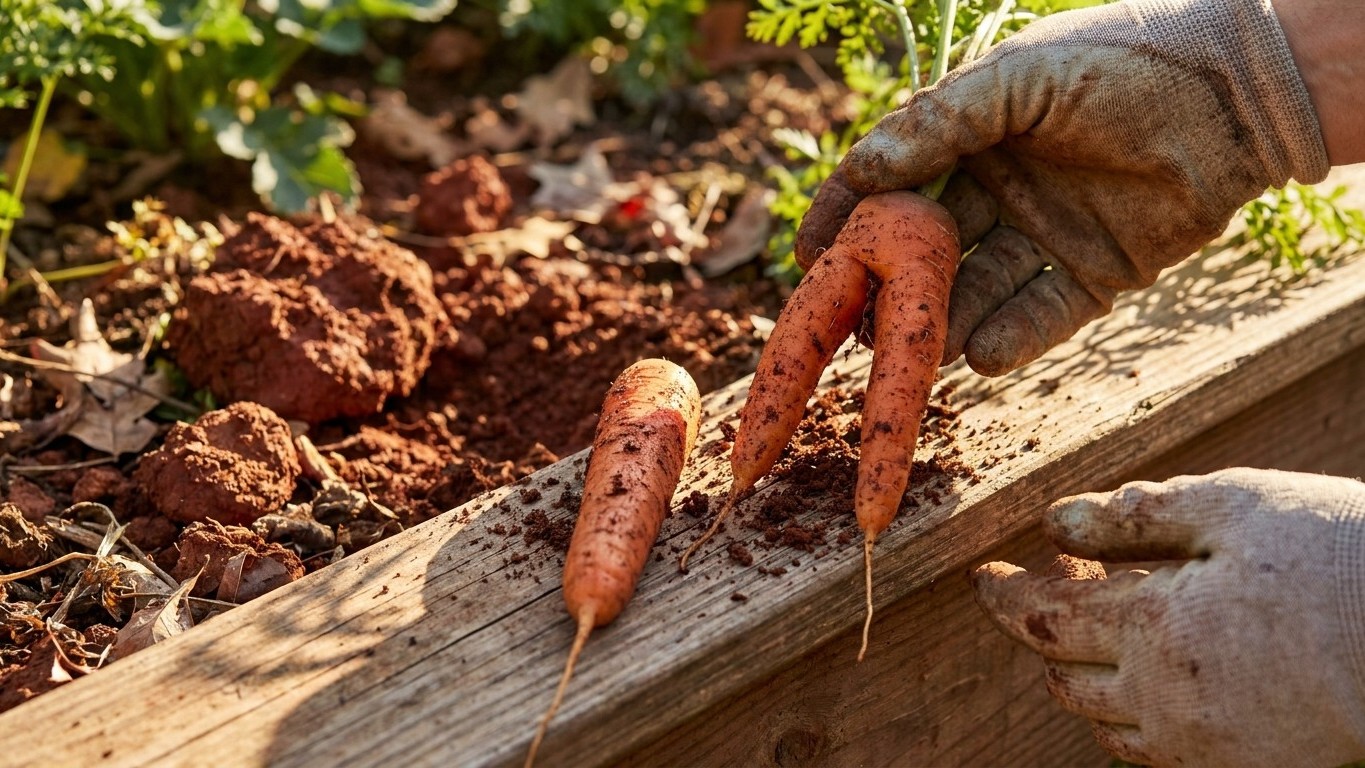

Tennessee’s benchmark soil, the Dickson series, runs 68 percent silt, 20 percent clay and just 11 percent sand, moderately well drained, with a surface acid enough to sting at pH 5.0. That texture is close to what Utah State University Extension calls the exact recipe for a forked carrot: heavy, silty ground with too little sand and too little organic matter. The fix is not a different variety. It’s compost, double digging, or building up instead of digging down.
The short answer
Start with what USDA NRCS actually measured. The Dickson series, the soil the agency’s State Soils program lists as representative of Tennessee, is a loam to silt loam in its surface horizon: 11 percent sand, 20 percent clay, 68 percent silt, organic matter around 1.5 percent, and a drainage class of moderately well drained. The surface tests strongly acid, at roughly pH 5.0. None of that reads like the loose, sandy, deep-rooting bed a carrot wants.
Utah State University Extension is blunt about what carrots need: deep, sandy, well-drained soil loaded with organic matter. Put a carrot root into ground that’s heavy or full of small stones, and the taproot hits resistance. It splits into two or three legs, or throws out side roots trying to find a path around a clay lens or a compacted layer. That’s forking, and it’s a mechanical problem, not a disease or a pest. The Dickson profile, with two-thirds silt and a fifth clay, is the kind of ground where that resistance shows up a few inches down, right where a carrot root is trying to lengthen.
Does that mean Tennessee soil dooms every carrot to a wishbone shape? No. It means a Dickson-type bed, worked as-is, stacks the odds against a straight root. Utah State’s remedy for heavy ground is direct: work in plenty of compost and double dig the bed, breaking up and loosening the soil a full spade’s depth or more so there’s no hard layer waiting to deflect the taproot. Where the ground is rocky as well as heavy, a raised bed filled with a lighter, sifted mix sidesteps the problem instead of fighting it season after season.
The acidity matters too, though the source here doesn’t hand out a target pH for carrots. What’s worth flagging is that a surface running around pH 5.0 is strongly acid, and strongly acid ground plus heavy silt and clay is a double handicap: compaction from one direction, poor nutrient availability from the other.
None of this is a verdict on any one backyard. The Dickson series is the state’s representative soil, the one USDA uses to stand in for Tennessee in national comparisons. But a state spans hundreds of mapped soil series, and a plot ten miles away, on a river terrace or a filled house lot, can carry none of these numbers at all. This is a starting point for what the region’s ground tends to do, not a diagnosis of the dirt under any particular garden.
The test that settles it in your own garden
The only way to know what a carrot will meet underground is to look at the ground itself, not at a state average. None of the steps below require lab equipment, and none of them will hand back a number the way a soil test report would, but together they answer the question a state series can’t.
- Dig a hole where the carrots will actually grow. Go down at least a foot, the depth a carrot root will try to travel. Note where the soil changes color or gets harder to dig; that’s the layer a taproot has to push through or fork around.
- Check for stones and hard layers as you go. Pull out anything bigger than a marble and set it aside. A bed thick with small stones in the top foot is a bed where forking is close to guaranteed unless it’s sieved or raised.
- Feel the texture between your fingers. Grab a handful of moist soil and squeeze it. Sand feels grainy and falls apart. Clay smears and holds a ribbon shape. Silt feels smooth, almost slippery, like flour. Most garden soil is some blend of the three, and how it behaves in your hand is a rough read on how it will behave around a growing root.
- Watch how water moves through it. Pour a bucket of water into the hole and time how long it takes to drain away. Water that vanishes in minutes points to sandy, fast-draining ground. Water that sits for hours points to clay-heavy, slow-draining ground, the kind that also compacts hard once it dries.
- Compare what you found against what a carrot wants. Deep, loose, well-drained ground with plenty of organic matter is the goal. Wherever the dig, the feel, or the drain test comes up short, that’s the specific thing to fix, whether that’s adding compost, double digging, or building a raised bed instead.
What goes wrong here
Certain problems show up over and over in heavy, silt-and-clay ground worked without amendment, and each one has a specific answer rather than a general one.
- Forking in heavy, unamended ground. A taproot meets a compacted or clay-rich layer and splits rather than pushing through. The remedy Utah State University Extension gives is direct: work in plenty of compost and double dig the bed to loosen it well below the depth the root needs to travel, or skip the fight altogether with a raised bed filled with lighter soil.
- Poor germination during a hot, dry stretch. Carrot seed is tiny and sits near the surface, so it dries out fast once the top inch of soil bakes. A silty surface that crusts over after watering makes this worse, sealing the seed under a hard skin it can’t push through. Keeping the seedbed consistently damp until seedlings appear, rather than watering heavily and then letting it dry, is what keeps a stand from thinning itself out before it starts.
- Splitting from uneven watering. A root that grows through a dry spell and then gets hit with heavy rain or a deep soak swells fast and cracks along its length. This is a watering-schedule problem more than a soil problem, and it shows up on any texture once the moisture supply is erratic rather than steady.
- Slow, stunted roots in compacted silt. Even without full forking, a taproot pushing through dense, low-organic-matter ground grows shorter and stubbier than it would in loose soil, since the plant spends more energy fighting resistance than lengthening. Deep amendment before sowing, not after the carrots are already in the ground, is the only point where this is easy to fix.
Common questions
Does every garden in Tennessee have the Dickson soil described here?
No. Dickson is the series USDA lists as representative of the state, but a state contains hundreds of mapped soil series. A garden on a river bottom, in hill country, or on ground a builder has scraped and filled can differ completely from these numbers. Digging a test hole in your own bed is the only way to know what you’re actually working with.
Is compost enough on its own, or does the bed need double digging too?
Utah State University Extension names both together for heavy soil: plenty of compost worked in, plus double digging to loosen the ground well below the surface. Compost alone improves fertility and structure over time, but it doesn’t break up a compacted layer sitting a foot down the way double digging does in one pass.
How many days should a gardener count on from sowing to harvest?
Carrots are sown directly in place, never transplanted, so the 70 to 100 days growers typically count run from the day seed goes into the ground, not from any later transplant date. There’s no transplant step to adjust for with this crop.
Is a raised bed better than amending the existing ground?
It depends on how rocky and heavy the native soil is. Where stones and hardpan run deep, double digging and compost can still work if done thoroughly. Where the ground is shallow over rock or consistently heavy no matter how it’s amended, a raised bed filled with a lighter, well-drained mix sidesteps the problem instead of fighting it every season.