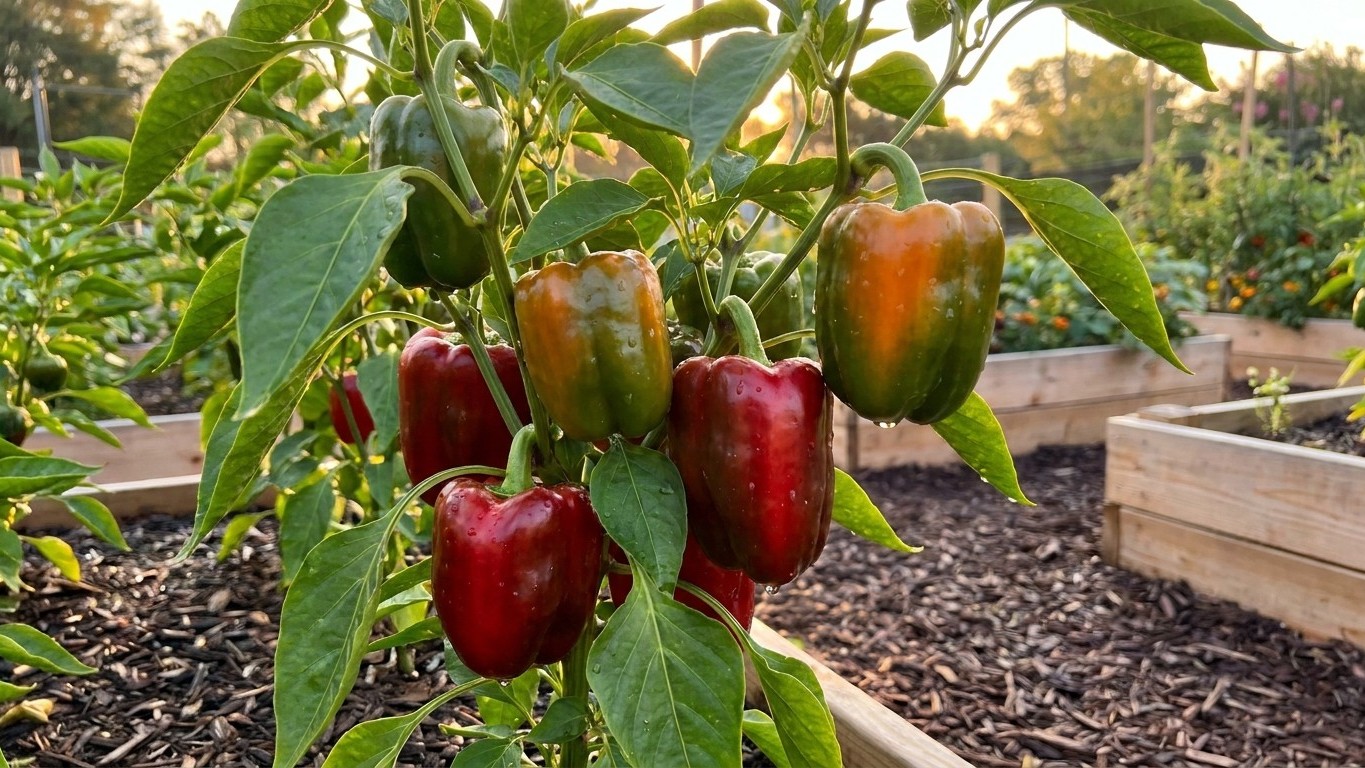

Weather does most of the damage to peppers in Saskatchewan, and the timing matters more than the intensity. Extreme heat is rare. Cool nights and a planting date set too early cause more trouble. Insects are a separate subject, and this site carries no pest calendar for the province, so nothing below names a bug or a date for one. What follows covers the weather limits on fruit set, how to count back to a seeding date, and the failures this climate produces.
The short answer
Saskatoon Diefenbaker Int’l A, the reference station for this page, averages 4.98 days a year reaching 32 °C. That number comes from Environment and Climate Change Canada’s published climate normals. Pepper fruit set is known to fail when days climb above that mark, according to Utah State University Extension. Five such days in a year is a small exposure. A hot spell can still drop the blossoms open during it, but the crop has the rest of the summer to recover.
For the looser, more familiar benchmark, the same station records 13.1 days a year above 30 °C. That is about two weeks of genuinely hot weather, spread across a season. Neither count says heat-loving crops are a bad bet here. A single figure for scorching days measures the extremes, not the season. What decides a pepper crop is how long the frost-free stretch lasts and how warm the summer runs on average, and this page does not carry either of those numbers. A variety that ripens early enough matters a great deal, which is what Pepper Varieties That Ripen in a Saskatchewan Season sorts out.
The other end of the scale is where Saskatchewan gardeners are more likely to lose flowers. Utah State University Extension says fruit set fails at both ends: days above 32 °C, and nights below 55 °F (about 13 °C). A pepper plant can be healthy, green and covered in blossoms, and still produce almost nothing because the nights stayed too cool while it was trying to set.
This site does not carry summer night minima for Saskatchewan, and there is no honest way to guess them. Latitude tells you little about a given July night, and the coldest month of winter tells you nothing about it. Your own garden can differ from the nearest airport by several degrees, depending on low ground, shelter, a south wall or open prairie. So the reading has to be yours. A cheap min/max thermometer placed at plant height, checked each morning from the day the first buds show, will tell you more than any regional average.
One more date belongs in the picture. The average last spring frost at the SASKATOON SRC station is May 18. It is a mean, so in one year out of two the last frost falls later. Treat it as the middle of a window, not a safe date. It also comes from one station, and northern or upland districts in the province run weeks behind it. The Why Peppers Fail to Set Fruit in Saskatchewan page goes further into the fruit-set problem. The broader overview is at Growing Peppers in Saskatchewan.
When to start seed here
The seeding date is not a fixed calendar square. You work backward from the day the plants can go outside, and the arithmetic is simple enough to redo for any county. Utah State University Extension gives two rules: transplants need 8 to 10 weeks indoors, and they go out when the soil reaches 60 °F (about 16 °C), after frost. Here is the count, step by step.
- Find your frost date. At the SASKATOON SRC station the mean last spring frost is May 18. Half of all years run later, so use your own local date if you have one, and lean later if you garden north of Saskatoon or at higher elevation.
- Wait for the soil. The frost date is the earliest possible transplant day, not the actual one. Push the date back until the soil at planting depth reaches 60 °F. A soil thermometer costs little and removes the guesswork.
- Subtract 8 to 10 weeks. Taking May 18 as a transplant day, eight weeks back is March 23 and ten weeks back is March 9. That is the seeding window if everything lines up perfectly.
- Redo it with a realistic date. If the soil only warms enough on June 1, the same count gives a seeding window of March 23 to April 6. June 1 is an example, not a forecast. Put your own transplant date in.
- Check the far end. Clemson Cooperative Extension puts harvest at about 70 to 85 days after transplanting. That is a southern source and the range will stretch with cool weather, but it is a useful test. A June 1 transplant lands between August 10 and August 25 on that count, and you then have to ask whether your variety can finish in that time.
- Do not start early to get ahead. Seedlings seeded well before the 10-week mark do not gain a head start outdoors. They only spend longer in a tray under your care while the soil stays cold.
The same arithmetic works anywhere. Only the frost date and the soil-warming date change, and those two figures are the ones worth verifying against your own yard.
What goes wrong here
The failures below are the ones this climate most plausibly produces. Each item carries its remedy.
- Blossom drop in a hot spell. Flowers fall off during days above 32 °C, even on plants that looked fine the day before. There is little to do in the moment beyond cutting the stress: water deeply and evenly, and put up shade cloth over the hottest afternoons. New blossoms open again once the heat breaks, so do not pull the plant.
- Blossom drop on cool nights. Nights under 55 °F (about 13 °C) cause the same failure from the opposite direction. Watch your own thermometer, since this site has no summer night minima to lean on. On a night forecast near that line, drape a floating row cover or cloche over the plants at dusk and remove it in the morning so the bees can work the flowers.
- Sunscald. Pale, papery, sunken patches appear on the side of the fruit facing the sun. They show up when leaves are thin or stripped and the fruit is exposed to direct summer sun. Protect the canopy. Do not prune leaves away for airflow, and use shade cloth in the brightest stretch of the day if the plants are sparse.
- Blossom-end rot. A dark, leathery patch forms on the bottom of the fruit, opposite the stem. It usually traces back to uneven watering rather than a shortage of calcium in the soil. Water on a steady schedule, mulch to hold moisture, and avoid heavy nitrogen feeding that pushes leaves at the expense of the fruit. Cut off the affected peppers so the plant puts its effort into the next ones.
Two of the four are about temperature at the flower, and the other two are about water and leaf cover. None of them calls for chemicals. All of them start with watching the plant and the thermometer.
Common questions
Do hot days hurt peppers in Saskatchewan?
Seldom, and only for a few days at a time. Saskatoon Diefenbaker Int’l A averages 4.98 days a year reaching 32 °C, the level at which fruit set can fail. The station also logs 13.1 days a year above 30 °C. Those are extreme days, not a season-long problem.
What night temperature is too cool for peppers?
Utah State University Extension names nights below 55 °F (about 13 °C) as a point where fruit set fails. This site does not publish summer night lows for Saskatchewan, so the answer for your yard comes from a thermometer at plant height.
Is May 18 a safe date to transplant?
No. It is the mean last spring frost at the SASKATOON SRC station, so the frost falls later in one year out of two. Peppers also want soil at 60 °F (about 16 °C), which often arrives after the frost date, and districts farther north or at higher elevation run weeks behind.
Can I keep harvested peppers in the refrigerator?
Not for long. Clemson Cooperative Extension gives the best storage conditions as 45 to 50 °F (7 to 10 °C) at 80 to 90 percent relative humidity, good for two to three weeks at most. A household refrigerator runs colder than that, and below about 45 °F peppers pit and soften from chilling injury. A cool pantry or basement shelf suits them better.