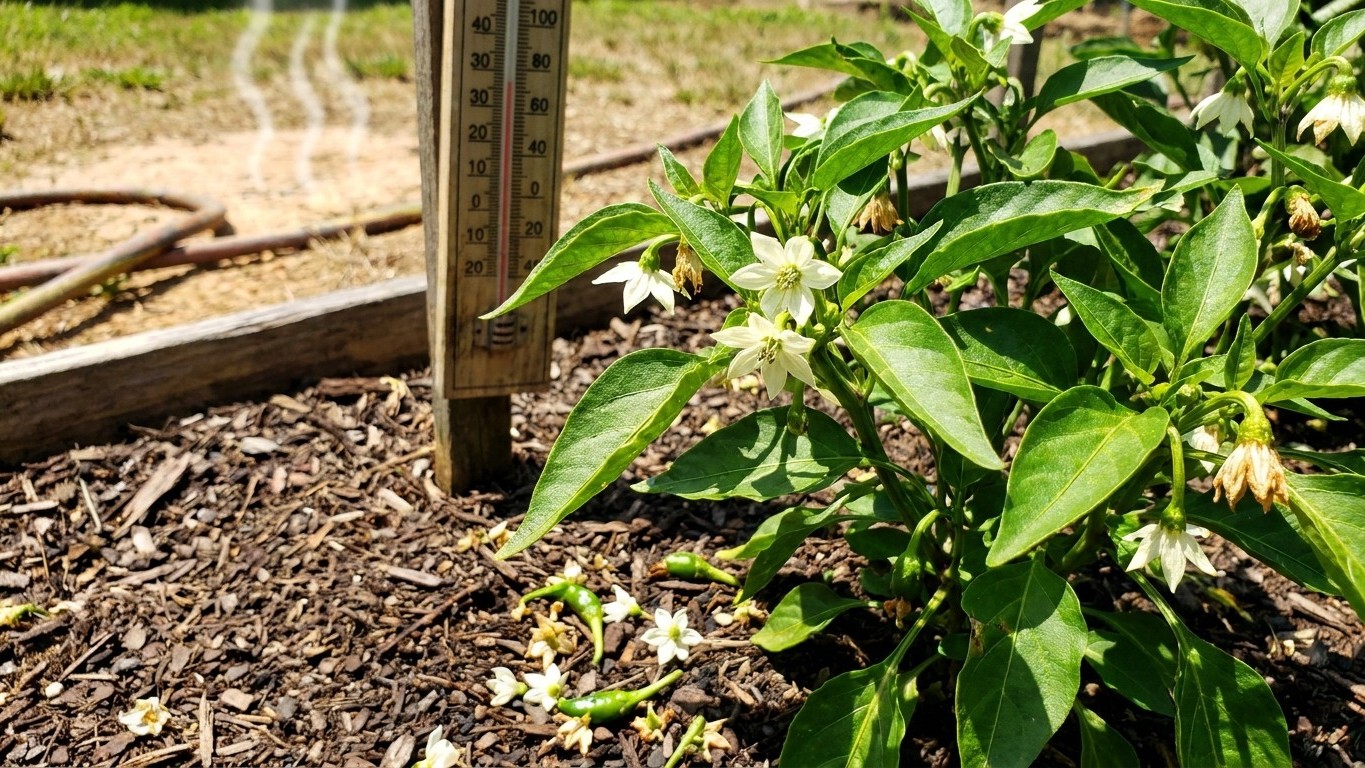

Peppers set fruit only inside a narrow temperature window: nights above 55°F and days below 90°F. Saskatoon’s climate normals put the average number of 90°F-plus days at zero for the whole year, so heat almost never causes the failure here. The more likely culprit is the cool end, especially overnight lows this site doesn’t track, layered on top of a frost-free season that opens, on average, only in mid-May.
The short answer
Start with the number that matters most for the hot side of the equation: Saskatoon, the reference station for this province under the Canadian Climate Normals 1981-2010, averages 0.0 days a year at or above 90°F. That’s not a rounding artifact. It means a typical Saskatchewan growing season never pushes daytime temperatures into the range that causes pepper flowers to abort and drop, which is one of the two ways fruit set fails according to Utah State University Extension. Gardeners in hotter regions spend July worrying about blossoms cooking off the plant in a heat spell. That’s not the fight here.
The fight here is on the other end. Pepper flowers also fail to set when nights drop below 55°F, and that threshold is a real risk on the northern prairies even in mid-summer, when a clear night after a cold front can knock temperatures down fast. The trouble is this site does not carry summer night minima for Saskatchewan or any other territory it covers. There’s no average low for July or August to point to, and no shortcut around that gap. What that means in practice: track your own nights. A cheap min-max thermometer on the patio, checked through the warmest stretch of summer, will tell you more about whether your peppers are setting fruit than any provincial average ever could.
This matters because it flips the usual troubleshooting order. In a hot state, the first question when peppers stall is “did it get too hot.” In Saskatchewan, that question almost answers itself, since 90°F days essentially don’t happen at the reference station. The first question here should instead be about cold snaps, wind exposure, and whether the planting site holds heat overnight, since a garden tucked against a south-facing wall behaves very differently after sundown than an open bed in a low spot where cold air pools. Two gardens ten miles apart can have meaningfully different night minima, which is exactly why a province-wide average wouldn’t help even if one existed. Watching your own thermometer, rather than relying on a distant station reading, is the only way to know which side of the 55-to-90°F window is actually costing you fruit.
When to start seed here
Utah State University Extension’s guidance gives the pieces: transplant peppers outdoors only after the last frost and once soil has warmed to 60°F, and start seed indoors 8 to 10 weeks before that transplant date. Saskatchewan gardeners can build their own calendar from those two facts, working backward from the frost date rather than forward from a calendar guess.
- Anchor the transplant date to the frost record. Saskatoon’s average last spring frost, per Environment and Climate Change Canada’s 1981-2010 normals for the SASKATOON SRC station, falls on May 18. That’s a mean, not a guarantee: in one year out of two, frost arrives later than that date, so treat May 18 as the midpoint of a window rather than a green light.
- Confirm soil temperature separately. Air can feel warm while the ground is still cold, and pepper roots stall in cool soil regardless of frost risk. Don’t transplant until a soil thermometer pushed a few inches into the bed reads 60°F, even if that means waiting past the average frost date.
- Count backward 8 to 10 weeks for indoor sowing. If the realistic transplant target, factoring in the mean frost date and typical soil warm-up, lands in late May, counting back 8 weeks points to late March for starting seed indoors, and counting back 10 weeks points to mid-March. Split the difference and most Saskatchewan gardeners land on a sowing window in mid-to-late March.
- Adjust for your own district. A single reference station can’t speak for the whole province. Northern communities and higher-elevation districts typically see frost persist longer than the Saskatoon normal suggests, which pushes both the transplant date and the backward-counted seeding date later. If local frost tends to linger, shift the whole schedule back rather than sowing on the Saskatoon-derived date and hoping.
The arithmetic is simple enough to redo for any county: take your best estimate of a safe transplant date, factoring in that the mean frost date is a 50/50 line rather than a safe one, then subtract 8 to 10 weeks for the indoor head start peppers need before they’re sturdy enough to go outside.
What goes wrong here
- Blossom drop from a cool night. Given that Saskatoon averages zero days above 90°F, a hot spell is rarely the trigger here. A night that slips under 55°F during flowering is far more plausible, and since this site doesn’t publish summer night minima, the only fix is to monitor your own garden with a thermometer and be ready to cover plants or delay flowering-stage exposure when a cold night is forecast.
- Sunscald on exposed fruit. Even without extreme heat, direct prairie sun on fruit that’s lost its leaf cover, from wind damage, pruning, or a plant that never filled out, can scald the skin and leave a pale, papery patch that invites rot. Keep foliage full and avoid stripping leaves around developing peppers so the fruit stays shaded.
- Blossom-end rot from uneven watering. This shows up as a sunken, leathery spot on the bottom of the fruit and it’s a calcium-delivery problem tied to inconsistent soil moisture, not a lack of calcium in the soil itself. Water on a steady schedule, mulch to hold moisture evenly, and avoid letting the root zone swing from bone-dry to soaked.
Common questions
Do Saskatchewan gardeners need to worry about heat stress at all?
Rarely. Saskatoon’s climate normals average zero days a year at or above 90°F, so the daytime-heat side of pepper fruit-set failure is not the province’s typical problem. Watch instead for cool-night stress during flowering.
Is May 18 a safe date to transplant peppers outdoors?
No. It’s the average last spring frost date from Environment and Climate Change Canada’s 1981-2010 normals for the SASKATOON SRC station, meaning frost falls later than that in roughly half of all years. Confirm soil has reached 60°F before transplanting, and lean later rather than earlier if in doubt.
Why doesn’t this article give a specific summer night-temperature threshold for my town?
Because that data isn’t published here. This site tracks days at or above 90°F by territory but not summer night minima, and night lows vary too much between a sheltered yard and an open, low-lying garden to responsibly estimate from latitude or from winter temperatures. A local min-max thermometer is the only reliable substitute.
How many weeks before transplanting should I start pepper seed indoors?
Utah State University Extension recommends starting seed 8 to 10 weeks before transplanting outdoors. Working back from a realistic Saskatchewan transplant date in late May, that points most gardeners to a mid-to-late March sowing window, adjusted earlier or later based on how quickly frost typically clears in their specific district.