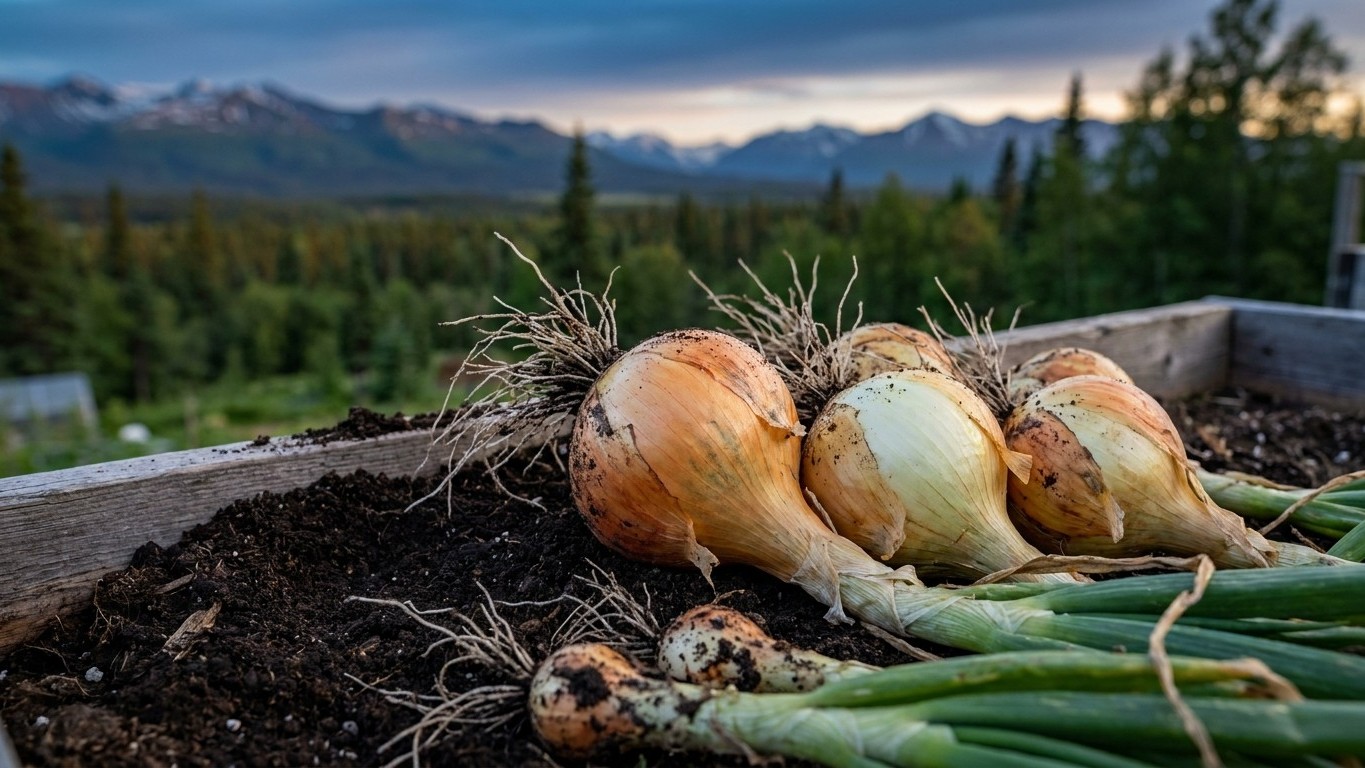

Lift onions once the tops have flopped over and the necks have gone soft. Then cure them in a warm, shaded, airy spot until the necks are tight and the skins turn papery. In Indiana that usually means late summer, but the plant sets the schedule, not the calendar. Skip the curing and bulbs start rotting in storage far sooner than they should. Cure them properly and a pungent keeper can sit in a cool, dry corner of the house well into winter.
The short answer for Indiana
Indianapolis sits at 39.71 degrees north, and on its longest day the sun is up for 14 h 49. The latitude comes from the NOAA NCEI station that also supplies the city’s climate normals. We calculated the daylight figure from it at the geometric horizon, so the roughly seven extra minutes added by atmospheric refraction are not counted. Those two numbers explain the harvest. Onions start bulbing because of day length, not because the weather turns hot. Clemson Cooperative Extension puts the trigger for short-day varieties at about 12 hours, while long-day types wait for 14 to 16 hours. Central Indiana clears the long-day bar with room to spare, so long-day onions swell through June and July and finish in late summer.
Reading the tops
The signal is the foliage. When the bulb is finished, the necks weaken and the green tops fall over on their own, then start to yellow. Lift when most of the row has toppled. Pull on a dry day, loosen the soil with a fork first, and handle the bulbs like eggs, because a bruise is where rot starts. Leave the tops attached.
Check each bulb as it comes up. A thick, wet, stiff neck means the bulb is not ready to store, and it should go to the kitchen first. The same goes for any bulb chewed at the neck or base. The damage patterns are covered in What Eats Onion in Indiana, and When, and a bulb with an open wound is a poor candidate for the pantry.
Curing and storing
Curing dries the outer skins and seals the neck so rot cannot walk in. Spread the bulbs in a single layer on screens, slatted racks or a clean tarp, somewhere warm with moving air and no rain. Direct afternoon sun can scald the bulbs, so shade is the better bet. Indiana’s humid Augusts can stretch the process, which is why the test matters more than the timeline: the neck should be tight and dry, with no moisture when you squeeze it, and the outer skins should rustle. Only then do you trim the tops and roots and move the bulbs into storage.
Clemson’s Home & Garden Information Center gives the target for storage: “Ideal conditions are between 45 °F and 55 °F, and 50 to 60 percent humidity.” (Clemson Cooperative Extension.) Onions want dry air. Use mesh bags, crates or open baskets, never sealed plastic.
What will not work here
The mistakes with onions mostly come from planting a variety built for a different day length. At Indianapolis’s latitude, three kinds of onion fail in different ways:
- Varieties that need 16 hours of daylight. The longest day in Indianapolis is 14 h 49, so the trigger never arrives. The plant makes leaves all season, forms no real bulb, and the thick neck then rots.
- Short-day sweet types, such as Granex or Vidalia-type onions. They start bulbing at about 12 hours, which Indiana passes early in spring. The plant begins bulbing while it is still small and finishes with a small bulb that does not keep.
- Short-day onions planted in fall for winter growth. That is how mild-winter states grow them. Indiana winters are not mild enough, and the plants are set back or lost before day length ever comes into play.
Planting late fails differently. A late start does not push the harvest back. It shrinks it. Each leaf the plant has grown by the time day length triggers bulbing becomes one ring of the bulb, so the size of the plant at that moment is the size of the onion. Set out transplants or sets weeks behind schedule and the day length arrives on the same date anyway, to a smaller plant. The result is a bulb the size of a golf ball that no amount of extra watering will fix.
Choosing the right group is half the job, and the other half is picking within it. The Best Onion Varieties for Indiana goes through that. For the full picture of the season, start with Onions in Indiana.
What changes across Indiana
Every figure above belongs to Indianapolis, the reference city. Indiana is not one latitude. It stretches a few degrees from the Ohio River in the south to the Lake Michigan shore in the north, and because summer daylight grows with latitude, the long-day advantage grows as you move north. This page does not publish day-length figures for other parts of the state, so a reader far from Indianapolis should work out the numbers for their own latitude.
| Location | Latitude | Longest day | What it changes |
|---|---|---|---|
| Indianapolis (reference) | 39.71 degrees north | 14 h 49 | Long-day onions bulb comfortably; this is the baseline for the advice above. |
| Northern Indiana | Higher than 39.71 (check your own) | Longer than 14 h 49 | Long-day types fit even better and bulb later; spring planting windows open later. |
| Southern Indiana | Lower than 39.71 (check your own) | Shorter than 14 h 49 | Types needing 16 hours fail harder; short-day sweet types bulb earlier and run smaller; earlier lifting. |
In practice, a gardener along the Ohio River gets a slightly earlier finish and a narrower margin for long-day varieties, while a gardener near Lake Michigan gets a later finish and a bigger margin. Neither crosses into a different group of onions, but each should expect the harvest to drift from the central Indiana pattern. Frost dates shift along the same line, and those figures are not published here, so look them up locally.
Sweet now, or onions that last
Every onion garden makes a trade, whether the gardener notices or not. The sharp bite of an onion comes from volatile sulfur compounds, and those same compounds protect the bulb while it sits in storage. A sweet variety carries fewer of them. That makes it better raw, but it has less defense once the weather cools. The University of Missouri Extension (publication G6355) says it plainly: “As a rule, ‘sweet’ onions do not store as well as the more pungent types.”
Day length lines up with that chemistry. Short-day types run sweeter, long-day types keep longer. A southern garden therefore tends to give onions to eat soon, and a northern one gives onions that feed the household into March. Indiana sits in the middle, which means the choice is yours instead of being made for you.
Picture the pantry in March. A basket of pungent, long-day onions cured properly is still firm, the skins crisp, and a few may have started to sprout. A basket of sweet onions is a different story. The bulbs are soft, some are sprouting, many are gone, and you ate the best of them in the first weeks. Never plan on a sweet onion that stores, because that onion does not exist.
The practical answer is to grow both. Eat the sweet ones first, straight from the cure, and put the pungent ones in the cool, dry corner. Lifting them on the same schedule and curing them the same way works for both, but only one group will still be around when the garden is covered in snow.
Checking this against your own garden
Everything here is anchored to a single city, and a single city is not your garden. A few checks, each doable this week, tell you how far to trust the Indianapolis numbers:
- Find your own latitude. If you live well north or south of Indianapolis, compare it to 39.71 degrees north and expect a longer or shorter longest day than 14 h 49.
- Look up your local first and last frost dates through your county Purdue Extension office. This page does not publish frost dates, and a state-wide figure would not apply to every garden.
- Check what day-length group the onions in your bed belong to, using the seed or set packaging, and compare it to the 12-hour and 14-to-16-hour thresholds above.
- Put a hygrometer in the spot you plan to store onions and see whether it holds 50 to 60 percent humidity and a temperature between 45 and 55 °F.
- Walk the row and note how many tops have fallen. That, not the date, tells you when to lift.
Your county extension office is the best single source for local conditions, from frost dates to which onion problems are active in your area this year.
Common questions
How do I know my onions are ready to lift?
Look at the tops. When most of them have fallen over by themselves and begun to yellow, the bulbs have finished growing. Waiting a little longer is safer than lifting early, as long as the weather is dry.
How long does curing take?
It depends on the weather, so judge by condition rather than by a fixed number of days. The necks should be tight and dry, and the outer skins should feel papery. Humid weather slows the process.
Can I store sweet onions through the winter?
Not reliably. Sweet onions have fewer of the sulfur compounds that protect a bulb in storage, so they spoil sooner than pungent types. Eat them first and save the sharp ones for winter.
Can onions share a cellar with carrots?
Poorly. Onions want 50 to 60 percent humidity and 45 to 55 °F, while root crops like carrots want damp air. A single cellar rarely holds both well, so keep onions in the driest, coolest spot in the house and give the carrots their own damp corner.