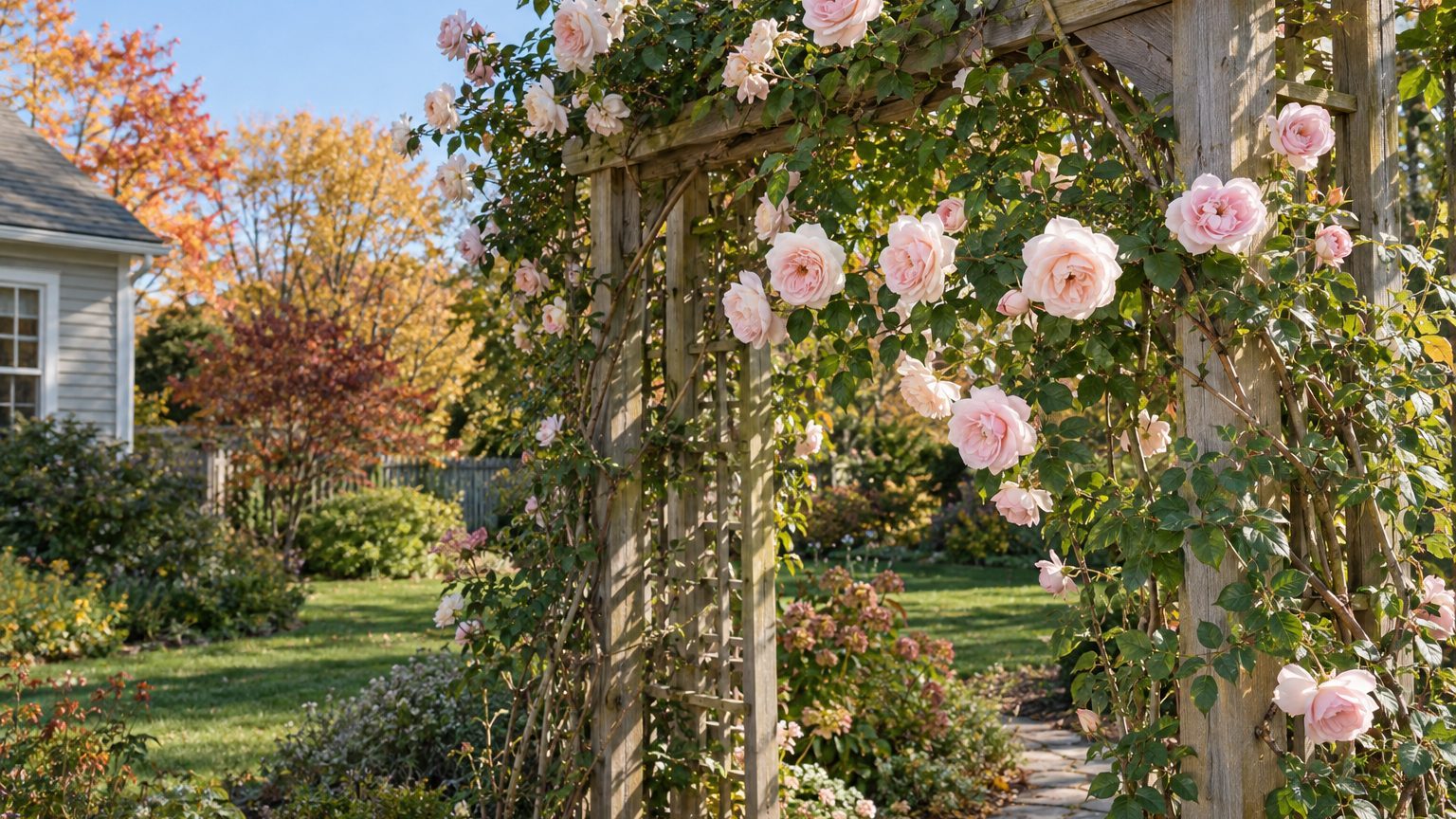

New Dawn is a pale climbing rose that flowers on new wood, carried on laterals that grow off a permanent framework. The real question is: does the plant get through your season intact, and what does that cost you in care? Your own frost dates answer the first half.
What New Dawn actually is
The North Carolina Extension Gardener Plant Toolbox entry for Rosa is the reference. It describes New Dawn as a pale climbing rose with good disease resistance, and it places the cultivar in the climbing group. A rose is not a crop that finishes on a schedule.
Habit is the fact that shapes everything else. A climber flowers on new wood, and in New Dawn’s case that means laterals coming off a framework of older canes that stays in place year after year. You are building a permanent structure and asking it to throw flowering shoots each season. That needs a trellis, a fence, an arbor or a wall, and it needs the support in place before the plant outgrows a temporary stake.
On size, the only documented dimensions are for the genus: 1 to 8 feet tall and 1 to 6 feet wide, depending on cultivar. That range is too wide to plan around, so check the figure per plant before you pick a spot. The fruit is a hip, an accessory fruit holding achenes, which turns from green to red in fall. Growth rate for the genus is medium and maintenance is rated HIGH.
What New Dawn Is Good For in the Garden
A climbing rose earns its place by covering vertical space. The framework-and-laterals habit means the plant fills a fence line or an arbor with flowering shoots at the height you trained them to, which a bush rose cannot do. If you have a bare wall or a chain-link run, that is the job this variety suits. If you want a rounded shrub in a border, a climber asks for more tying and more structure than the result justifies.
The source sorts rose fragrance into five groups: old rose, fruity, tea, myrrh and musk. The genus runs from 5 petals (single) to more than 20 (double), and New Dawn’s own count is not given.
The hips are the one edible part. The source states that the hip is edible and turns from green to red in fall.
If you are comparing climbers, the pages for The Fairy Rose: When to Plant the Tomatoes That Ripen All at Once and Seafoam Rose: Bloom, Hardiness and Care sit in the same silo, and the full index is under Rose Varieties.
Where New Dawn Grows Well: Hardiness Zones and Season Length
For a rose, “ripening” means two things. The new laterals have to grow long enough to flower, and the wood has to ripen before frost so the plant hardens on its own for winter. You can work out your own window with the arithmetic below.
Take the weeks between your average last spring frost and your average first fall frost. That is the window in which the plant can push laterals, flower on them and let the wood firm up. What eats into that window is your own behavior late in the season: every feeding, every heavy cut and every deadheading pass after midsummer asks for new growth that then has to ripen in whatever weeks remain.
Hardiness is the other half. USDA zones 5a through 11b for the genus, a very wide band. A garden near the cold end of that range has the least margin for wood that ripens late. A garden near the warm end has the most.
Your zone also decides when you prune. For the actual timing, go to the page for your state.
Two Common Mistakes With New Dawn
A long frost-free window is not automatically a good season. Two risks matter for New Dawn.
The first is soft late growth. Each deadheading cut pushes a new shoot, so the way to avoid late, tender growth is to stop making the cuts. Shoots too soft to ripen in time are the ones frost damages. This is the failure that matters more for New Dawn, because its whole bloom depends on the new wood: a plant that is being pushed into growth late is spending the weeks it needs to firm up.
The second is pruning with the wrong rule in mind. The source separates ramblers, which flower from old wood, from climbers, which flower from new wood. Treat a climber like a rambler and you may leave the laterals too long. Treat it like a bush rose and you may cut into the permanent framework that carries them. With New Dawn the correct sequence is to keep the framework and shorten the laterals. The cost of getting it wrong is a season of leggy, thin flowering rather than a lost plant.
What it resists, and what it does not
The only resistance statement for New Dawn is: good resistance to diseases. That matters, because intermediate resistance means the plant slows a disease, not that it escapes it. Treat “good” as a lower chance of trouble, not as protection.
The diseases the source names for roses are botrytis, blights, powdery mildew, leaf spots and anthracnose. None of the five can be ruled out for your plant. Powdery mildew is worth a specific note: it overwinters in dormant buds and on stems, not in leaf litter, so raking up fallen leaves does not end it.
Pests are listed at genus level too: Fuller rose beetle, Japanese beetle, rose chafer, rose thrips, southern red mite and two-spotted mite. Two of those are mites, which are arachnids and not insects, so call the group “insects and mites” when you scout.
Growing it without the usual mistakes
Start with the site. The source asks for full sun, 6 or more hours of direct sunlight a day, and a soil that is clay or loam with a pH from acid (below 6.0) to neutral (6.0-8.0). That is a wide band, so there is no need to chase a narrow number. Put the support up first and tie in the main canes as they grow, since the framework is what the whole plant depends on.
Check the tag for how it was propagated. Budded roses carry a union with a rootstock; own-root roses have no union at all. Winter protection guards the union on a budded plant and the crown on an own-root one.
The mistake this variety invites is the late push. A climber that flowers on new wood tempts you to keep feeding and deadheading to get more laterals. Stop making deadheading cuts when your season shortens, and leave the new growth alone to firm up.
Pruning follows the habit: keep the framework, shorten the laterals, and take your date from the state page. Remove what is diseased or unsafe, and leave dead stems cut back to 12-24 inches standing for stem-nesting native bees. Maintenance is rated HIGH for the genus, and a climber adds tying and training on top of the pruning.
Wear gloves when you tie in canes. The sharp structures on the stems are prickles, not true thorns, and they are only skin-deep outgrowths.
Common questions
When should I prune New Dawn?
The date depends on your zone. What is fixed is the rule: New Dawn flowers on new wood from laterals off a permanent framework, so you keep the framework and shorten the laterals. Use the page for your state for the timing.
How long after planting until it flowers?
Flowering depends on the new laterals the plant grows each season, and the length of your frost-free window sets how much time they have.
Are rose thorns dangerous on a climber?
They are prickles, not true thorns. Prickles grow from the outer skin of the stem, which is why they can be rubbed off, but they still scratch when you tie in canes, so wear gloves.
Is New Dawn disease-proof?
No. Good disease resistance is not immunity. The source names botrytis, blights, powdery mildew, leaf spots and anthracnose as the diseases to watch for on roses.