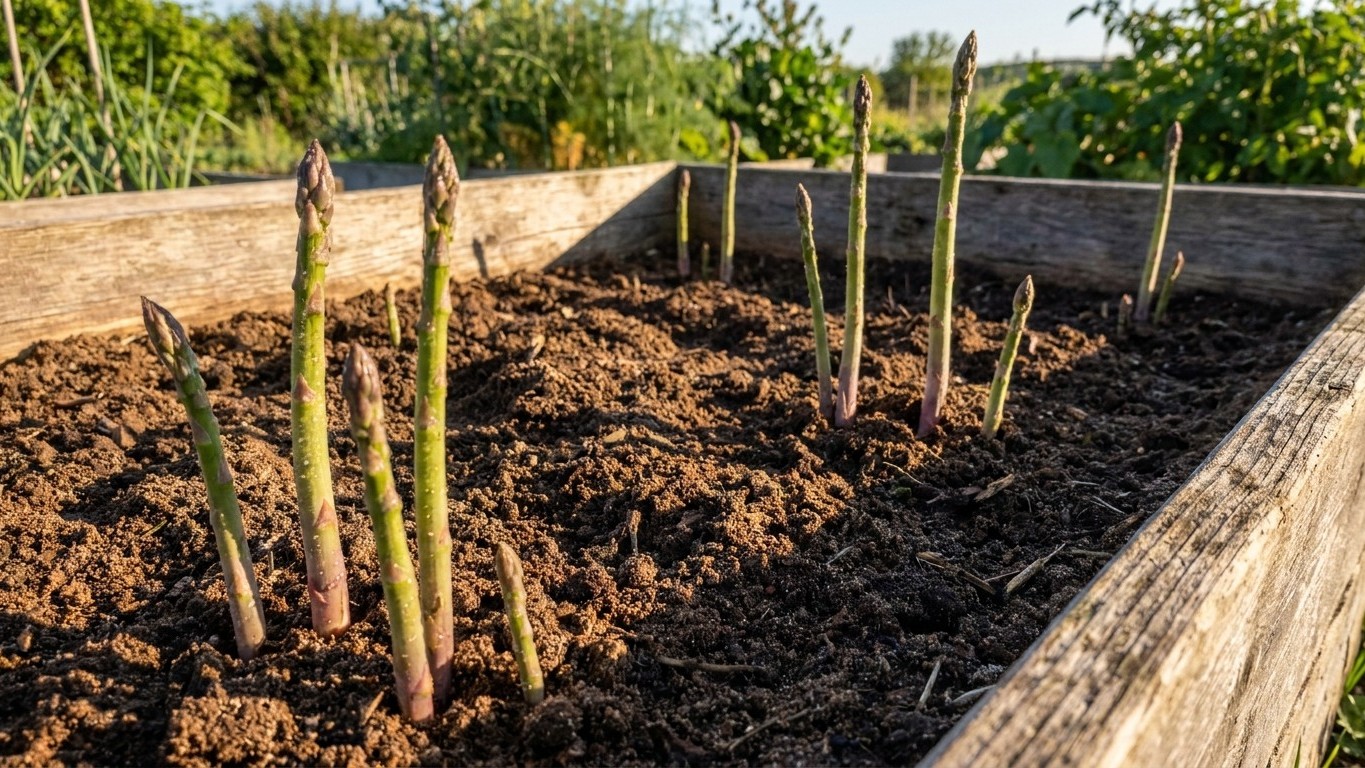

Stop cutting when most of the spears coming up are thinner than a pencil. That signal is something you can hold in your hand, not a week on the calendar. A new Connecticut bed gets no harvest at all until year 3, then four weeks of cutting, then six, then eight. Once cut, spears keep best at 32 to 35°F with their butts standing in water. Above 50°F they toughen within hours.
The short answer
Connecticut’s state soil is the Windsor series, and it drains almost too well. USDA classes it as an Entisol, a very young soil with almost no profile development. The surface runs about 82 percent sand, 2 percent clay and 16 percent silt, and USDA rates it excessively drained. That matters more for asparagus than for any other crop in the garden. A bed lasts 10 to 15 years, and Utah State University Extension’s only soil requirement is that the ground drains. Most soils will do as long as they do.
On drainage, then, the state’s dominant soil passes with room to spare. The risk runs the other way. Water leaves a sandy bed fast, which is why the next section is about watering rather than waterlogging. The surface pH in the USDA record is about 5.1, strongly acid. That describes the series, not your garden, and the extension source is silent on any pH target for asparagus, so this page gives none. A soil test will give you your own number.
One more figure needs a warning label: the organic matter, listed at about 95.0 percent. That reflects a natural organic layer on the mapped surface, the sort of thing found under forest litter. A cultivated bed will not have it, so don’t plan around it.
If your ground doesn’t drain
The state soil is a starting point, not a diagnosis. Connecticut spans hundreds of soil series. River bottoms, hill country and any lot a builder has scraped or filled can behave nothing like Windsor sand. In most vegetable beds a heavy soil is an annual nuisance you amend each season. Here it is a decision you live with for fifteen years.
If water stands in a hole a day or so after heavy rain, don’t plant there and hope. Build a raised bed or choose another spot. Our guide on Will Connecticut Soil Hold an Asparagus Bed for Fifteen Years? goes deeper on checking a site before you commit.
What the wait looks like
The cutting rule only makes sense against that timeline. Nothing is cut in years 1 and 2, and the rule is not “you may take a few spears.” Year 3 allows four weeks, year 4 six weeks, year 5 eight weeks. Within any season, the pencil test ends the cutting. Whatever the calendar says, when most spears come up thinner than a pencil, you are done. Leave the rest to grow. Pests can also hit a young bed hard, which is covered in What Eats Asparagus in Connecticut, and When.
Will the summer here water it for you?
Partly. The rain is there on paper, but sandy ground doesn’t hold on to it.
The numbers side by side
The Utah State schedule asks for 1 to 2 inches every other week for the first two years, then every three weeks after that. NOAA’s most recent 30-year normals for the Bridgeport station show about 11.1 inches of rain across June, July and August, out of 44.1 inches for the whole year. By month, June brings 3.77 inches, July 3.32 and August 3.98. July is the driest. Spread evenly, that is a little under 2 inches in any two-week stretch, so the average summer nearly covers the bed.
Averages hide how rain actually falls. A single thunderstorm mostly runs off rather than soaking in. A sandy surface lets the rest through within the day, and days at or above 90°F pull water back out through evaporation. These are normals for one coastal station, not a forecast, and not your plot.
What to do with them
- In years 1 and 2, aim for 1 to 2 inches every other week, counting rain and hose together.
- From year 3 on, stretch that to every three weeks.
- Put a rain gauge on the plot itself. It settles what actually fell better than any normal can.
- If a two-week stretch brings less than 1 inch, add the difference with the hose. In a dry July that can mean the full 1 to 2 inches.
- On sandy ground, expect to top up more often than a clay-soil neighbor, because the soil sheds water within the day.
The practical answer to “how much must I add” is whatever the gauge says is missing. In a typical Connecticut summer that is some of it, and in a hot dry spell it is all of it.
When to put the crowns in
Early spring, in 8-inch furrows. Utah State’s wording is “early spring,” and it gives no frost-relative offset, so that is the anchor here. For Connecticut, NOAA’s normals put the last spring 32°F freeze at around April 2 to April 12, based on the 30 to 70 percent probability band at Bridgeport. A mean frost date is an average, and some years fall on either side of it.
Bridgeport sits on Long Island Sound and is the mildest part of the state. Inland and northwest Connecticut freeze later in spring, so those gardeners should plant later than that window.
Backfilling the furrow
The furrow is not filled in all at once. Backfill gradually across the year, about 2 inches every other month. A planting that goes in early in spring gets its soil in stages, and the furrow gradually levels out.
The seed route, and the varieties
Starting from seed is the alternative to crowns. The extension source behind this page gives no seed-sowing dates or timetable, so none is offered here. Treat the crown schedule as the one with a published anchor.
The source names four varieties and says only whether each is male or female:
- Jersey Giant: all-male
- Jersey Knight: all-male
- UC 157 F1: male and female
- Purple Passion: male and female
No flavor, yield or reason to prefer one is published, so any claim that one is better would be invented. For the full planting walkthrough, see Growing Asparagus in Connecticut.
Common questions
How do I know it’s time to stop cutting in a given year?
Look at what is coming up. When most of the new spears are thinner than a pencil, stop. That is the rule, and it is an object, not a date, so a warm spring and a cold one end the season at different times.
How should I store the spears once they’re cut?
UC Davis Postharvest gives the optimum as 32 to 35°F (0 to 2°C), with relative humidity of 95 to 100 percent. The fact sheet calls high humidity essential, because spears lose water fast. In a home kitchen, stand the butts in water or wrap them damp. The cut end loses moisture faster than anything else.
What temperatures actually damage them?
Both edges bite. Above 50°F, spears toughen rapidly. At 30.9°F or lower, freezing injury sets in, a water-soaked look that leads to extreme softening. A refrigerator thermometer will tell you whether your fridge sits inside the narrow window, since the cold back of a shelf can run lower than the door.
Can I cut a few spears in the first two years?
No. Nothing is harvested until year 3, and then only for four weeks. After that comes six weeks, then eight, and a healthy bed then produces for 10 to 15 years. The early patience is what pays for those long seasons.