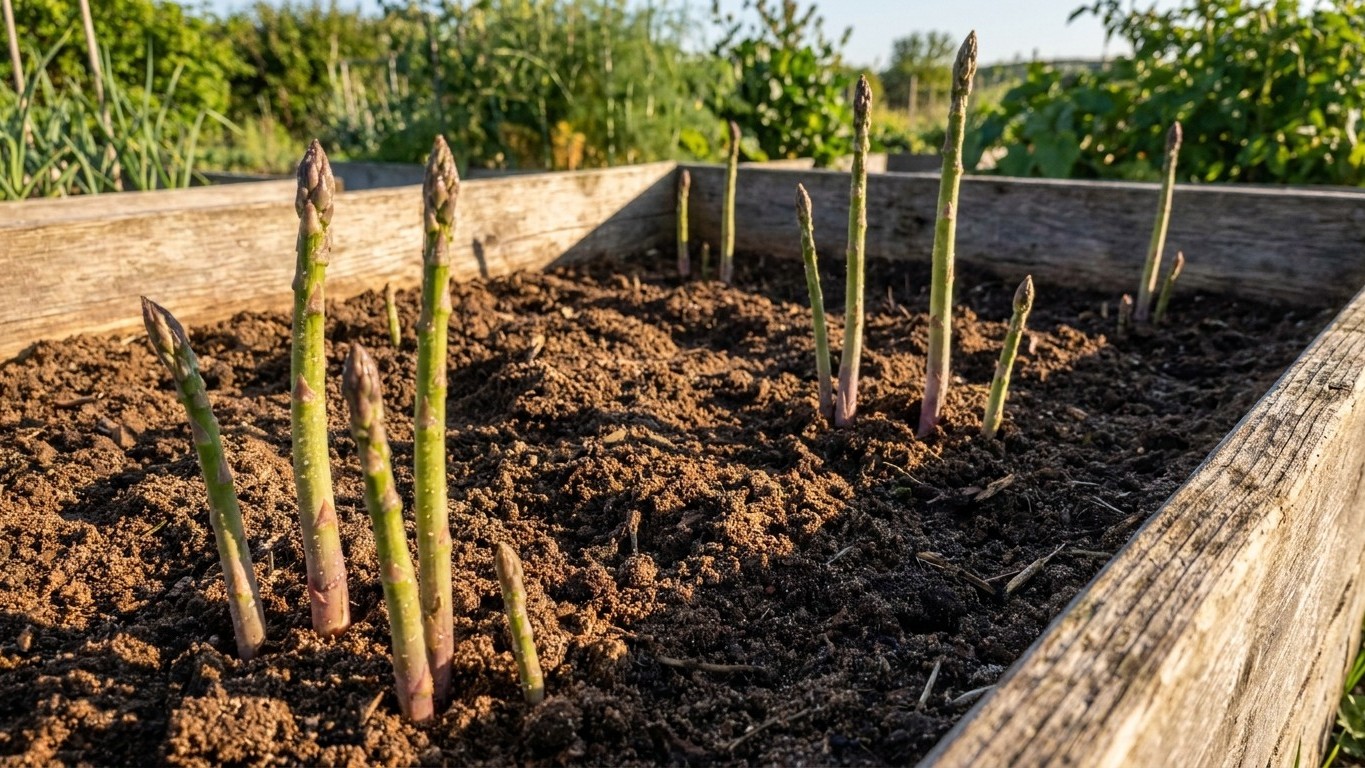

UConn Extension documents ten garden pests active in Connecticut, but only a handful ever touch asparagus. Cutworms clip young spears at the soil line in early spring. Japanese beetles and four-lined plant bugs chew the ferny top growth once the bed matures for summer, and brown marmorated stink bug shows up as an occasional visitor rather than a regular feeder.
Which pests attack asparagus in Connecticut

UConn Extension lists ten pests documented in the state: allium leafminer, brown marmorated stink bug, Colorado potato beetle, cutworms, four-lined plant bug, Japanese beetle, lily leaf beetle (Lilioceris lilii), squash bug (Anasa tristis), squash vine borer (Melittia cucurbitae), and striped cucumber beetle (Acalymma vittata). That’s the full documented list for this territory, and it’s shorter than most vegetable growers expect. It does not include the asparagus beetle, which is the insect most gardening references treat as the crop’s signature pest elsewhere in the country. On this list, none of the species is an asparagus specialist.
Six of the ten have no business on an asparagus bed. Allium leafminer targets true alliums, onions, garlic, leeks, chives, and it needs that plant chemistry to complete its life cycle, so it skips asparagus entirely. Colorado potato beetle feeds on nightshades: potatoes, eggplant, tomato. Lily leaf beetle is locked onto true lilies and fritillaria despite the name confusion with “asparagus fern” foliage that sometimes gets mistaken for lily leaves. Squash bug, squash vine borer, and striped cucumber beetle are all cucurbit specialists, built for pumpkin, squash, and cucumber vines and unable to feed on asparagus tissue.
Four species remain, and each is a generalist rather than an asparagus specialist. Cutworms are soil-surface caterpillars that sever tender stems at ground level, and a newly emerged asparagus spear is exactly the kind of soft target they favor. Japanese beetle feeds on foliage across hundreds of plant species, including the feathery mature fern growth asparagus produces after harvest ends. Four-lined plant bug punctures leaf tissue on a wide range of herbaceous plants and can mark asparagus fern the same way it marks mint or basil. Brown marmorated stink bug is the loosest fit of the four, a true generalist that will probe almost any soft plant tissue but shows no particular preference for asparagus over dozens of other garden crops.
The one decision that matters most here is protecting the crown in its first two seasons, since UConn Extension’s list contains no pest that specifically hunts asparagus, and the plants most at risk are young spears before the bed has enough growth to shrug off a bite.
When each one shows up, and what it does first
Crowns go into the ground as bare roots in early spring, planted in 8-inch furrows. Connecticut’s last spring frost typically falls between April 2 and April 12, according to NOAA’s 1991-2020 climate normals for the coastal reference station, and that window is the anchor point for everything that follows, since inland and northwest parts of the state trail behind it. Cutworms are active on the soil surface as soon as the ground warms enough for spears to push through, which puts them at the very start of the season, often before a gardener has even confirmed the bed survived winter. The first sign is rarely the insect itself. It’s a spear that toppled overnight, cut cleanly near the base, with no chewing damage higher up the stalk.
Four-lined plant bug arrives once the bed has real leaf surface to feed on, which for a first- or second-year planting means the ferny growth that follows the short early spears. Its damage shows up as small, sunken, discolored spots scattered across the foliage, almost like a fine buckshot pattern, rather than any missing tissue. Japanese beetle follows a similar rhythm, appearing later in the growing season once fern growth is well established, and it skeletonizes leaflets, leaving behind a lace of veins where solid green tissue used to be. Because a mature bed isn’t harvested for spears again until the following spring, this foliage damage matters more for the plant’s long-term vigor than for any crop lost that week.
Brown marmorated stink bug is the least predictable of the four. It moves through gardens opportunistically through the warmer months, probing a wide range of plants with its piercing mouthpart, and on asparagus that usually means faint stippling or discoloration on stems and foliage rather than the more obvious feeding scars left by beetles. None of these four follows a tight calendar the way a specialist pest would. What decides the order is the plant’s own growth stage, tender spear first, then expanding fern, and each insect simply takes what’s available when it turns up.
Telling the damage apart from everything else
Asparagus grows in a wide range of soils, but Connecticut’s representative state soil, the Windsor series, is sandy and excessively drained, with a strongly acid surface pH near 5.1. That combination produces stress symptoms that get mistaken for insect damage more often than actual insect damage occurs. A spear that emerges thin, pale, or bent is more often a drainage or fertility issue than a pest problem, since none of Connecticut’s documented pests attack asparagus roots or crowns underground.
The table below separates the likely causes for the symptoms a gardener actually sees at ground level.
| What you see | Likely cause | What tells them apart |
|---|---|---|
| Spear toppled overnight, cut cleanly at the base | Cutworm | Clean cut low on the stem, insect often curled in soil nearby |
| Small sunken spots scattered on fern foliage | Four-lined plant bug | Spots stay small and don’t spread; no missing leaf tissue |
| Leaflets skeletonized, only veins left | Japanese beetle | Visible beetles clustered on foliage during feeding |
| Pale, thin, or wilted spears with no chewing marks | Drought stress or nutrient shortage | No insect present; soil is sandy, dry, or untested |
| Yellowing or dieback spreading through the bed | Possible root or crown disease | Below-ground symptom; no pest on this list feeds underground |
The organic-matter figure recorded for the Windsor series surface, about 95 percent, describes the mapped natural horizon of that series, not a cultivated garden bed. A worked asparagus row will never carry anything close to that number, so it’s not a benchmark to compare a home bed against. When symptoms don’t clearly match an insect on the documented list, a soil test and a call to the local extension office settle it faster than guessing.
What actually works here, and what is a waste of time
Physical exclusion beats almost anything else on a short growing season. A collar or barrier placed around emerging spears in early spring, timed to go up before the April 2 to April 12 frost window closes, keeps cutworms from reaching tender stems when they’re most vulnerable. Hand-picking Japanese beetles off fern foliage in the morning, when they’re sluggish, is tedious but effective, and it avoids the tissue damage that comes with chemical treatments on a plant that’s still building the energy reserves it needs for next year’s crop.
Beetle traps marketed for Japanese beetle control are widely considered a poor choice for a single garden bed. They release a scent that draws beetles in from well beyond the property line, often pulling in more insects than were there to begin with. Broad insecticide applications aimed at four-lined plant bug are similarly hard to justify. The damage is cosmetic on established fern growth, and the bug is a generalist that will simply move on to another host plant nearby.
Because asparagus isn’t harvested at all in its first two years and only lightly after that, the plant’s job during most of the growing season is building fern growth to feed the crown underground. Protecting that fern from serious damage matters more than eliminating every insect that lands on it. Since no pest on Connecticut’s documented list attacks the crown or roots directly, the practical priority is straightforward: shield young spears from cutworms early, tolerate minor cosmetic feeding on fern foliage later, and reserve any stronger intervention for a UConn Extension recommendation specific to the situation, since this site doesn’t name products or rates.
Where to check this for your own county
UConn Extension is the source for every pest named on this page, and its county-level offices track local conditions that a statewide list can’t capture. Pest pressure inside Connecticut varies from the shoreline to the northwest hills, the same way the state’s frost dates do, and a pest documented somewhere in the state is not a guarantee it’s active in a specific backyard.
The Windsor soil series used to represent Connecticut in USDA records is one series among hundreds mapped across the state. A garden on river-bottom soil, hillside ground, or fill from a home build will behave nothing like it, particularly on drainage and pH, both of which shape how stressed a plant looks before an insect ever gets involved. A soil test through the local extension office gives an actual number instead of a statewide estimate.
The next useful step is contacting the county office directly, describing the symptom rather than naming a suspected pest, and asking whether it matches something currently active in that part of the state. That conversation, backed by a soil test on the actual bed, answers the question a general list never can.
Common questions
Does Connecticut have an asparagus-specific pest?
UConn Extension’s documented list for the state doesn’t include the asparagus beetle or any other asparagus specialist. The species that do occasionally feed on asparagus here, cutworms, Japanese beetle, four-lined plant bug, and brown marmorated stink bug, are all generalists that also attack many other garden plants.
When are asparagus spears most vulnerable to insect damage?
Right after they emerge in early spring, close to the region’s last frost window of April 2 to April 12, when cutworms are active at the soil surface and the spears themselves are soft and unprotected by any woody tissue.
Can I harvest asparagus the same year I plant it?
No. Asparagus crowns aren’t harvested until year three after planting, and even then the harvest period is short and expands gradually over the following seasons as the crown matures.
Is Connecticut’s soil naturally good for asparagus?
The state’s representative soil, the Windsor series, is sandy and excessively drained, which suits a crop that needs well-drained ground. Its surface pH runs strongly acid, but this page’s sources don’t specify an ideal pH for asparagus, so a soil test on the actual planting site is the only way to know where a given garden stands.