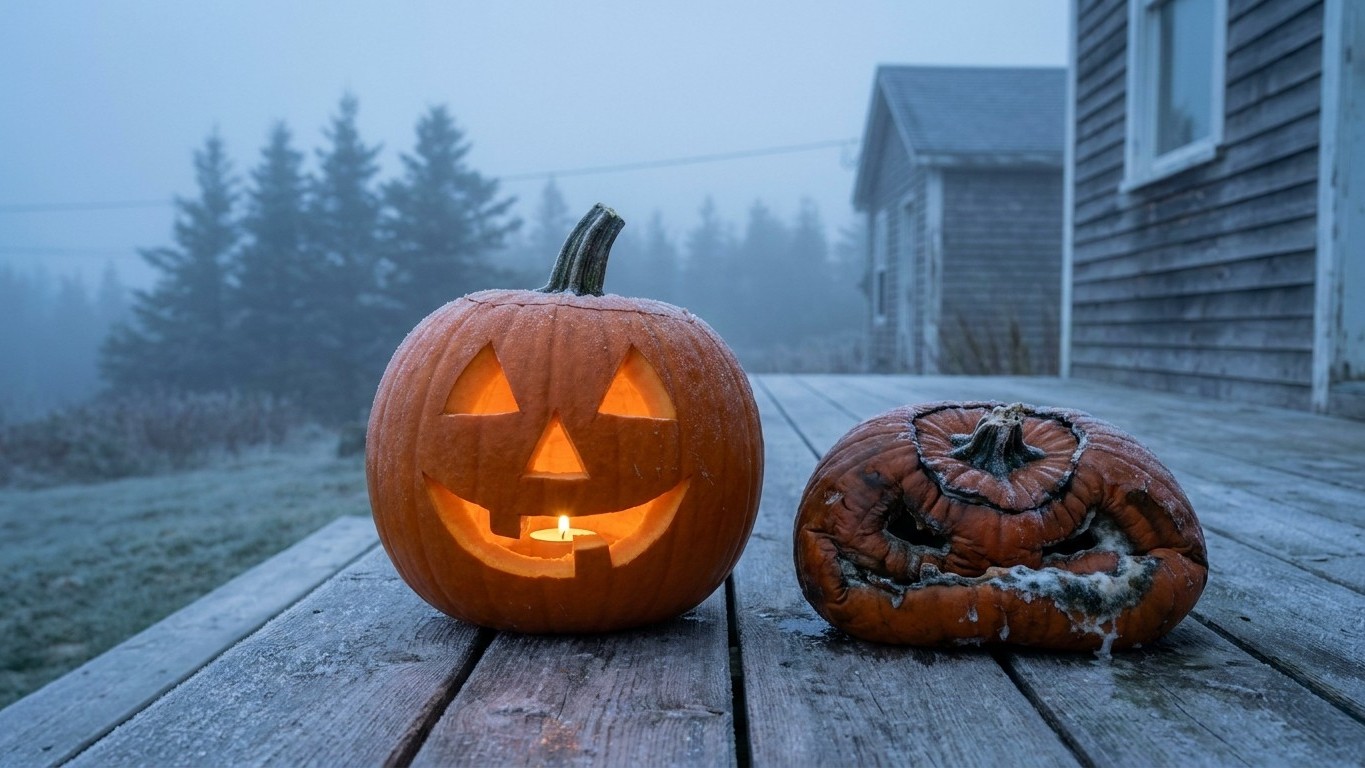

In Pennsylvania, the thing that eats the most pumpkins is the calendar. Frost ends the season before late fruit can ripen, and the clock that decides this runs from the day a flower opens, not from the day you sowed seed. Squash bugs and cucumber beetles also feed on the vines, and both have their own pages on this site. This one covers the timing, and the failures that come with it.
The short answer
The first fall freeze at 32 F lands between November 5 and November 16, according to NOAA NCEI U.S. Climate Normals. That window covers the middle of the probability band, the stretch where a first freeze is neither unlikely nor certain. Pumpkins need 45 to 55 days to mature after flowering (Utah State University Extension). Count backward from the frost window and you get the latest a flower can open and still give a ripe pumpkin.
The arithmetic is short. Take the early end of the frost window, November 5, and subtract 55 days: September 11. Take the late end, November 16, and subtract 45 days: October 2. So the deadline for a flower to open falls somewhere between September 11 and October 2. It is a window, not a single day, because both the frost date and the ripening time are ranges. A flower opening on September 11 is safe only if frost holds off until mid-November and the fruit ripens on the fast end. By October 2 you need both numbers to break your way.
Treat the early edge as the real deadline. Planning around the generous end means betting on a late frost and a quick ripening at once.
Why the count starts at the flower
The 45 to 55 days begin when the female flower opens and gets pollinated. They do not begin at seeding or transplanting. A vine can be lush and green by midsummer, but the fruit clock has not started until a flower opens. Forty-five to 55 days is roughly six and a half to eight weeks, which is a long time to ask a vine to hold its fruit through a Pennsylvania autumn.
Utah State University Extension also says to harvest with the stem attached, before frost. A pumpkin that has not colored by the time the window closes will not catch up in the cold, and a freeze-damaged fruit is a short-lived one. If you want the full picture of whether a given fruit will make it, Will Pumpkins Ripen Before Frost in Pennsylvania? walks through it.
One caution about the dates themselves. The frost window above comes from the Philadelphia station, which is the mildest corner of the state. The northern tier and the Alleghenies run two to four weeks later in spring. Fall frost dates for those areas are not published here, so I will not guess at them. If you garden outside the southeast, expect your own window to start earlier than the one above, and keep a closer eye on the forecast. For the broader picture, see Growing Pumpkins in Pennsylvania.
When to sow here
Sowing waits on the soil, not on the last frost. Pumpkins are sown when the soil reaches 65 F, and soil lags the air by weeks. The last spring freeze at the Philadelphia station falls between March 29 and April 6, but that date says nothing about when the ground is warm enough. Here is the sequence in order, with the arithmetic spelled out.
- Start with the last frost. March 29 to April 6 in Philadelphia, per NOAA NCEI U.S. Climate Normals. This is the air, not the soil.
- Add the soil lag. The soil trails the air by weeks, plural. Even a lag of only two weeks pushes the earliest sensible sowing to about April 12 through April 20. Treat that as a floor, because the real lag is often longer. The exact date soil hits 65 F is not published here.
- Confirm with a thermometer. Push a soil thermometer a few inches into the bed and sow when it reads 65 F, not when the calendar says so.
- Subtract the row cover bonus. Row covers buy about two weeks. Under cover, you can sow roughly two weeks ahead of the date your uncovered soil would warm.
- Shift for your location. In the northern tier and the Alleghenies, spring runs two to four weeks later than in Philadelphia. Move every date above later by that much.
- Check the result against the flowering deadline. Whatever sowing date you land on, the vine has to flower and set fruit before the window of September 11 to October 2 closes. How many days a vine takes to go from seed to first flower is not published here, so watch your own vines rather than trusting a number.
The trap is reading “last frost passed” as “time to plant.” Seed in cold soil can sit and rot, and a seedling that stalls loses weeks that the fall deadline will not give back. The detailed dates by region are on When to Sow Pumpkins in Pennsylvania.
What goes wrong here
A Pennsylvania season is long enough for pumpkins, but not long enough to forgive slack. Most failures come from the same source: fruit that starts too late, or a vine that quits too early.
- A late flower that never colors. A flower that opens after the window of September 11 to October 2 gives a fruit that stays green. Count your own dates: if a flower opens near the edge, the fruit is a long shot. The remedy is to stop expecting it to finish and pick it for decoration or leave it, and to put your energy into the fruit that set earlier. Sowing on time, which means waiting for 65 F soil and using row covers if you want that two-week head start, is the real fix for next year.
- A fruit caught by frost. A freeze in the November 5 to November 16 window, or earlier in colder parts of the state, damages fruit still on the vine. Harvest with the stem attached before frost, as Utah State University Extension advises, and watch the forecast through the end of October. Don’t wait for the date alone, since the window is a probability band and not a promise.
- A vine that dies back before the skin hardens. Insects and disease can finish a vine early, leaving fruit with soft skin. Squash bugs and cucumber beetles are the usual suspects, and their state pages on this site cover what to look for. For the fruit already on the vine, harvest with a stem attached and move it to a cool, dark place to finish.
- A stored pumpkin that ages too fast. A whole pumpkin keeps three to six months in a cool, dark spot between 45 and 50 F (University of Illinois Extension). The catch is that ripening fruit such as apples, potatoes, and tomatoes gives off a gas that ages the pumpkin. The porch next to the apple crate is the worst place for it. That 45 to 50 F range applies to a whole pumpkin only, and no figure is published here for a carved one.
Utah State University Extension’s only guidance on storage is to keep pumpkins where they will not freeze. It gives no temperature or keeping time, so the numbers above come from Illinois.
Common questions
What eats pumpkins in Pennsylvania?
Frost is the biggest threat, because it ends the season before late fruit ripens. Squash bugs and cucumber beetles also feed on the plants, and each has its own page on this site.
How late can a flower open and still make a ripe pumpkin?
Counting 45 to 55 days after flowering back from the November 5 to November 16 frost window gives September 11 to October 2. Aim for the early edge, not the late one. The count starts at flowering, not at seeding.
Can I sow as soon as the last frost has passed?
No. Sow when the soil reaches 65 F. The last frost in Philadelphia falls between March 29 and April 6, and soil lags the air by weeks. Row covers buy about two weeks, and the northern tier and Alleghenies run two to four weeks later in spring.
Where should I store a whole pumpkin?
A whole pumpkin keeps three to six months in a cool, dark spot between 45 and 50 F, away from apples, potatoes, and tomatoes. Ripening fruit gives off a gas that ages it. No storage figure is published here for a carved pumpkin.