
Stop cutting when most of the spears coming up are thinner than a pencil. That is the whole rule, and it is an object you check by eye, not a date on the calendar. It applies only to an established bed. A crown planted this spring is not cut at all until its third year, and then the season runs four weeks, then six, then eight. Once cut, spears keep best at 32 to 35°F with their butts standing in water. The full picture of the crop is in Growing Asparagus in Indiana.
The short answer
A bed planted this spring is a bed you live with for 10 to 15 years. Utah State University Extension, the only authority behind the planting figures on this page, asks one thing of the soil: most soils will do, provided they are well drained. It does not ask for rich, loose or perfectly amended ground. It asks for ground that drains.
Indiana’s state soil is the Miami series, an Alfisol, a forest soil of moderate fertility that holds nutrients reasonably well. USDA records its surface layer as loam to silt: about 30 percent sand, 20 percent clay and 49 percent silt, with roughly 2.0 percent organic matter and a surface pH of about 6.5, slightly acid. The line that matters most is the drainage class. Miami is moderately well drained. Those are representative values for the mapped surface layer across 627 components of the series, not a reading from a worked garden bed, and that pH belongs to the series, not to your yard.
So does the dominant soil drain well enough? Mostly yes, with an asterisk. Moderately well drained sits one step short of well drained. The soil sheds water, but it can stay wet for a stretch after heavy spring rain, and spring is exactly when crowns are buried in an 8-inch furrow. A silty loam like this is forgiving on a slight rise and unforgiving in a low corner of the yard.
For a tomato bed, a soggy corner is an annual nuisance you amend away each season. For asparagus it is a decision you cannot undo. The crowns stay put for a decade or more, and nobody wants to dig up a four-year-old planting to fix a drainage mistake.
The state soil is also a starting point, not a diagnosis of one garden. Indiana spans hundreds of soil series. River bottoms, hill country and any lot a builder has scraped or filled can behave nothing like Miami, and many suburban back yards fall into that last group. Your own ground might drain better than the state soil or far worse.
If yours does not drain, the options are simple. Pick the highest, best-draining spot on the property, or build the bed up so water has somewhere to go. Before planting, dig a hole where the bed will sit, fill it with water, and check whether any is still standing a day later. A soil test will give you your own pH and texture numbers. This page does not name a target pH for asparagus, because the source does not publish one. The longer discussion is in Will Indiana Soil Hold an Asparagus Bed for Fifteen Years?
Will the summer here water it for you?
Partly. The bed wants 1 to 2 inches of water every other week for its first two years, then every three weeks after that. NOAA’s 1991-2020 normals for the Indianapolis reference station put June, July and August at about 12.6 inches of rain combined (43.6 inches over the full year). By month, that is 4.95 inches in June, 4.42 in July and 3.2 in August, the driest of the three.
Spread across roughly 13 weeks, that is just under an inch a week on average, which on paper covers a 1-to-2-inch-every-other-week schedule. Paper is generous, though. Rain arrives in bursts, and a thunderstorm that drops an inch in twenty minutes mostly runs off instead of soaking in. Hot stretches pull moisture back out of the ground quickly. These are normals, not a forecast, and a slope, a city lot or a neighbor’s tall hedge changes what actually lands on your bed. Here is how to handle it:
- Put a rain gauge at the bed. It settles the question better than any normal. Count what actually falls, not what the weather app says fell across town.
- In the first two years, aim for 1 to 2 inches every other week. Add up the rain over each two-week stretch. If the gauge shows less than 1 inch, water to make up the difference. If it shows 1 inch or more, leave the hose alone.
- Expect to add the most in August. At 3.2 inches for the month it is the thinnest of the three summer months, so that is where the shortfalls will show up.
- From the third year, stretch the interval to every three weeks. The same logic applies. Let the gauge tell you whether the rain covered the 1 to 2 inches or whether you owe the bed the balance.
In a normal summer, then, the gardener adds little. In a dry spell the whole gap falls to you. Miami’s silt-loam surface holds water better than sand would, but sandy ground, if yours is sandy, would let the same inch through within the day. The soil beneath your own bed decides how often you really water.
When to put the crowns in
Crowns go in during early spring. For Indianapolis, the NOAA 1991-2020 normals put the last 32°F freeze somewhere around April 9 to April 21 (the 30-70% probability band). Southern Indiana runs earlier in spring than the north by a fortnight or more, so a gardener near the Ohio River starts sooner than one near the Michigan line.
Treat those dates as the middle of a spread, not a promise. Purdue adds a useful caution: there is still roughly a 10% chance of a 32°F night after the published spring date. Crowns set out on the early edge of the range need a cover ready, such as a bucket, a sheet or row fabric, for the odd cold night.
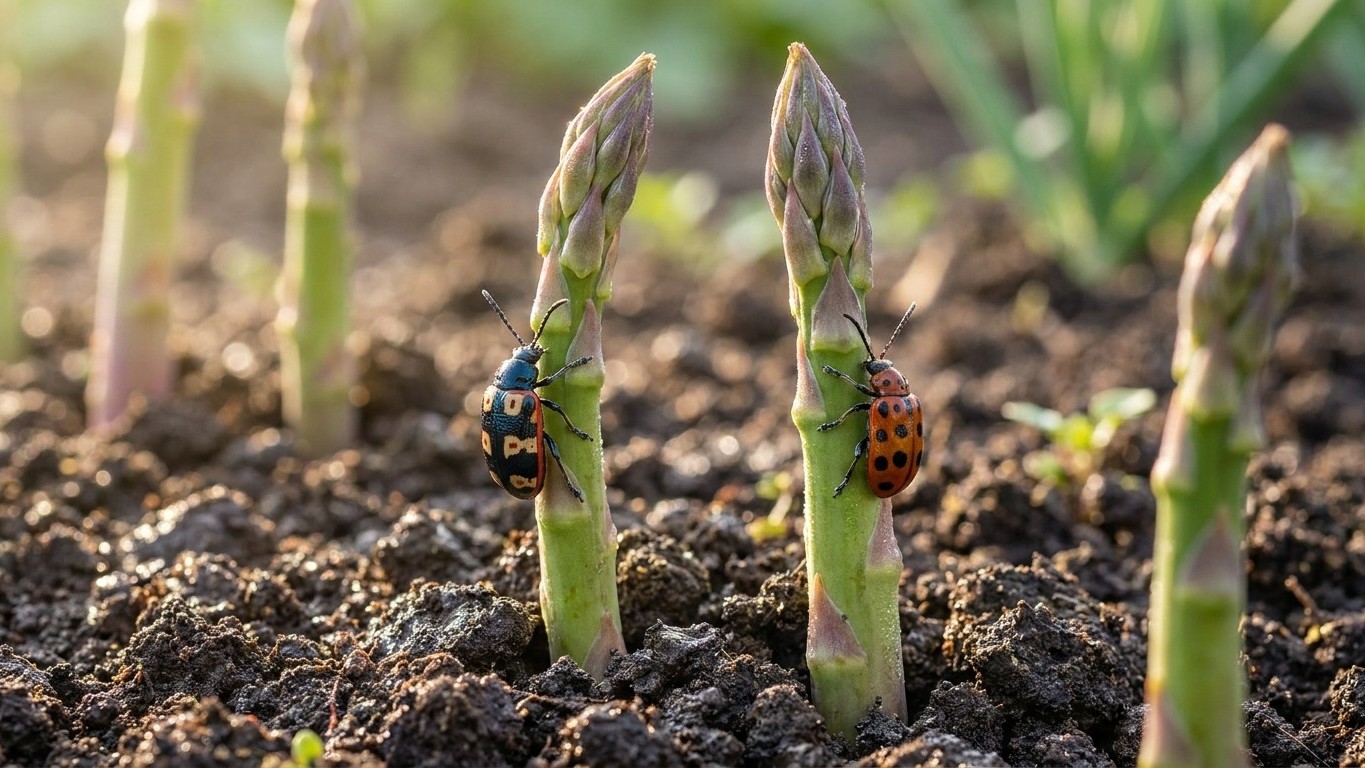
Planting itself is a matter of digging an 8-inch furrow, setting the crowns in it, and filling the furrow back in gradually across the year, about 2 inches every other month, instead of all at once. Then comes the waiting. Nothing is harvested until year 3, and the bed produces for 10 to 15 years after that. When spears finally show up, so do the creatures that eat them, and What Eats Asparagus in Indiana, and When covers who arrives and at what time of year.
Four varieties come up in the Utah State University Extension guide, and the only thing it says about them is their sex. Jersey Giant and Jersey Knight are all-male. UC 157 F1 and Purple Passion are male and female. The source publishes no flavor notes, no yield figures and no reason to prefer one over another, so any claim about which tastes best or crops heaviest would come from somewhere else. This page names no nursery either.
Growing from seed is the alternative to crowns. The source figures here describe crowns, so this page carries no seed-sowing date, and you should not assume that starting from seed shortens the wait until the first cut. Check the Utah State University Extension guide before committing to that route.
Common questions
When do I stop cutting each season?
Stop when most of the spears are thinner than a pencil. That is a visual signal, not a week number, and this page does not convert it into one. Look at the whole patch. A stray thin spear among thick ones is not the signal, but a bed where thin spears dominate is telling you to quit and let the ferns grow.
How do I keep cut spears fresh?
The UC Davis Postharvest Technology Center gives the target as 32 to 35.6°F with 95 to 100 percent relative humidity (its asparagus fact sheet has the details). Both edges bite. Above 50°F, spears toughen rapidly. At about 31°F or lower, they suffer freezing injury, turn water-soaked and collapse as they thaw. In a home kitchen, the practical way to get that humidity is to stand the butts in water or wrap them damp, because spears lose moisture through the cut end faster than anywhere else. A fridge thermometer is worth a few dollars, since you want to know whether your coldest shelf is edging toward freezing.
Can I cut any spears in the first two years?
No. Nothing is harvested until year 3. After that the cutting season is four weeks, then six, then eight in the following seasons. Those limits are not suggestions to soften into “a few spears here and there.”
Does the stopping rule change between northern and southern Indiana?
The signal is the same everywhere, the pencil-thin spears. What shifts is the calendar. Spring arrives a fortnight or more earlier in the south, so cutting there starts and ends on a different schedule than in the north. Watch the spears, not the date.