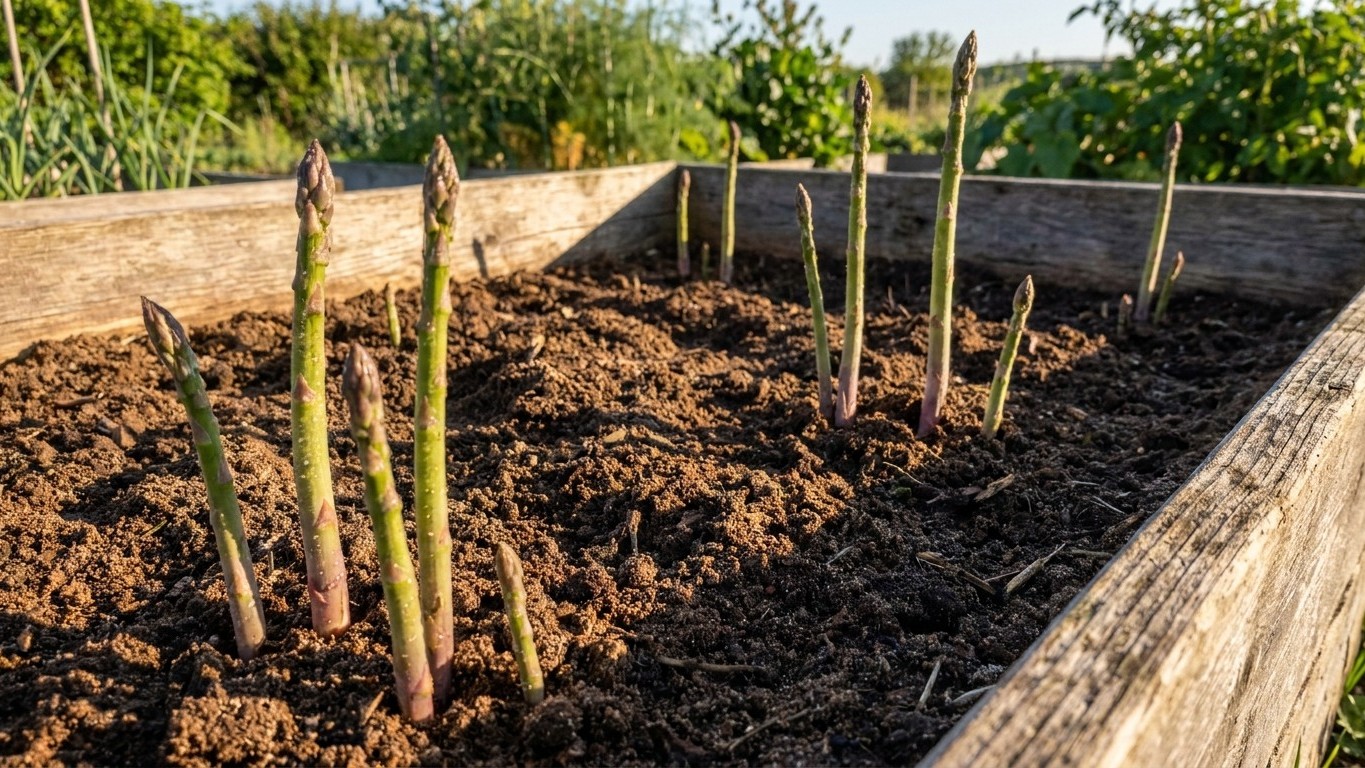

Yes, in most cases. The soil that represents Indiana drains “moderately well,” which is exactly the condition an Asparagus Bed needs, and nothing more specific than that. The catch is the word “represents”, your own dirt may be nothing like the state average, and a 10 to 15 year planting is not a crop you get to reposition once the roots are down.
The short answer
Start with what the crop actually asks for. Asparagus is planted as crowns set into 8-inch furrows in early spring, and the plant does not give you a single spear to eat until year three. After that, harvest runs about 4 weeks the first cutting season, then 6, then 8 in later years, and you stop each season not on a calendar date but on an object: when most of the spears coming up are thinner than a pencil. The furrow itself isn’t filled in one afternoon either. Soil goes back over the crowns gradually, roughly two inches every other month across the year, until the trench is level with the surrounding bed. Utah State University Extension, the source behind these figures, is blunt about the one soil condition that actually matters: most soils will do, provided they are well drained.
That’s where Indiana’s representative soil comes into the picture. USDA’s Soil Survey Geographic Database lists the Miami series as the soil that stands in for the state. It’s an Alfisol, a forest-derived soil of moderate fertility, running loam to silt in texture: about 30 percent sand, 20 percent clay, and 49 percent silt in the surface layer, with organic matter around 2.0 percent and a surface pH near 6.5. Drainage is classed as moderately well drained. For a bed you’re committing to for a decade and a half, that’s a workable starting point. It isn’t waterlogged clay, and it isn’t the kind of loose sand that dries out between rains.
But “moderately well drained” describes the map unit USDA surveyed, not the compacted strip behind a garage or the low corner where a downspout empties every spring. If your chosen spot holds standing water an hour after a heavy rain, or the soil balls up wet and cracks like tile when dry, that’s not the Miami series showing up, that’s a local drainage problem asparagus crowns will not tolerate for fifteen years. The fix is straightforward: build a raised bed, 8 to 12 inches above grade, so the crowns sit above whatever the native ground is doing underneath. A soil test through a local extension office will also tell you what the state number can’t: your actual pH, your actual organic matter, your actual drainage class.
On variety, the source names four options and gives no reason to prefer one over another beyond their reproductive type:
| Variety | Type |
|---|---|
| Jersey Giant | All-male |
| Jersey Knight | All-male |
| UC 157 F1 | Male/female |
| Purple Passion | Male/female |
No flavor comparison, no yield claim, and no nursery name is published here. Soil drainage, not variety, is what decides whether a bed makes it to year fifteen.
Will the summer here water it for you?
Rain does most of the work early on, but not all of it. Utah State’s guidance calls for 1 to 2 inches of water every other week during the first two years while roots establish, then eases to about 1 to 2 inches every three weeks once the planting matures. Set that against what a typical Indiana summer delivers, using 1991-2020 normals from the NOAA reference station in Indianapolis, and the picture is uneven month to month.
- June: normal rainfall runs about 4.95 inches for the month, well above what a young bed needs on the every-other-week schedule, in a normal June, the sky is doing most of the watering.
- July: normal rainfall drops to about 4.42 inches, still generally enough to cover the bed’s needs if it falls in useful increments rather than one storm followed by three dry weeks.
- August: the driest of the three months, at about 3.2 inches normal, closer to the bed’s minimum requirement, and the point in the season where a gauge check matters most.
- Across the full summer: June, July and August together average about 12.6 inches, against an annual normal of 43.6 inches, comfortably above the bed’s stated need on paper, but normals describe an average, not the week you’re actually watering in.
The gap between “enough rain on average” and “enough rain when the plant needs it” is where a gardener’s judgment has to fill in. A single Indianapolis-area thunderstorm can dump most of a month’s normal in an hour and run off a compacted Miami-series surface before it soaks past the first few inches, leaving the bed drier than the monthly total suggests. That’s especially true in August, when the normal is already thinnest. The practical move is a rain gauge staked next to the bed rather than trust in the seasonal average: if two weeks pass with less than an inch registered, the bed needs a supplemental soak, particularly in that first-two-years establishment window when roots haven’t reached deep moisture yet.
When to put the crowns in
Crowns go into the ground in early spring, which in practice means working around the last threat of a hard freeze rather than a fixed calendar date. For the Indianapolis reference station, NOAA’s 1991-2020 normals put the window for a 32F freeze event between around April 9 and around April 21. That’s a mean derived from three decades of data, not a guarantee for any single spring, and Purdue’s own caution on this kind of normal holds here too: there’s roughly a 10 percent chance of a 32F freeze turning up after that published date even in a typical year. Anyone planting crowns on the early side of that window should have row cover or straw mulch ready in case a late cold snap follows.
Geography inside the state moves that window around further. Indianapolis sits roughly in the middle of Indiana’s north-south span, and southern counties tend to warm up earlier in spring and hang onto warmth later into fall, sometimes by two weeks or more compared with the north. A gardener near the Ohio River can generally expect to work a bit ahead of the Indianapolis normal; a gardener near the Michigan border should expect the opposite and plan later.
Crowns are the standard route because they save a full growing year compared with starting from seed, and because year three is already the earliest you’ll cut a spear regardless of method. Seed is the alternative for gardeners who don’t mind the extra season: seed goes in once soil has warmed in spring, seedlings spend their first year building a root system in a nursery bed or containers, and the resulting crowns get transplanted out the following spring on the same timing logic as purchased crowns. Either route, the furrow depth and the gradual backfill schedule described earlier apply once the crowns or transplants are actually going into the permanent bed. What doesn’t change with either method is the underlying soil test: a warm, well-drained spot found in early spring is the same spot that needs to still be draining well come year fifteen.
Common questions
Can I plant asparagus in heavy clay if I just add compost?
Compost improves structure over time, but it does not substitute for drainage on a bed meant to sit undisturbed for a decade or more. If the site holds water after rain, a raised bed above the native grade is the more reliable fix than amendment alone.
Do I really get nothing to eat for three full years?
Correct, and the source is specific on this point. No harvest happens in years one or two; year three is the first cutting, running about 4 weeks, followed by longer harvest windows in later years.
How do I know when to stop cutting each spring?
Not by counting weeks. Stop when most of the new spears coming up are thinner than a pencil, that’s the signal the plant needs to switch from producing spears to building the fern growth that feeds next year’s crop.
Does Indiana’s soil pH need adjusting before planting?
The Utah State University source that sets the drainage requirement is silent on soil pH for asparagus, and no chilling requirement is published either. A local soil test, rather than the state’s representative pH figure, is the only way to answer that for a specific bed.