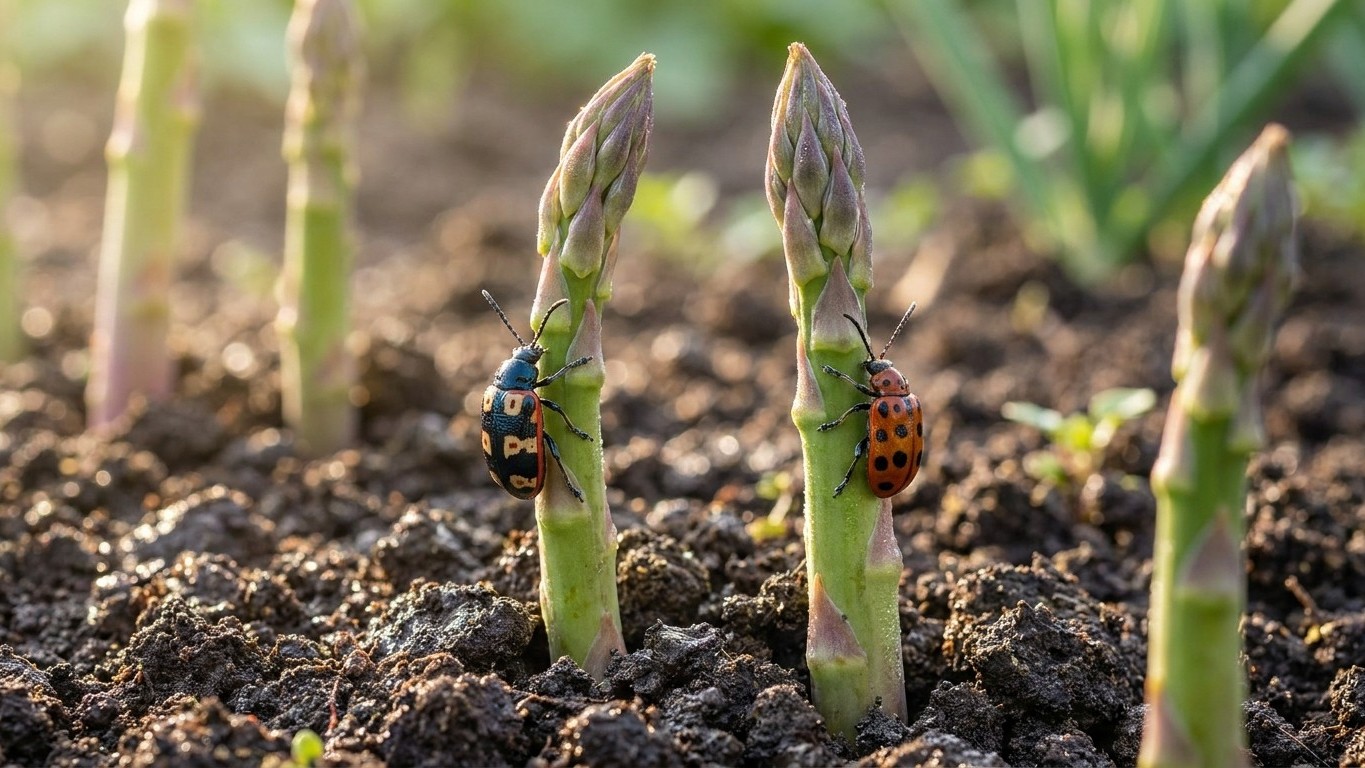

The best-documented thing that eats asparagus is the gardener, and the calendar says not until year 3. After that the bed feeds you for 10 to 15 years. Insects and wildlife are a separate question, and the sources behind this page publish no Oklahoma pest calendar, so none is invented here. What follows covers what the bed asks of the ground, the summer and the spring, because those decide whether it lives long enough to be eaten. For the full growing picture, start with Growing Asparagus in Oklahoma.
The short answer
What the state soil tells you
Most vegetables forgive a bad choice of spot, because you amend, rotate and start over every spring. Asparagus does not. Utah State University Extension describes crowns set in 8-inch furrows in early spring, no harvest until year 3, then 10 to 15 years of production. That is a bed you will still be cutting when a child born this year is old enough to drive. The same source gives one soil requirement: most soils will do, provided they are well drained. Drainage is the whole test.
Oklahoma’s state soil is the Port series, a Mollisol, the deep, dark prairie ground of the kind that built the Corn Belt. USDA’s representative values for its surface layer read 12 percent sand, 19 percent clay and 69 percent silt, which makes it a loam to silt, with organic matter of about 2.0 percent. USDA classes it as well drained. The surface pH comes in around 7.0, near neutral, but treat that as a description of that soil only. The asparagus source says nothing about pH, so no pH target is offered here.
So does the dominant soil drain well enough? Yes. A silt-heavy loam with a modest share of clay sheds standing water far better than a gumbo clay does, and that is the property a fifteen-year bed needs.
When your own ground doesn’t drain
The state soil is a starting point, not a diagnosis of your garden. A state holds hundreds of soil series. River bottoms, hill country, and any lot a builder has scraped or filled can behave nothing like Port, and the figures above describe a mapped surface layer, not a worked garden bed.
The stakes are different here too. Heavy soil elsewhere is an annual nuisance you amend each season. For asparagus it is a decision you cannot undo for a decade or more. Before you dig a single furrow, dig a test hole where the bed would go, fill it with water, and see how long it takes to empty. If water sits well after the hole should have drained, plant somewhere else. Move the bed to higher, freer ground, or build it up above the heavy layer, rather than counting on amendments later.
A soil test from your county Extension office gives you your own numbers instead of the state’s. Will Oklahoma Soil Hold an Asparagus Bed for Fifteen Years? takes the drainage question further.
Will the summer here water it for you?
What the summer actually delivers
The bed wants 1 to 2 inches of water every other week for its first two years, then every three weeks. Against that, the 30-year climate normals for the Oklahoma reference station show about 11.7 inches of rain across June, July and August, out of 36.4 inches for the whole year. That is just under a third of the annual total, falling in the hottest months.
Month by month, June brings 4.49 inches, July 3.59 and August 3.6. July, the driest of the three, works out to roughly 1.6 inches per two-week stretch if it fell evenly. That sits inside the 1 to 2 inch target. On paper, a normal summer nearly waters a young bed by itself.
Rain never falls on paper, though. It arrives as thunderstorms, and a heavy downpour mostly runs off instead of soaking in. Hot days pull moisture back out of the ground. These figures are normals for one station, not a forecast, and a slope, a city lot or a rain shadow changes them. A gauge on your own plot settles it.
Watering, step by step
- Set a rain gauge, or any straight-sided can, beside the bed and note what each storm leaves.
- Add up a rolling two-week total. A typical July lands near 1.6 inches in that window, but your plot may differ.
- If the total falls short of 1 inch, run the hose until the bed has had 1 to 2 inches for the fortnight. In a fully dry two weeks, that means the whole amount comes from you.
- Discount a storm that dumped most of its rain in an hour. Count it as less than the gauge says, since much of it left the bed.
- After two years, stretch the schedule to every three weeks and keep using the same gauge.
Your soil matters here as well. A well-drained silt loam takes in a deep soaking and holds it better than sand does, so the same inch lasts longer. On a sandier patch the interval will feel shorter, and the gauge will show it.
When to put the crowns in
Anchoring to the frost dates
Crowns go in during early spring. For Oklahoma, the NOAA NCEI climate normals put the last spring freeze around March 28 to April 10, based on the 30 to 70 percent probability band for 32°F at the airport reference station. Early spring planting therefore means around the turn of March into April, not a hard calendar date, since a mean frost date is an average and any given year can run earlier or later.
Those dates describe the reference city only. Suburban and rural gardens typically see the last spring frost later, often by one to two weeks, and more at higher elevation. Check the figure for your own county before you commit. The full timing discussion lives in When to Plant Asparagus Crowns in Oklahoma.
Once the crowns are in their furrows, the furrow is backfilled gradually through the year, 2 inches every other month, not all at once. Then comes the long wait. Nothing is harvested in years 1 and 2, and nothing in year 3 either until the schedule begins: four weeks of harvest, then six, then eight. Stop cutting when most spears are thinner than a pencil, and let the rest grow into ferns.
The seed route
Starting from seed is the alternative to buying crowns. The facts behind this page carry no seed-sowing dates and no seed timetable, so none is given here. Seed puts you one step behind the crown route, which is the one with a published schedule, so ask your county Extension office for local timing if you go that way.
Four varieties are named in the Utah State source, and only by sex. Jersey Giant and Jersey Knight are all-male. UC 157 F1 and Purple Passion are male and female. The source publishes no flavor, yield or reason to prefer one over another, so any claim of a winner would be guesswork.
Common questions
What insects and animals eat asparagus in Oklahoma?
The sources behind this page do not publish a pest list or a pest calendar for Oklahoma, so there is no verified answer to give. Your county Extension office can tell you what is active in your area and when. Any pest advice that arrives with exact dates and no named source deserves suspicion.
When can I first eat from the bed?
Not until year 3. Then the harvest runs four weeks, then six the following year, then eight. You stop when most spears are thinner than a pencil. A few spears early are not on the schedule.
How do I keep cut spears fresh?
The target is 32 to 35°F with near-saturated air, 95 to 100 percent humidity. Both edges of that window bite: above 50°F, spears toughen within hours, and at about 31°F or lower they freeze and go soft when thawed. In a home kitchen, stand the cut butts in water, or wrap them damp, because water leaves through the cut end faster than anywhere else (UC Davis Postharvest Technology Center).
Does Oklahoma’s soil need amending for asparagus?
The state soil, the Port series, is well drained, which is the one requirement the source names. Your own garden may differ, so a soil test and a water-filled test hole tell you more than the state average does. The source gives no pH requirement, so no pH target is offered.