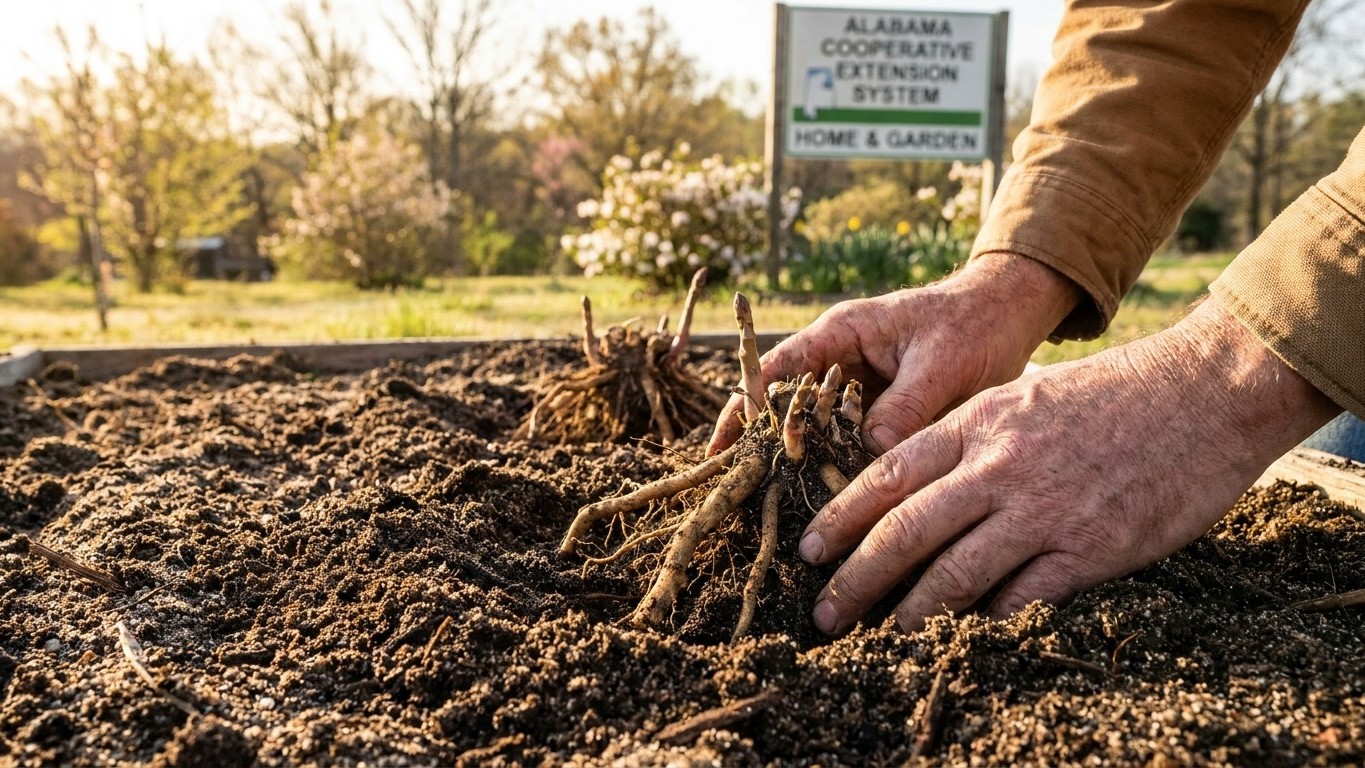

Plant asparagus crowns in Oklahoma in early spring, timed to the last frost window of late March into early April. This is a one-time planting that will occupy the same ground for 10 to 15 years, so the timing matters less than the soil it goes into and the water it gets once it’s there. Get the bed right first, then worry about the calendar.
The short answer
Ten to fifteen years. That’s how long a well-placed asparagus bed keeps producing, which makes this one of the rare vegetable-garden decisions where the spot you pick this spring is still feeding you a decade from now. The only requirement the Utah State University Extension guidance attaches to that spot is drainage. Most soils will grow asparagus, the source says, provided they are well drained. Everything else about siting the bed is negotiable. Drainage is not.
Oklahoma’s official state soil, the Port series, gives a useful baseline for what “typical” ground looks like across a lot of the state. It’s a Mollisol, the deep, dark prairie soil that built the Corn Belt, and its surface layer runs loam to silt: about 12 percent sand, 19 percent clay, and 69 percent silt, with organic matter around 2.0 percent. USDA records it as well drained, and the surface pH sits near neutral at about 7.0. On paper, that’s asparagus-friendly ground. Silt-heavy soils like this hold moisture well without turning into the kind of dense clay that suffocates roots, and a decade-long bed benefits from that kind of steady moisture retention between waterings.
But the Port series describes a representative soil mapped across the state, not the dirt behind any one house. It’s a starting point, not a diagnosis. River-bottom ground, hill country, and anything a builder has scraped, filled, or compacted during construction can behave nothing like the state soil, even a few miles from a spot where Port series soil is mapped. A silt-heavy soil that’s been driven over by heavy equipment for months can compact into something that holds water for days after a rain, which is exactly the situation asparagus crowns can’t tolerate for fifteen years running.
The practical move is to actually watch the spot in question. After a hard rain, does standing water clear within a few hours, or does it sit for a day or more? If it clears fast, the ground is probably fine as-is. If it lingers, the fix isn’t complicated: build a raised bed, or work in enough coarse organic matter to open up the structure before the crowns ever go in the ground. Raised beds solve drainage problems outright, and given that this planting is meant to outlast most other decisions made in the yard this year, spending an afternoon improving drainage before planting is cheap insurance against a bed that rots out in year six.
Will the summer here water it for you?
Not on its own, and the gap is bigger than it looks on paper. Newly planted asparagus needs 1 to 2 inches of water every other week for its first two full growing seasons, then eases to about the same amount every three weeks once it’s established. Oklahoma’s summer rainfall, measured at the reference station behind these figures, averages about 11.7 inches across June, July, and August combined, with July running driest at 3.59 inches, June at 4.49 inches, and August at 3.6 inches.
- Do the math on July first. An every-other-week schedule during a two-year establishment period means roughly two watering cycles per month, each wanting 1 to 2 inches. July’s 3.59 inches of rain, if it fell in two evenly spaced soakings, would just about cover the low end of that need on its own. It almost never falls that way. Oklahoma summer rain tends to arrive as thunderstorms, dumping an inch or two in an hour and running off rather than soaking into the bed.
- Expect to supplement, not skip. Because rainfall arrives unevenly and the driest month sits right in the middle of peak heat, a young asparagus bed here almost certainly needs hand or drip irrigation filling in the gaps between storms, especially through July when natural rainfall is thinnest and evaporation is highest.
- Watch the soil, not the calendar. A silt-heavy soil like the Port series holds moisture longer than sand, which buys a few extra days between waterings, but it also means the reverse mistake, watering into already-saturated ground, does more damage over fifteen years than an occasional dry stretch.
- Ease off after year two. Once the bed shifts to an every-three-week rhythm, Oklahoma’s roughly 11.7 inches of combined summer rainfall covers a much larger share of that lighter demand, though a dry July can still leave a mature bed wanting a supplemental soak.
- Put a rain gauge on the actual bed. These are normals for one reference station, not a promise for any specific yard. A slope, a nearby building, or just being on the far side of a county changes how much rain actually reaches the ground. A five-dollar gauge settles the question these averages can’t.
When to put the crowns in
Crowns go into the ground in early spring, and in Oklahoma that lines up with the region’s last frost window, which runs around March 28 to April 10 at the reference weather station behind these figures. That’s a mean date built from three decades of freeze-probability data, not a guarantee tied to any single spring, so treat it as the center of a range rather than a hard line on the calendar. Suburban and rural gardens away from that station often see their own last frost run later, sometimes by a week or two, and more at higher elevation, so a gardener a county or two from the station should lean toward the later end of that window rather than the earlier one.
The planting method itself is straightforward: crowns go into furrows about 8 inches deep. What trips people up is what happens after the crowns go in. The furrow isn’t backfilled all at once. Soil gets added gradually over the course of the year, roughly two inches every other month, rather than filling the trench flush at planting time. That gradual backfill gives the emerging shoots room to push upward without being smothered under a full 8 inches of soil on day one.
Patience matters more than timing precision here, because the payoff is slow no matter when in that early-spring window the crowns go in. There’s no harvest at all in year one or year two. The first cutting doesn’t happen until year three, and even then it’s limited: about four weeks of harvest that first cutting year, extending to six weeks the following year, and eight weeks once the bed is fully established. The stopping point each season isn’t a date either. Harvest ends for the year when most of the spears coming up are thinner than a pencil, a sign the plant needs to stop being cut and start rebuilding its root reserves for next year.
For gardeners who’d rather start from seed instead of crowns, that’s the alternative route the Extension guidance describes, though it adds a full growing season before seedlings reach transplant size, pushing the eventual harvest even further out. Crowns remain the faster path to that year-three first cutting. On variety, the published guidance names four options by sex alone: Jersey Giant and Jersey Knight are all-male, while UC 157 F1 and Purple Passion are male-female mixes. No flavor, yield, or performance comparison between them is published, so choosing among them comes down to availability rather than a documented advantage of one over another.
Common questions
Can I plant asparagus crowns in Oklahoma in the fall instead of spring?
The planting guidance behind this article specifies early spring planting for crowns, tied to the region’s frost timing. It doesn’t address a fall planting window, so that option isn’t addressed here.
How do I know if my soil drains well enough for a 15-year asparagus bed?
Watch the spot after a heavy rain. If standing water clears within a few hours, drainage is likely adequate. If it sits for a day or more, build a raised bed or work in coarse organic matter before planting, since this bed can’t easily be relocated once it’s established.
Do I need to fertilize or adjust soil pH before planting asparagus crowns?
The Utah State University Extension guidance behind this article names drainage as the soil factor that matters and doesn’t publish a pH requirement or fertilizing schedule. A soil test on the actual planting site is the way to settle any pH question for that specific ground.
Why can’t I harvest any asparagus the first two years after planting?
The plant spends those first two seasons building the root system that will support a decade or more of future harvests. Cutting spears too early weakens that root development, which is why the first harvest waits until year three, and even then only for about four weeks.