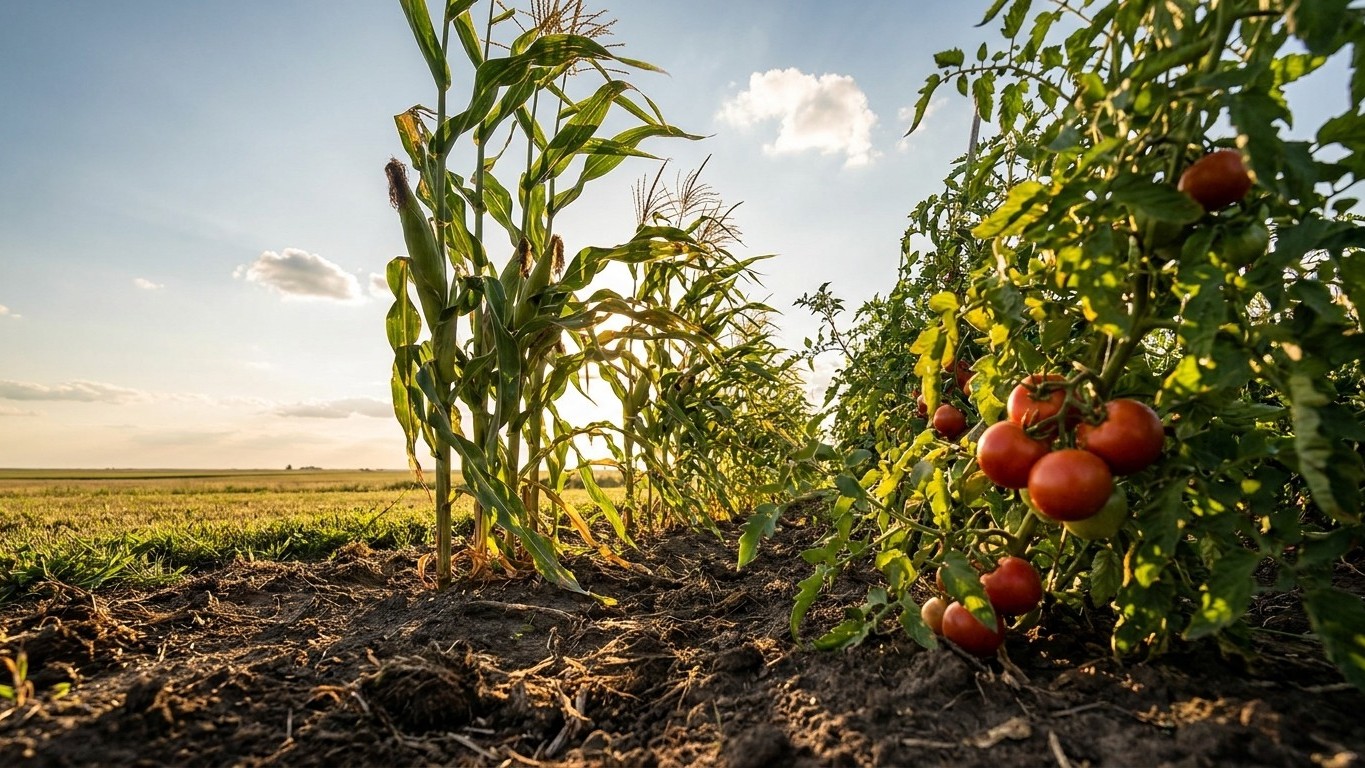

Sweet corn in Colorado is ready about 60 to 90 days after planting, and planting waits on the soil, not the calendar. The soil has to be at least 60 F, which comes well after the last frost. On the Denver plains, 60 to 90 days still fit before fall. Ready is a narrow window, though. Once picked, sugar drains out of the kernel faster than most gardeners expect, and heat speeds it up.
The short answer
Soil first, then the calendar
The soil reaches 60 F later than the last frost, not on the same day. At the Denver station, NOAA NCEI climate normals put the last 32 F freeze between May 1 and May 11 (that is the band where the chance of a freeze runs from 30 to 70 percent). Dirt at corn-planting temperature arrives well after that. No date goes here, because the date changes with each spring and each bed. Frost is an air-temperature event. A corn seed answers to the ground around it.
Utah State University Extension says sweet corn needs soil above 60 F. Clemson Extension is more precise about where to measure: “Do not plant before the soil temperature at the 4-inch depth is at least 50 ºF. Wait to plant extra-sweet varieties until soil temperatures reach 65 °F.” Keep the depth in mind. A reading at the surface runs warmer and sends people out too early. The two thresholds also are not interchangeable. Ordinary sweet corn tolerates the lower number, while extra-sweet (sh2) seed sown into 50 F soil tends to rot instead of sprouting. That is how one gardener succeeds one year and fails the next just by changing seed packets. For the planting side of this, see When to Sow Sweet Corn in Colorado.
Now the other end of the season. The first fall freeze at the same station falls between September 30 and October 12. Count from May 11 to September 30 and you get 142 days. Count from May 1 to October 12 and you get 164. Even if soil warming eats a full month of that, 112 days remain on the tight end, and corn needs 60 to 90 from planting. On the plains, the season fits. Denver sits at 5,280 feet, though. Mountain towns run far shorter seasons and can frost in July, and the western slope differs again. Those figures are not published here.
What “ready” means, and how fast it fades
Two clocks run on a corn patch, and they answer different questions. Days from planting (60 to 90) tell you whether a variety fits your season. Days from silk emergence (17 to 24) tell you which week to start checking ears. Never swap one for the other.
Then use three signs together: dry brown silks, husks still moist and green, and milky juice when you puncture a kernel. One sign alone misleads. Silks can brown before the kernels fill out.
After that, the clock turns against you. Clemson Extension puts it plainly: “Sweet corn loses sugar from the kernel rapidly at high temperatures… Sweet corn can be stored under optimal conditions for about five days, but will lose sweetness with each day of storage.” Read “about five days” as a ceiling under ideal conditions, not a promise. Colorado’s summers push the other way. The Denver reference station averages 39.6 days a year at 90 F or higher, so an ear left on a warm porch is losing sweetness quickly. The genotype matters too: su loses sugar fastest, se holds it longer, and sh2 holds it longest.
Does a late variety fit here?
A 60-day variety
Easily, on the plains. Sixty days uses less than half of the 142-day tight window computed above, so a cool spring that delays planting costs you little. The spare time is useful in another way: you can run a second planting a couple of weeks behind the first and still finish ahead of the fall freeze. Staggering also spreads the harvest, which suits the fade problem. Corn that all ripens in one weekend in a hot stretch is corn you cannot eat or freeze fast enough.
One catch. A fast variety ripens in the middle of summer, when the 90-degree days cluster. Pick in the cool of the morning, get the ears into the refrigerator quickly, and eat them within a day or two. The earliest types are not a way around the sugar-loss problem. They only move it into warmer weather.
A 90-day variety
On paper, yes. On the Denver plains, 90 days from a planting made once the soil is warm still lands before the first fall freeze of September 30 to October 12. Run the numbers conservatively: a month lost to cold soil leaves 112 days against 90, which is 22 days of cushion. That is thin. Sixty to ninety is a range, and the later end is where a slow summer hurts. If you are growing an extra-sweet type that must wait for 65 F soil, the cushion shrinks further, because that threshold arrives later than the 50 F one.
In the mountains, the answer is no. A town that can frost in July does not have a reliable 90 days anywhere in its summer, and I would not bet a bed on it. Even a 60-day type is a gamble there. The western slope is a different climate again, and no frost dates for it are published here, so check a local source before committing. A slower variety on the plains is workable. A slower variety at altitude is a hope.
What goes wrong here
Three failures account for most disappointing corn in this state. Two come from the climate. The third has nothing to do with it. For the broader picture, Growing Sweet Corn in Colorado covers the full season.
- Seed sown into cold soil. A mild week in spring tempts people to plant on the strength of air temperature. The seed sits in ground below the threshold and rots or comes up patchy. The remedy is a thermometer at the 4-inch depth: 50 F is the floor for ordinary sweet corn, 65 F for extra-sweet. Soil at 60 F is the working mark in the Utah State guidance. Wait for the number, not the date, and not the last frost.
- A variety too late for the season. A 90-day type planted late, or at elevation, meets the first fall freeze with ears still in the milk stage or earlier. The remedy is arithmetic you do before buying seed: count the days from your real planting date to the average first freeze for your location, and choose a variety whose days to maturity fits with room to spare. In high country, go to the shortest seasons available.
- Sweetness lost to neighbors. This one is not about climate at all. Utah State warns that sweetness is lost if su, se and sh2 types tassel at the same time. The source publishes no separation distance, so none is given here. The advice rests on timing: do not let different types tassel together. Plant one type per season, or space plantings far enough apart in time that their tassels do not overlap. Plant in blocks of three or more rows, not a single long row, so pollen has a good chance of landing on the right silks.
A fourth problem, ears chewed before you get to them, is a pest story rather than a climate one, and it follows its own calendar. See What Eats Corn in Colorado, and When.
Common questions
How can I tell sweet corn is ripe?
Use three signs together: the silks are dry and brown, the husks are still moist and green, and a punctured kernel gives milky juice. Starting the checks 17 to 24 days after the silks first appear tells you which week to begin looking.
How long does picked sweet corn stay sweet?
Less time than the folklore suggests. Clemson Extension says it can be stored under optimal conditions for about five days, but will lose sweetness with each day. Five days is a ceiling. In warm weather, and with su types, expect the sugar to go faster.
Can I grow su, se and sh2 corn in the same garden?
Only if they do not tassel at the same time. When they do, sweetness is lost. Utah State Extension names the condition but gives no distance, so manage the timing, keep plantings in blocks of three or more rows, and consider growing one type per season.
Is the last frost date the day to plant corn?
No. At the Denver station the last frost falls between May 1 and May 11, but soil at 60 F comes well after that. Plant when the 4-inch soil temperature has reached the threshold for your type: at least 50 F for ordinary sweet corn, 65 F for extra-sweet.