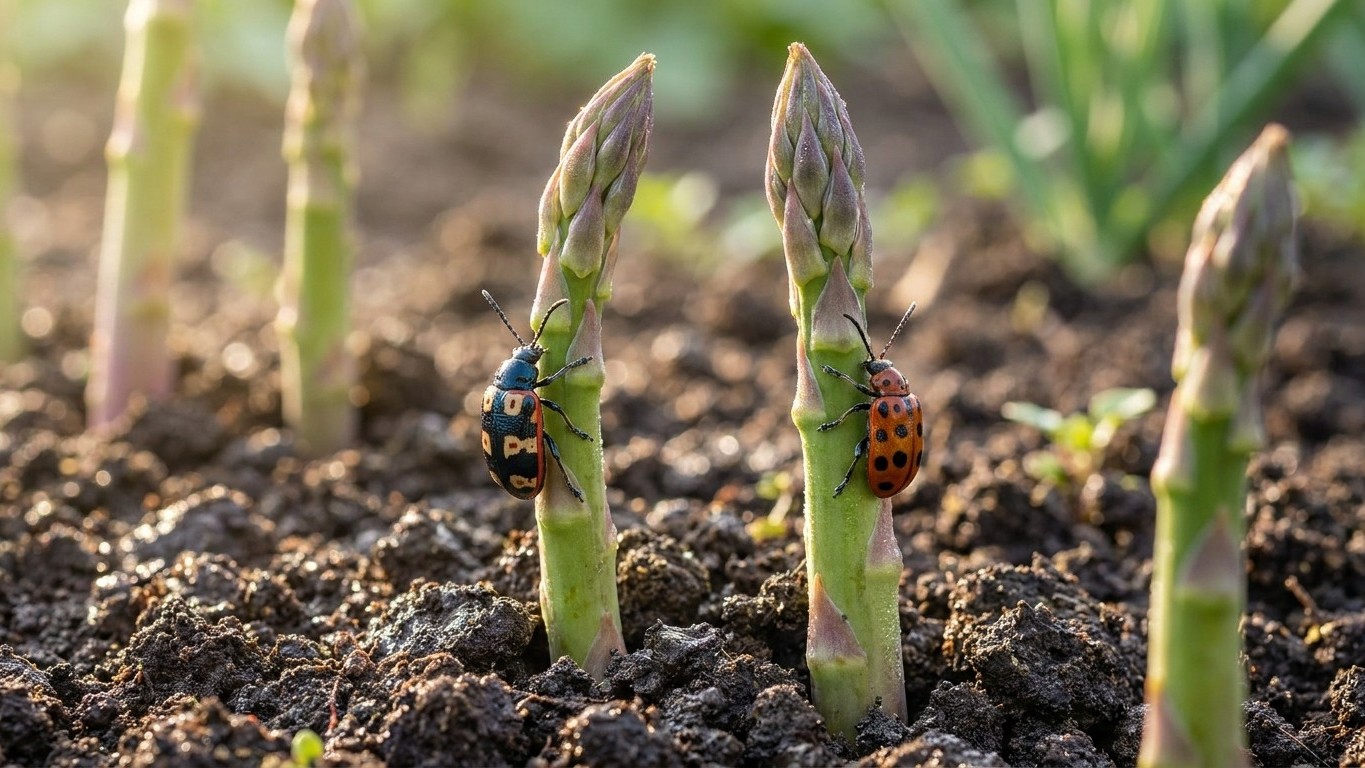

Stop cutting when most of the spears coming up are thinner than a pencil. That is a sign you can hold in your hand, not a date on a calendar. Spears you have already cut keep best at 32 to 35°F with the cut ends standing in water. Both answers sit inside a bigger commitment: a North Carolina asparagus bed is planted once and cut for 10 to 15 years, and the first cut comes three years after planting.
The short answer
Start with the ground, because it is the one thing you cannot change after the crowns go in. Utah State University Extension, the only authority this page leans on, says most soils will do for asparagus provided they are well drained. That is the whole soil requirement. Drainage is the question to answer before you buy a single crown.
What the state soil tells you
The soil USDA lists as representative of North Carolina is the Cecil series, an Ultisol. That is an old, heavily weathered, leached soil, naturally acid and low in nutrients. The representative surface layer is sandy: 68 percent sand, 13 percent clay and 20 percent silt, with about 0.8 percent organic matter and a surface pH around 5.5. USDA classes it as well drained (figures from NRCS Soil Data Access, major components of the series).
So the dominant soil passes the one test asparagus sets. Water moves through it. The flip side of a sandy, low-organic surface is that it holds little water and little fertility, which matters for the next section. That pH belongs to the mapped series, not to your yard, and the Utah source says nothing about soil pH for asparagus. A soil test through your county Cooperative Extension office gives you your own number.
If your spot does not drain
The state soil is a starting point, not a diagnosis. North Carolina spans hundreds of soil series. River bottoms, hill country and any lot a builder has scraped or filled can behave nothing like Cecil. For most crops a heavy patch is an annual nuisance you amend each season. Here it is a fifteen-year decision. If water lingers in a test hole well after the rest of the yard has dried, do not plant there. Move the bed to higher ground or build it up above the surrounding soil instead of digging down into a basin. Our guide on Will North Carolina Soil Hold an Asparagus Bed for Fifteen Years? goes deeper on that choice.
The harvest clock
Crowns go into 8-inch furrows in early spring. There is no harvest until year 3, and that is not a soft guideline. Taking a few spears early is exactly what the rule rules out. When cutting does begin, the season runs 4 weeks, then 6 weeks the following year, then 8 weeks. The pencil rule ends each season: when most new spears come up thinner than a pencil, the crown is running low and the cutting is over. Because the signal is an object, not a week number, it works whether spring runs early or late. If something is chewing on the thin spears, What Eats Asparagus in North Carolina, and When covers who the usual suspects are.
Will the summer here water it for you?
Mostly on paper, less so in practice. Here is how the numbers line up.
- Know what the bed wants. The source calls for 1 to 2 inches of water every other week for the first two years, then every three weeks after that.
- Read what summer delivers. The NOAA NCEI climate normals for the Charlotte reference station show about 12.1 inches of rain across June, July and August, out of 43.6 inches for the year. June brings 3.99 inches, July 3.74 (the driest of the three) and August 4.35. Spread over two-week slices, that is roughly 1.7 to 2 inches, which lands inside the bed’s range.
- Discount the rain. The same inch behaves differently on different ground. A sandy surface like the Cecil series lets rain through within the day, so a wet summer on sand can still leave roots thirsty. Hot days pull water back out through evaporation. Rain that arrives as a single thunderstorm mostly runs off instead of soaking in. Averages hide the dry fortnight in the middle of July.
- Measure instead of guessing. These are normals for one reference station, not a forecast and not your plot. A slope, a city heat island or a rain shadow changes the picture. A cheap rain gauge on your own bed settles it. If a two-week stretch gives less than an inch, you add the difference to bring it up toward the 1 to 2 inches.
- Back off on schedule. After two years, the interval stretches to every three weeks. That is the point where an average North Carolina summer does most of the work, and your hose covers the dry spells.
So how much must you add? In an ordinary summer, little in total. In a dry stretch, up to the full inch or two. The bed is not asking for a daily soak, just a regular check on what the sky actually left behind.
When to put the crowns in
Early spring is the window. In Charlotte, which sits in the Piedmont, the last spring freeze falls around March 23 to April 5. That range comes from the NOAA NCEI climate normals, the 30 to 70 percent probability band for a 32°F freeze (station data here). It is an average, so some springs will freeze a week or two after it and some will not. Treat it as a planning marker and watch your own forecast.
Location shifts everything. The Blue Ridge mountains to the west run several weeks later in spring, so a gardener in the mountains plants later than one in Charlotte. The coastal plain runs earlier. The calendar on your fridge matters less than your local frost dates.
Set each crown in an 8-inch furrow. The furrow is not filled in at planting. You backfill it gradually across the year, about 2 inches every other month, until the trench is level. Filling it all at once would bury the young shoots, and the source describes the gradual route.
Four varieties are named by Utah State, and the only thing published about them is sex. Jersey Giant and Jersey Knight are all-male. UC 157 F1 and Purple Passion are male and female. The source gives no flavor, yield or reason to prefer one, so I will not invent one. Name no nursery, either: the choice is yours.
Seed is the other route. The source this page relies on does not give sowing dates or how much longer seed adds before the first cut, so there are no numbers here to quote. If you go that way, ask your county Extension office for the local timing. For a related overview, see Growing Asparagus in North Carolina.
Common questions
How do I know it is time to stop cutting for the season?
Look at the spears pushing up. When most of them are thinner than a pencil, stop. Thin spears mean the crown is spent for the season, and cutting on past that point draws down the reserves it needs for next year. This is an object to check, not a week to count. After that, leave the new growth alone.
Can I take a few spears in the first or second year?
No. Nothing is harvested until year 3. The first cutting season lasts 4 weeks, the next 6, and the one after that 8. A young bed cut early pays for it later, and a patient start is what buys the 10 to 15 years of production.
How do I keep cut spears fresh?
Aim for 32 to 35°F with near-saturated air, 95 to 100 percent humidity. UC Davis Postharvest notes that high humidity is essential to prevent desiccation (UC Davis Produce Facts). In a home kitchen, that means standing the butts in a little water, like flowers, or wrapping the cut ends damp. The cut end is where spears lose water fastest.
How warm or cold is too much for the spears?
Both edges bite. Above 50°F spears toughen rapidly, within hours. At about 31°F or lower (UC Davis gives 30.9°F), they suffer freezing injury, with a water-soaked look that collapses into mush on thawing. A fridge thermometer tells you which side of the window your shelf sits on.