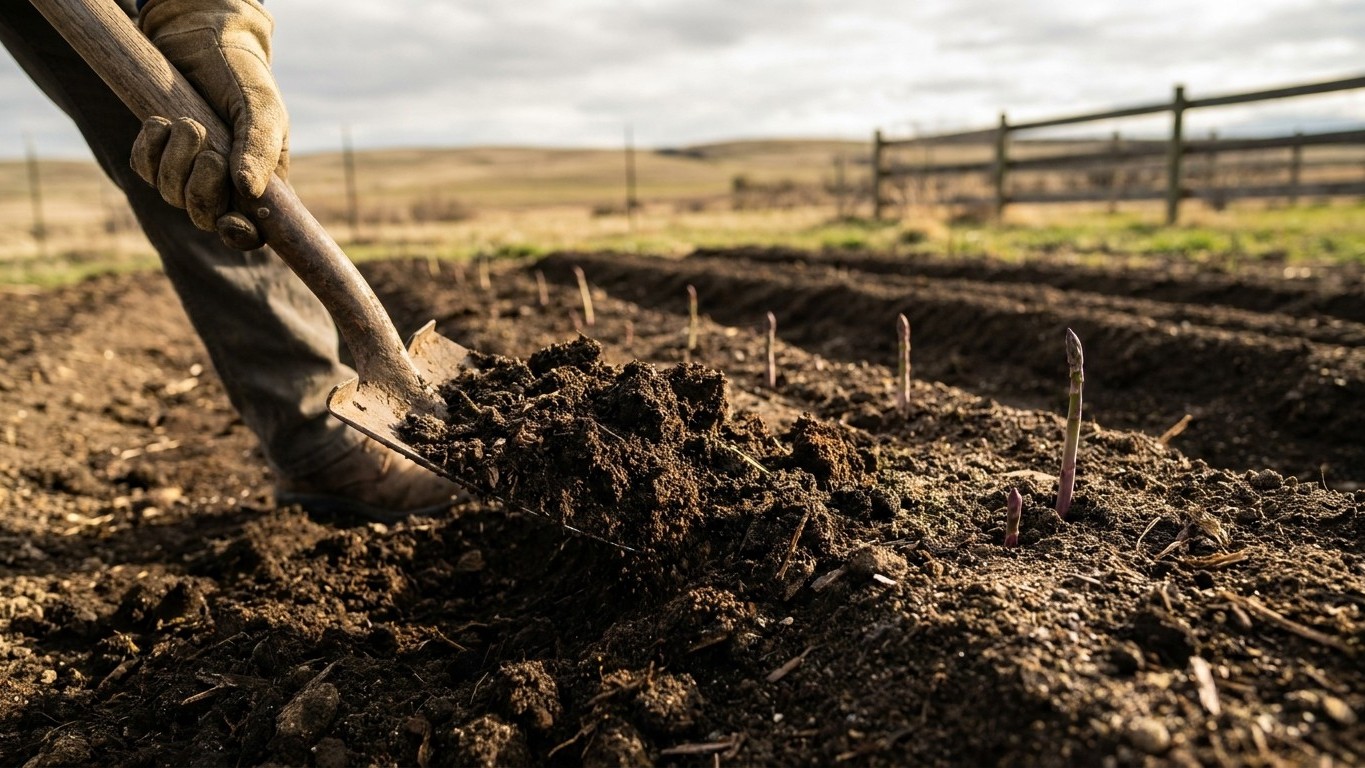

The soil that represents North Carolina drains well, and that is the one requirement an asparagus bed actually has. But “represents the state” is not the same as “sits under your tomatoes.” Will North Carolina Soil Hold an Asparagus Bed for Fifteen Years? That’s the real question, more than whether asparagus can grow here at all. It’s whether your particular patch of ground behaves like the state’s typical soil, or like something else entirely.
The short answer
North Carolina’s benchmark soil is the Cecil series, an Ultisol, which is a fancy way of saying it’s old, heavily weathered, and has been leached of a lot of what plants want. USDA’s own survey data puts the surface horizon at roughly 68 percent sand, 13 percent clay, and 20 percent silt, with organic matter around 0.8 percent and a surface pH near 5.5, on the acid side of neutral. The one trait that matters here: it’s classified well drained. Sandy ground doesn’t hold water in a puddle. It lets it move through, which is precisely what an asparagus crown needs, because sitting in wet soil rots the roots long before it produces a single spear.
That’s the good news for the state as a whole. The catch is that Cecil is a representative series, not a diagnosis of your yard. River bottoms, old pastures, and anything a builder graded or filled can behave nothing like it. If you dig a hole, fill it with water, and it’s still standing after an hour, your soil doesn’t drain the way the state benchmark does, no matter what county you’re in. The fix isn’t complicated: build a raised bed, or mound the row 8 to 10 inches above grade, so the crowns are never sitting in standing water. A soil test from your own bed, not a state average, is the only number that actually tells you where you stand.
Assuming drainage checks out, the planting itself follows a set pattern, and knowing When to Plant Asparagus Crowns in North Carolina matters as much as the method. Crowns go into furrows about 8 inches deep. You don’t backfill all at once. Instead, cover with about 2 inches of soil, then add another 2 inches roughly every other month as the ferny top growth rises, until the furrow is level with the surrounding bed by year’s end. No harvest happens the first year, or the second. Year three brings the first cutting, limited to about 4 weeks. Year four stretches to 6 weeks, and by year five you’re up to 8 weeks. After that, the rule isn’t a date on a calendar; it’s a look at the spears. Once most of them come up thinner than a pencil, harvest stops for the season, because the plant needs that foliage to rebuild its root reserves for next year.
On variety, Utah State University Extension names four options, distinguished only by sex: Jersey Giant and Jersey Knight are all-male, while UC 157 F1 and Purple Passion are male and female. No flavor comparison, no yield figure, and no reason to prefer one over another is published by that source, so treat any claim that one tastes better or produces more as someone’s guess, not documented fact.
Will the summer here water it for you?
An asparagus bed asks for 1 to 2 inches of water every other week through its first two years, then eases to about every three weeks once established. North Carolina’s growing-season rain doesn’t arrive in that tidy rhythm, so it helps to walk through what a typical summer actually offers.
- Total summer rainfall runs about 12.1 inches across June, July, and August, based on the 1991-2020 climate normals for the reference station used across this series. Spread evenly, that’s a bit over an inch a week, which sounds close to the asparagus target on paper.
- July is the dry month, at 3.74 inches, compared with 3.99 in June and 4.35 in August. That dip lands right in the middle of the growing season, which is exactly when a young bed is most sensitive to a dry stretch.
- Rain rarely falls evenly. Climate normals are averages built from decades of data, not a weekly schedule. A summer’s worth of rain can arrive as a handful of heavy thunderstorms with dry weeks in between, and a sandy, well-drained surface like Cecil lets that water move through fast rather than banking it for later.
- The math still favors supplementing. Even hitting the seasonal average doesn’t guarantee the bed gets its inch every other week in the exact window it needs it. A rain gauge staked next to the row, checked weekly, is the only way to know whether you’re actually short.
- When you’re short, add it slowly with a soaker hose or drip line rather than a hard blast from a sprinkler, so the water has time to soak into that sandy profile instead of running off.
When to put the crowns in
Crowns go into the ground in early spring, and in this part of the country that means timing the planting around the last spring frost rather than a fixed date. The 1991-2020 climate normals put that window at around March 23 to April 5 for the reference station used here, with “around” doing real work in that sentence, since a mean frost date is an average built from many years, not a promise about this particular spring.
That window shifts depending on where in the state you’re standing. This particular frost range reflects Piedmont conditions. Head west into the Blue Ridge and frost can linger several weeks later into spring, while the coastal plain tends to warm up and clear frost earlier than the Piedmont does. None of that changes the underlying rule, which is to get crowns in the ground once the soil has warmed and the hard freezes have passed, rather than racing the calendar.
Seed is the other route, though it asks for more patience up front. Starting from seed means growing a season of seedlings before you ever get a crown worth planting into the permanent bed, which pushes the harvest timeline out further than starting with purchased crowns already does. The source material doesn’t give a specific seed-starting calendar for this region, so anyone choosing that path is better served checking with a local grower or extension office for a schedule that fits the actual frost window here, rather than borrowing one from another climate.
One thing worth being clear about: nothing in the planting guidance ties a chilling requirement to this crop, and no winter chill hours figure is published for asparagus here. It’s tempting to assume a plant this cold-hardy needs a certain number of chill hours the way fruit trees do, but that’s not documented, and turning a hardiness zone into a chilling number would be a guess dressed up as a fact.
Checking this against your own county
Everything above describes the state in broad strokes: a representative soil series, a set of climate normals from one reference station, a planting window that shifts by region. None of it replaces a conversation with someone who knows your specific ground.
North Carolina State University’s Cooperative Extension Service, ces.ncsu.edu, maintains county-level offices across the state, and that’s the resource built for exactly this question. A county agent can look at your actual soil, your actual frost history, and tell you whether the general picture painted here holds up on your specific lot, or whether you’re dealing with a pocket of clay, a low spot that floods, or a microclimate that runs colder or warmer than the regional normal suggests. Fifteen years is long enough that a phone call up front is worth the ten minutes it takes.
Common questions
Can I harvest asparagus the year I plant it?
No. The bed needs its first two years to establish roots with no harvest at all. Cutting starts in year three, and even then it’s limited to about 4 weeks before you let the plant grow undisturbed for the rest of the season.
Does soil pH matter for Asparagus in North Carolina?
The state’s representative Cecil soil runs slightly acid, around pH 5.5, but the planting guidance used for this article doesn’t specify an ideal pH range for asparagus. A soil test from your own bed is the way to find out where you actually stand, since no pH target is published here to compare against.
What if my yard doesn’t drain like the state’s typical soil?
Raise the bed. A mounded row or a built-up raised bed keeps crowns out of standing water even where the native ground holds moisture longer than the sandy Cecil series does. Drainage is the one non-negotiable requirement for this crop, so it’s worth confirming with a simple hole-and-water test before committing a bed to fifteen years of use.
Is one of the four named varieties better than the others?
Not according to the documentation behind this guidance. Jersey Giant and Jersey Knight are all-male; UC 157 F1 and Purple Passion carry both sexes. No flavor, yield, or performance ranking is published to separate them, so choosing among them comes down to availability and personal preference rather than a documented advantage.