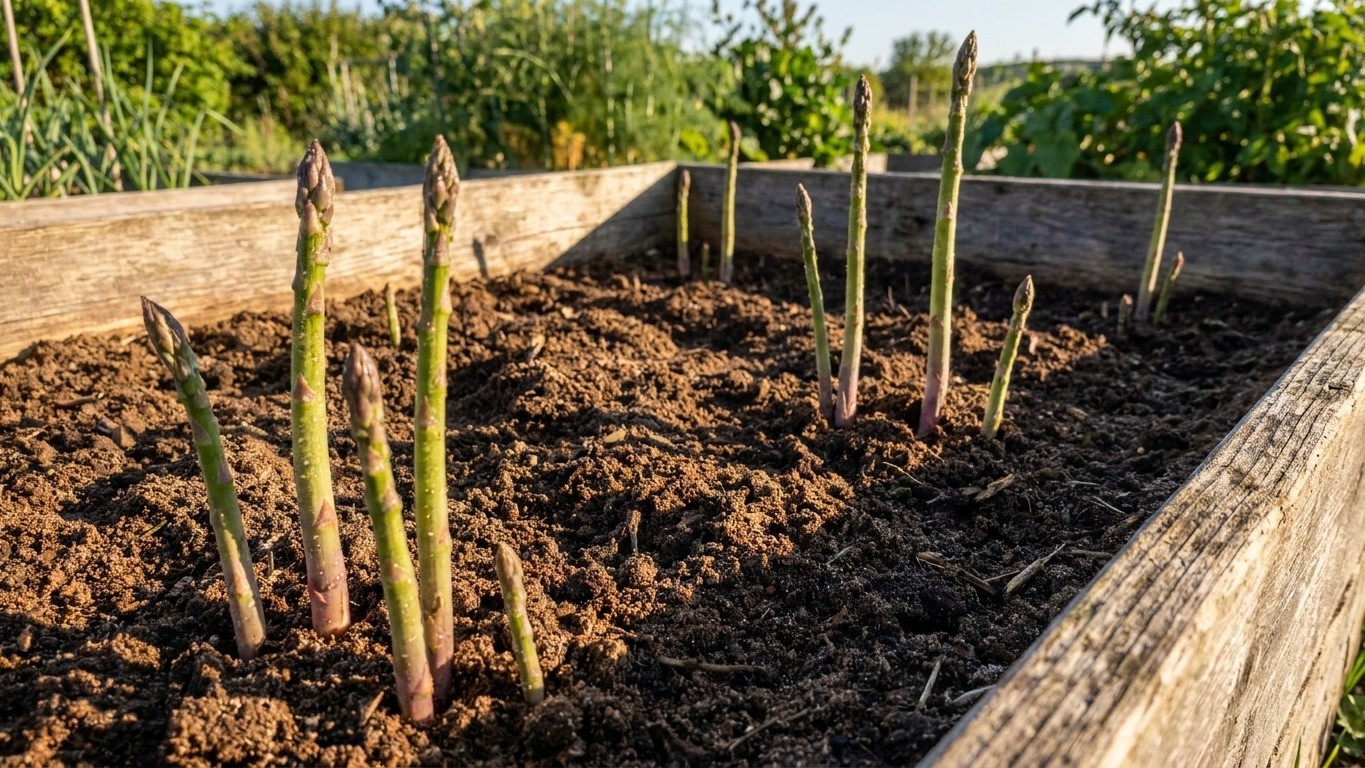

Stop cutting when most of the spears coming up are thinner than a pencil. That is an object, not a date, and it shuts the season down in any Tennessee bed. A new bed gets no cutting at all until year 3. After that the season runs 4 weeks, then 6, then 8. Once the spears are cut, they keep best at 32 to 35°F with the butts standing in water. What follows is the ground, the water and the planting that get a bed to that point.
The short answer
A bed lasts 10 to 15 years, and the only soil requirement Utah State University Extension puts on it is that it drains. Most soils will do, provided they are well drained. For Tennessee, the question is whether the ground sheds water. The series USDA lists as representative of the state is Dickson, an Ultisol: an old, heavily weathered, leached soil that is naturally acid and low in nutrients. Its mapped surface layer has a pH of about 5.0 (strongly acid) and is loam to silt, with 11 percent sand, 20 percent clay and 68 percent silt. Organic matter sits near 1.5 percent. USDA classes it as moderately well drained.
Does that drain well enough?
Almost. “Moderately well drained” is one step short of the “well drained” the source asks for. With only 11 percent sand, Dickson holds water instead of passing it through. On level or gently sloped ground that is workable. In a low spot where water lingers after a storm, it is not.
The stakes are higher here than anywhere else in a vegetable garden. A heavy tomato bed is an annual nuisance you amend each season. An asparagus bed is a decision you live with for up to fifteen years, and the payoff (nothing in years 1 and 2, then 4 weeks of cutting, then 6, then 8) arrives after the commitment is made. A bad spot costs you the years, not just a crop.
If your spot holds water
Those Dickson figures are USDA’s representative values for the surface layer of a mapped series. They are not a measurement of your garden. River bottoms, hill country and any lot a builder has scraped or filled can differ completely. After a soaking rain, watch how long water stays in a hole you have dug. If it is still sitting there when the ground around it has dried, that is your answer. A soil test through your county Extension office gives you your own pH and nutrient numbers. The Utah State source is silent on pH, so this page will not invent a target.
If the spot fails, the fix is location, not effort. Choose higher or sloped ground, or build the bed up above the surrounding grade. Digging an 8-inch furrow in a bowl-shaped patch just makes a trench that fills. The full reasoning is in Will Tennessee Soil Hold an Asparagus Bed for Fifteen Years?
Will the summer here water it for you?
Mostly, on paper. The bed wants 1 to 2 inches every other week for the first two years, then every three weeks. NOAA’s 30-year climate normals for the Nashville reference station show about 12.3 inches of rain across June, July and August, out of 50.5 inches for the year. Here is how that plays against the bed’s needs.
- Do the arithmetic. Summer is about 13 weeks, so 12.3 inches works out to just under an inch a week. Two weeks of normal rain comes close to the top of the 1 to 2 inch range. The monthly figures are June 4.36, July 4.16 and August 3.79 inches. August is the driest, and even it lands in the same neighborhood.
- Remember that an average is not a delivery schedule. A single summer thunderstorm mostly runs off instead of soaking in, and hot days pull moisture back out of the ground. The silty Dickson surface holds water better than sand would, which helps. It also means the bed should never sit wet for days, which is the drainage problem from the section above.
- Put a rain gauge on the plot. Every other week, read it. If it shows less than an inch, add water to bring the fortnight toward the 1 to 2 inch range.
- Expect to add little in a normal summer, and more in a dry spell. The gardener’s share is the gap between the gauge and the target. In a stretch of heat with no rain, that gap can be the full inch or two.
- Stretch the interval after year two. From the third year on, the same measure applies every three weeks instead of every other week.
These are normals for one station, not a forecast, and not your garden. East Tennessee and the Cumberland Plateau run cooler and can differ from Nashville, and a slope, a city or a rain shadow changes the picture further. Your own gauge settles it.
When to put the crowns in
Crowns go in early in spring, in 8-inch furrows. NOAA NCEI’s most recent 30-year normals put the last 32°F freeze in the Nashville area at around March 31 to April 12, the 30 to 70 percent probability band. That is the stretch where another freeze is neither unlikely nor certain. A mean date is an average, so some years it comes earlier and some later. East Tennessee and the Cumberland Plateau are cooler and run later in spring than Nashville, so shift your planting a little later there. The Utah State source says “early spring” and gives no calendar day, and this page will not invent one.
The furrow is not filled in at planting. It is backfilled gradually across the year, two inches every other month, and not all at once. Four rounds of two inches bring an 8-inch furrow back to level. The cutting clock is the one from the opening: nothing in year 3’s calendar before it, then 4 weeks, then 6, then 8. “A few spears” in the early years is not part of the rule.
Four varieties are named in the source, and only their sex is published:
- Jersey Giant: all-male
- Jersey Knight: all-male
- UC 157 F1: male and female
- Purple Passion: male and female
Nothing is published on flavor, yield or any reason to prefer one over another, so any ranking would be invented. Buy from whichever source you trust; this page names no nursery.
The alternative to crowns is seed. The one authority used here, Utah State University Extension, builds its guidance around crowns, and no Tennessee seed-starting dates are published in it. Rather than guess, take the frost window above as your anchor and check the seed packet. Once the ferny growth is up, What Eats Asparagus in Tennessee, and When covers what to watch for, and the full planting picture is in Growing Asparagus in Tennessee.
Common questions
How do I know it is time to stop cutting?
Look at the spears, not the calendar. When most of them are thinner than a pencil, stop and let the rest grow into ferns. There is no week number to count to, because the plant’s own output tells you when it is spent for the year.
How do I keep cut spears fresh?
The target is 32 to 35°F with near-saturated air, 95 to 100 percent humidity. UC Davis Postharvest says high humidity is essential to prevent desiccation. The window is narrow and both edges bite: above 50°F spears toughen quickly, and at about 31°F or lower they freeze, turn water-soaked and collapse into mush. In a home kitchen the practical move is to stand the butts in water, or wrap them damp, because spears lose moisture through the cut end faster than anywhere else. The full table is at UC Davis Postharvest Technology Center.
Does the variety change when I can cut?
Nothing published says so. Jersey Giant and Jersey Knight are all-male, and UC 157 F1 and Purple Passion are male and female. That is all the source records, with no differences in flavor, yield or harvest timing.
Do I fill the furrow right away?
No. Backfill two inches every other month across the year. The 8-inch furrow is closed in stages, not in one pass, and a wet, poorly drained spot is the one place you cannot afford to get this wrong.