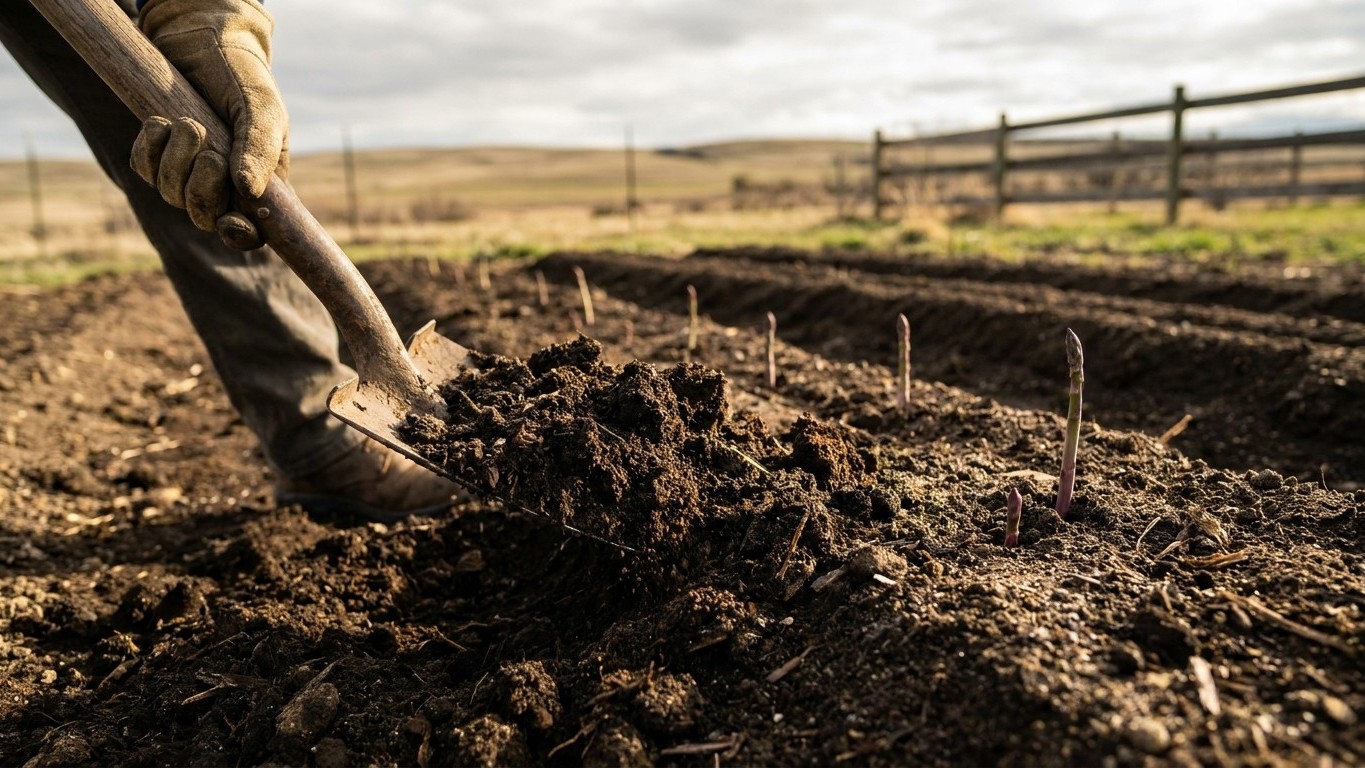

Once asparagus crowns take hold, most gardeners plan on harvesting from that same row for a decade or more. That means the ground you pick this spring is the ground you’re committed to well past the point where you’d normally rotate a bed. The question worth asking before that commitment is Will Tennessee Soil Hold an Asparagus Bed for Fifteen Years?, since the soil that represents the state drains only moderately well, which changes how much prep work that decision deserves.
The short answer
The only soil rule that matters for asparagus is drainage. Utah State University Extension puts it plainly: most soils will grow asparagus fine, provided they don’t stay wet. That single condition is why the choice of bed location outlasts almost every other decision in the vegetable garden, because a crown planted this spring is still expected to be producing spears fifteen years from now, long after a tomato bed has been moved, rested, or turned over to something else three or four times.
Tennessee’s representative soil, the Dickson series, sits right at the edge of that requirement. USDA’s own survey data describes it as moderately well drained, a loam to silt mix that runs 11 percent sand, 20 percent clay, and 68 percent silt at the surface, with organic matter around 1.5 percent. Moderately well drained isn’t the same as well drained. Water moves through this kind of ground, but slower than it does through a sandier soil, and a silt-heavy surface holds moisture longer after a storm than most gardeners expect. For an annual crop, that’s a mild inconvenience you work around each season. For a bed that isn’t moving for ten to fifteen years, it’s worth a harder look before the first crown goes in the ground, which makes knowing When to Plant Asparagus Crowns in Tennessee just as important as picking the right spot.
The surface pH USDA records for this series runs around 5.0, strongly acid, but that figure describes the mapped soil series generally, not the pH sitting under any one garden. The source material on asparagus itself says nothing about a preferred pH, so there’s no target number to chase here, just a reminder that a real soil test on your own plot tells you far more than a statewide average ever will.
If a test, or simply a look at how long puddles sit after rain, suggests the ground drains slower than it should, the fix isn’t complicated: build the row up. A raised bed or a mounded ridge, even just a few inches above grade, gets crown roots out of standing water without changing anything about the crop itself. Given how difficult it is to relocate an Asparagus Bed once it’s established and producing, that extra work at planting time is a much smaller commitment than discovering the drainage problem in year eight.
Will the summer here water it for you?
Newly planted asparagus needs 1 to 2 inches of water every other week for its first two years, tapering to roughly every three weeks once the bed matures. Measured against what a Tennessee summer actually delivers, here’s how that plays out month by month.
- June: the region averages 4.36 inches of rain, which comfortably covers the every-other-week target for a first- or second-year bed on its own, assuming it falls in a spread-out pattern rather than one or two storms.
- July: normals run 4.16 inches, close enough to June that a young bed likely needs little or no supplemental watering in a typical year.
- August: rainfall drops to 3.79 inches, the lowest of the three summer months and also historically the hottest stretch, which is exactly when evaporation works hardest against whatever moisture the soil is holding.
- Across the full summer: the three months average out to about 12.3 inches, a total that on paper matches or exceeds what a young bed asks for, but averages hide the gaps that matter.
- The catch: Tennessee summer rain often arrives as a thunderstorm rather than a steady soak, and on the Dickson series’ silty surface a hard downpour sheds more runoff than it lets soak down to root depth, so the gauge total and the actual water reaching the crowns aren’t the same number.
- The practical move: keep a rain gauge on the bed itself through the first two summers. If a two-week stretch falls short of that 1 to 2 inch mark, especially in August, that’s the signal to add water rather than trust the seasonal average.
By year three, once the every-three-week schedule kicks in, most established beds on this soil need little help from a hose at all in a normal year. It’s those first two summers, when roots are shallow and unforgiving of a dry stretch, where the gap between average rainfall and actual soil moisture matters most.
When to put the crowns in
Crowns go into the ground in early spring, planted in furrows about 8 inches deep. In Tennessee, that window lines up around the region’s average last spring frost, which falls between March 31 and April 12 depending on where in the state you are. That’s a mean date, not a guarantee, so treat it as a rough marker rather than a calendar entry to plant around exactly. Dormant crowns tolerate cool, workable soil well before the last frost actually arrives, since the growth that matters is still underground at that point. Gardeners in East Tennessee and up on the Cumberland Plateau should expect that window to run later than it does around Nashville, given the cooler spring in that part of the state.
Once the crown sits in its furrow, the furrow itself isn’t filled in all at once. It gets backfilled gradually, about two inches every other month across the growing season, rather than buried completely on planting day. That staged approach lets the emerging spear keep pushing through loose soil rather than fighting its way up through a deep, compacted fill from the start.
Crowns are sold under a handful of named varieties, and the only distinction Utah State University Extension publishes for them is which sex the plant is. Jersey Giant and Jersey Knight are all-male types. UC 157 F1 and Purple Passion are male and female. No flavor comparison, no yield figure, and no reason to prefer one over another appears in that source, so there’s no published basis here for ranking them against each other, whatever a seed catalog might imply.
Seed is the other route in, though it adds a full extra year to the timeline before crowns are even ready to plant out, since seedlings need a season to develop before they go into the permanent bed as young crowns. For most home gardeners, buying crowns directly and skipping that extra year is the more practical path, especially given how long the bed is already asking you to wait: no harvest at all in year one or two, a four-week harvest window in year three, stretching to six weeks and then eight weeks in the years after that. The signal to stop cutting each season isn’t a date on the calendar either, it’s the spears themselves: once most of what’s coming up runs thinner than a pencil, that year’s harvest is done.
Checking this against your own county
Everything above describes what the state’s representative soil and regional climate normals suggest in general terms. Neither one is a substitute for what’s actually happening in your own backyard. Soil series shift within a few miles, and a lot she reads on a mapped survey may not match ground that’s been graded, filled, or farmed differently than its neighbors.
The University of Tennessee Institute of Agriculture Extension is the named resource for exactly this kind of county-level check. Their office network runs soil testing and can speak to how the Dickson series, or whatever’s actually mapped under your address, behaves once you factor in local slope, drainage tile, or years of previous cultivation. Before committing a corner of the yard to fifteen years of asparagus, a call to your county’s extension office is worth more than any statewide average.
Common questions
Can I move an Asparagus Bed once it’s established?
Not practically. The crop’s value comes from crowns that stay in place and build strength over ten to fifteen years; digging them up to relocate undoes most of that investment. That’s the core reason drainage and site selection matter so much before the first crown goes in.
Does Tennessee’s acidic soil mean I need to add lime before planting?
The published material on growing asparagus doesn’t specify a preferred soil pH, so there’s no target figure to amend toward based on that source. A soil test on your specific plot, through your county extension office, is the only way to know where your ground actually stands.
How long until I get my first asparagus harvest?
None at all in the first two years after planting. Year three brings a four-week cutting window, which extends to six weeks and then eight weeks in the years that follow, as the crowns mature.
What if my yard doesn’t drain well?
Raise the row. A mounded bed or built-up ridge, even just a few inches above the surrounding grade, keeps crown roots clear of standing water without requiring a different variety or a different watering schedule.