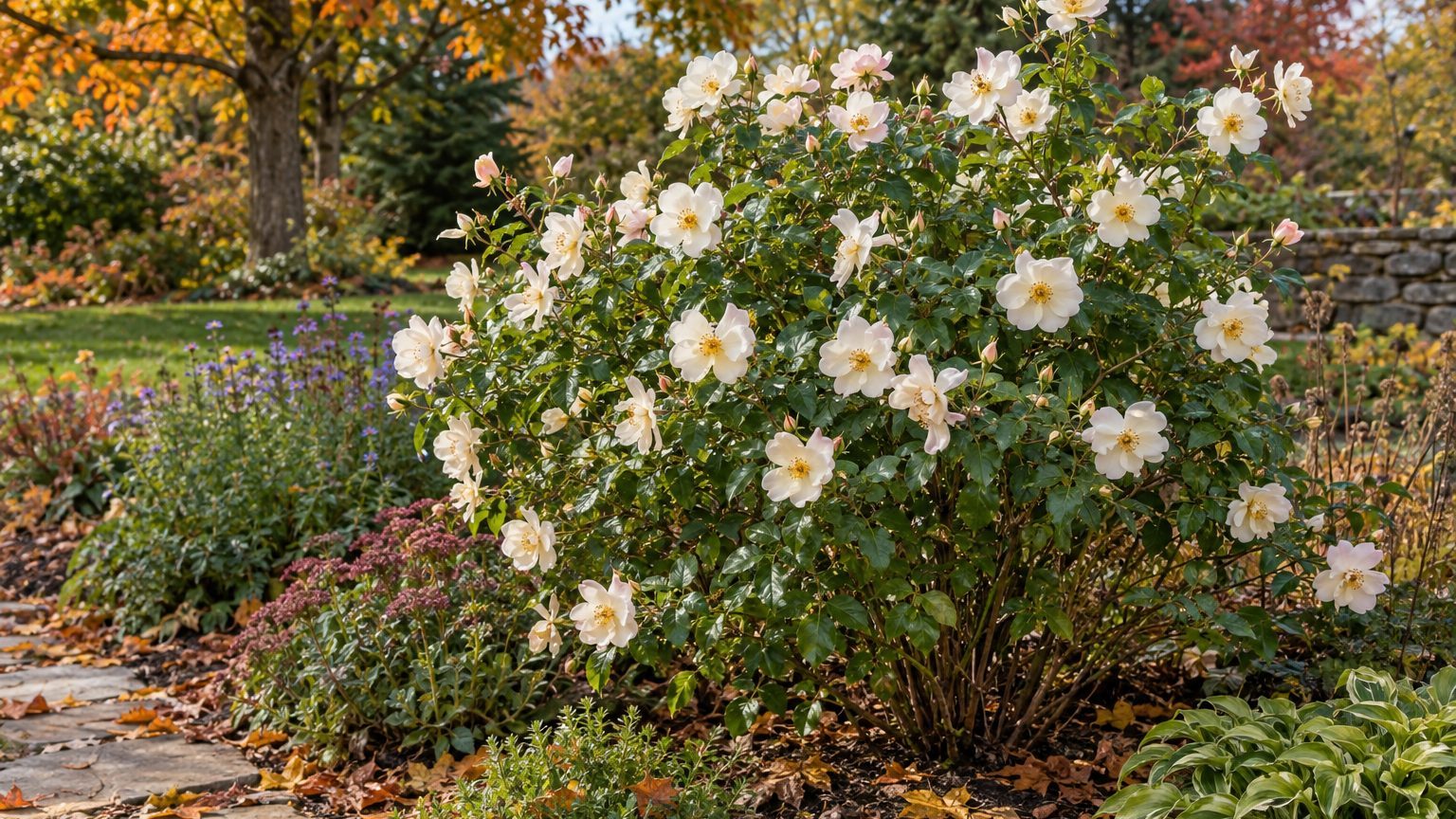

Sally Holmes is a shrub rose with buff-to-cream-white flowers and golden stamens, and it blooms on new wood. What decides whether it performs for you is the wood it flowers on and how you prune it. Light pruning keeps the bloom, and hard pruning costs it. The date depends on your zone, so it lives on your state’s page.
What Sally Holmes actually is
Start with the category. Sally Holmes belongs to the shrub group. Its flowers open buff to creamy white around golden stamens, and the source description adds that it can be trained as a climber if it is staked. It flowers on new wood, meaning on shoots grown this season, not on canes left over from last year.
The genus-level numbers are still useful for planning space. The source gives 1 to 8 feet tall and 1 to 6 feet wide, depending on cultivar. That is a wide band, and treat the range as a warning to check the tag. Growth rate is medium, maintenance is rated HIGH, and the source gives hardiness as USDA zones 5a through 11b for the genus as a whole. The broader Rose Varieties index shows how other cultivars compare.
Uses of Sally Holmes in the Garden and Vase
A shrub rose earns its place in the yard and the vase. Sally Holmes has no culinary use of its own. What the source does say is that rose hips, the fruit of the genus, are edible and turn from green to red in fall. A hip is an accessory fruit holding achenes, the small seeds inside.
The real use is the flower. Cream-white petals around golden stamens read as soft and informal, and the climbing option widens the job. Staked, it can cover a fence or a post. Left free, it stays a shrub. The source sorts rose scent into five groups (old rose, fruity, tea, myrrh and musk).
For cut flowers there is a rule that applies to any rose. Cut once the sepals have folded back and the first one or two petals are unfurling. A bud cut tighter than that often never opens, and you end up with a green knob in a vase.
There is also a mechanism worth knowing. Because it blooms on new wood, every stem you cut or deadhead pushes a fresh shoot, and that shoot is where the next flowers form. That makes cutting for the house a gentle form of pruning during the season. It also sets up the timing problem in the next section.
Where Sally Holmes Grows Well: Hardiness Zones
What a rose has to finish before cold arrives is its wood.
Timing your last cut
Find your first fall frost date from your own local records. Count back from it to the last cut you make, whether pruning, deadheading or cutting for a vase. Shoots pushed after that point are too soft to ripen in time. The wood ripens and the plant hardens on its own once day length shortens and cold arrives. Dormancy follows those two cues, not anything you do.
That is why the margin is about your habits more than your map. The genus range of zones 5a through 11b is enormous, and a gardener at the cold end has a shorter runway between the last useful growth and the first hard frost. A gardener at the warm end has more time but the same rule: stopping the cuts is what avoids soft late growth. Stopping lets hips form, and they turn from green to red in fall, which is a visible sign you have stopped pushing new shoots.
If you garden near the edge of the hardiness range, check what survives locally and ask a nearby rose grower. Then read the state page for your zone, which holds the pruning date for your area. The same new-wood question gets worked through for other cultivars on the Carefree Wonder Rose: When to Plant the Tomatoes That Ripen All at Once page, so you can compare habits.
Two Pruning Mistakes That Cost Bloom
The two failures that are documented for Sally Holmes are simpler and both are pruning problems.
The first is the hard prune. A gardener who treats it like a shrub to be cut to the ground each year pays for it in flowers. The second is soft late growth: cutting or deadheading so late that new shoots start and cannot ripen before frost. Every deadheading cut pushes a new shoot, so continuing the cuts into fall is how that happens.
Of the two, the hard prune is the one that matters more for this variety. Blooms ride on the season’s own growth, so the growth you remove in spring is growth you are not getting flowers from. Soft late shoots are a real risk, but their usual cost is some dieback at the tips, not a lost summer of bloom. A heavy cut is the more expensive mistake, and it is also the easier one to avoid once you know the rule.
What it resists, and what it does not
Resistance in roses is per cultivar, not per group, so you cannot borrow a good reputation from a neighbor in the shrub group. Knock Out is a shrub rose bred specifically for resistance, while several classic ramblers are mildew-prone.
What the source does name for roses in general is a short list of diseases: botrytis, blights, powdery mildew, leaf spots and anthracnose. Treat all of them as possible here. The pests it names are Fuller rose beetle, Japanese beetle, rose chafer, rose thrips, southern red mite and two-spotted mite. Mites are arachnids, not insects, so the useful phrase is “insects and mites.”
One practical note on cleanup. Powdery mildew overwinters in dormant buds and on stems, not in leaf litter. Raking leaves alone will not end it. Look at the stems themselves when you prune.
Growing it without the usual mistakes
Give it full sun, which the source defines as six or more hours of direct light a day. Clay or loam works, with pH from acid (below 6.0) to neutral (6.0 to 8.0). Because maintenance is rated HIGH for the genus, plan on regular attention and not a plant-and-forget border.
Support depends on what you want. As a shrub it needs room for a width anywhere within the genus range, so leave space until you see how yours behaves. To use it as a climber, stake it from the start, since the source says it can be trained that way. Climbers flower from new wood, which matches this variety, and that is why training it up a support does not change the light-pruning rule.
The mistakes this variety invites are specific:
- Cutting it back hard each spring, which costs bloom.
- Deadheading deep into fall, which pushes soft shoots that will not ripen.
- Clearing every dead stem. Remove what is diseased or unsafe, and leave dead stems cut back to 12 to 24 inches for stem-nesting native bees.
- Assuming winter protection is the same for every rose. Check the tag: on a budded rose it protects the union, and on an own-root rose it protects the crown.
Comparing how timing plays out on a neighbor in the same bed can help, and the Seafoam Rose: Bloom, Hardiness and Care and Julia Child Rose: Bloom, Hardiness and Care pages ask the same question of those cultivars. Propagation, if you want more plants, is best by grafting, and the source also lists seed and stem cuttings.
Common questions
Does Sally Holmes bloom on old wood or new wood?
New wood. The shoots grown this season carry the flowers, which is why light pruning is the rule and a hard cut costs bloom.
Can I grow Sally Holmes as a climber?
Yes, if you stake or support it. The source description says it can be trained as a climber, and climbers flower from new wood, so the same light-pruning rule applies.
When should I prune it?
The type decides it, because it decides whether the plant flowers on old or new wood. Look up your state’s page for the date.
Are rose thorns dangerous?
They are prickles, not true thorns. They grow from the outer skin of the stem, which is why they can be rubbed off. Wear gloves when you prune.
Related guides
Sources : jacksonandperkins.com | highcountryroses.com