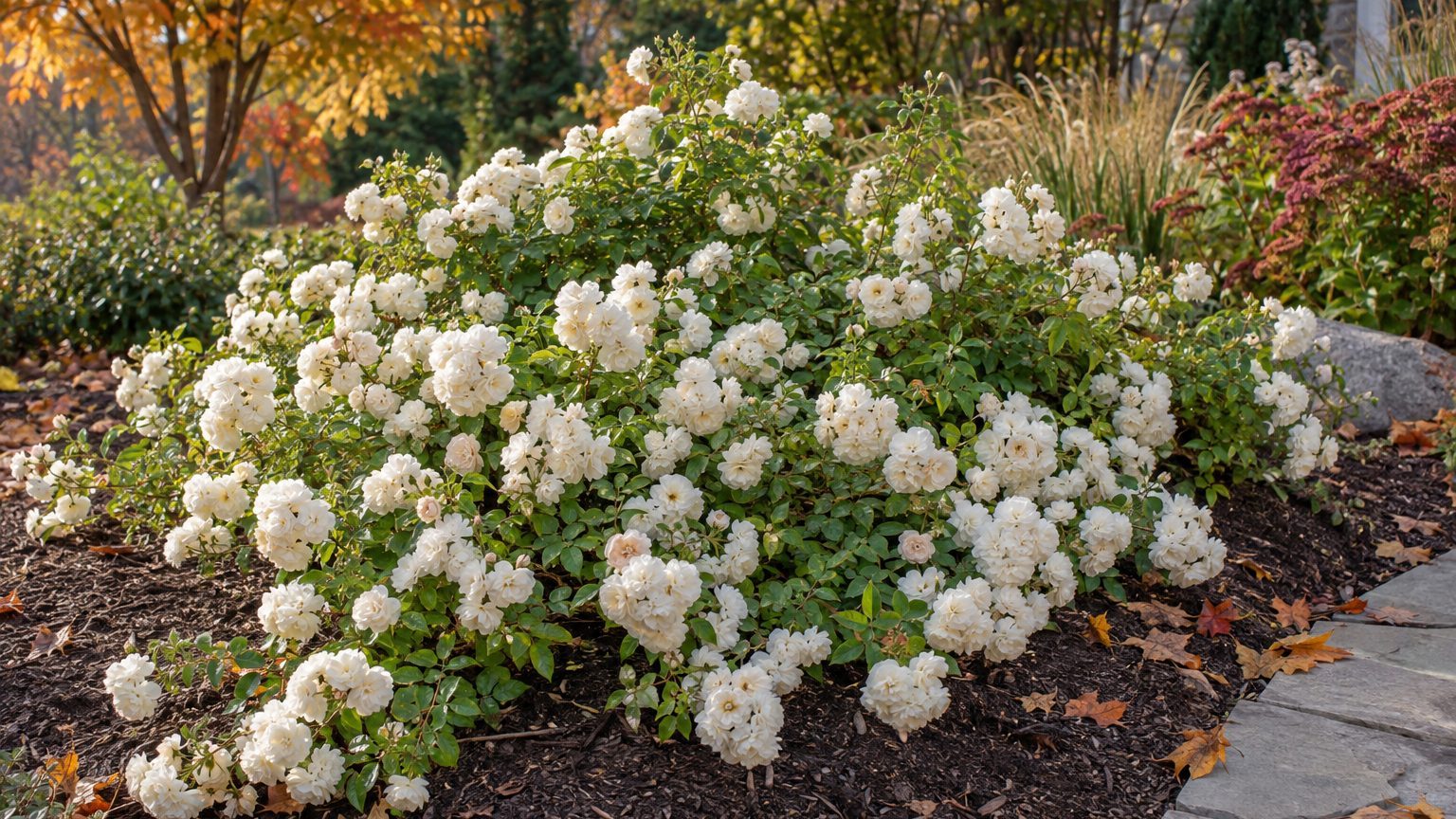

Seafoam is a ground cover rose with creamy white, pompon-shaped blooms in clusters, grown as a low spreader or trained up as a climber. It flowers on new wood, so what matters is how much growth it makes before frost. The pruning date depends on your zone, so that belongs on your state page.
What Seafoam actually is
Three facts decide whether Seafoam suits a garden: the group, the wood it flowers on, and the size. The group is Ground Cover. The flowering wood is new wood, meaning the stems grown this season carry the flowers. The source description, translated from the French catalogue entry, reads: cream-white pompon bouquets, usable as a ground cover or as a climber.
The only dimensions documented here are for the genus: 1 to 8 feet tall and 1 to 6 feet wide, depending on cultivar (NC State Extension Gardener Plant Toolbox, Rosa).
What matters for a rose is the wood itself, which has to grow, then ripen, before the plant hardens for winter. The same source lists the genus as hardy in USDA zones 5a through 11b, full sun (6 or more hours of direct sunlight a day), clay or loam, and maintenance rated HIGH. Those are genus-wide figures, so treat them as a ceiling, not a promise for this cultivar.
The fruit is the hip, an accessory fruit that is edible and turns from green to red in fall.
Ground Cover or Climber: How to Use Seafoam
Seafoam is grown to look at, not to eat, and it earns its place two ways. As a ground cover, a low spreading rose covers bare soil, shades out weeds and fills a slope or border edge with flowers. As a climber, the same plant can be tied up a support. The catalogue allows both, which is unusual in one cultivar.
The pompon bouquets are the draw. The source describes them as cream-white and borne in clusters, so one stem gives a spray of blooms rather than a single bud. The genus-level anatomy note says petals run from 5 (single) to more than 20 (double). The genus has five fragrance groups (old rose, fruity, tea, myrrh, musk), but no group is assigned to this cultivar.
For cut flowers, timing decides the result. Cut once the sepals have folded back and the first one or two petals are unfurling. A bud cut tighter than that often never opens. Cut stems also push new shoots, which feeds the next flush on a new-wood bloomer.
The hips are edible, according to the source, which is a bonus if you let late flowers go to fruit. Taste and yield for Seafoam are not documented.
If you are weighing it against other roses, the cultivar pages for Double Delight Rose: When to Plant the Tomatoes That Ripen All at Once and Joseph’s Coat Rose: When to Plant the Tomatoes That Ripen All at Once show how different the groups and habits can be.
Where Seafoam Grows Well: Hardiness Zones
The documented hardiness range is for the genus, so check the tag for your own climate.
The arithmetic, redone for a rose
You can still do the sum for your own garden. Start with the stretch between your last spring frost and your first fall frost. Take off the weeks the soil needs to warm and the plant needs to wake up and start growing. What remains is the time for new wood to grow, flower and then ripen before winter. A longer remainder is a comfortable margin. A short one leaves the late shoots too soft to ripen in time.
Why new wood changes the risk
Here Seafoam has a real advantage over old-wood bloomers. Because it flowers on new wood, a cold winter that kills back the tips does not take the season’s flowers with it. Old-wood roses (the source names ramblers) carry their buds on last year’s canes, and those can be lost. A new-wood rose regrows and blooms on that growth. It still needs a long enough season to do it.
The documented hardiness range is zones 5a through 11b for the genus, a span that takes in very different winters. Within it, the gamble is at the cold end, where the growing window is shortest and canes are more likely to die back. In milder zones the question is less whether it ripens than how much care it takes. Check the tag for whether Seafoam is narrower than the genus. For the planting and pruning dates in your state, use the page for your state, since the date follows from your zone.
Two Seasonal Problems: Late Soft Growth and Early Frost
A long season is not automatically a good one, and a short one is not automatically a loss. Seafoam can go wrong two ways, and both come down to timing.
The first is soft growth late in the year. Every deadheading cut pushes a new shoot, so cutting spent blooms into fall keeps producing tender growth that will not ripen before frost. Stopping the cuts is what avoids it. Dormancy itself follows day length and cold, not the hips. Letting the last flush go to hips is a choice you make, not a signal the plant sends.
The second is the opposite: growth pushed too early, before the soil and the weather have settled. This follows from how a new-wood bloomer works, since the plant spends its first weeks building the stems that will flower. Frost on those early shoots costs you flowers on the first flush. The remedy is patience in the planting date, which is why your state page matters.
Of the two failures above, the late soft growth matters more for this variety. The real deadline is the first frost, and every late cut moves new tissue closer to it.
What it resists, and what it does not
The catalogue entry lists no disease resistance for Seafoam. Not high, not intermediate: none. Treat it as unprotected until a grading says otherwise. Resistance in roses is per cultivar, not per group, so a ground cover rose bred for toughness tells you nothing about this one.
The source does name what attacks roses in general. The diseases are botrytis, blights, powdery mildew, leaf spots and anthracnose. The pests are Fuller rose beetle, Japanese beetle, rose chafer, rose thrips, southern red mite and two-spotted mite. Mites are arachnids, not insects, so “pests” is the safer word for the group.
A low, dense ground cover can hold humidity at the base, and powdery mildew and leaf spots are on the source’s list. That link is a reasonable inference, not a documented trait of Seafoam. Give the plants room, water the soil rather than the leaves, and watch the centre of the clump.
For comparison, Carefree Wonder Rose: When to Plant the Tomatoes That Ripen All at Once shows how a cultivar page reports a different resistance profile.
Growing it without the usual mistakes
Start with the tag. Is the plant own-root or budded onto a rootstock? Many landscape shrub roses are own-root and have no union at all. Budded roses (hybrid teas, grandifloras, many climbers) do. Winter protection guards the union on a budded rose and the crown on an own-root one, so the answer changes where you mound or mulch.
Because Seafoam flowers on new wood, the pruning logic is simpler than for old-wood roses. The note for this cultivar is to shear it rather than prune cane by cane. That suits a ground cover: you cut the mass back, not stem by stem. The type decides the date, since it decides whether the plant flowers on old or new wood. Your state page gives the date for your zone.
When you cut back, do not remove everything dead. Remove what is diseased or unsafe. Leave dead stems cut back to 12 to 24 inches standing where you can, since stem-nesting native bees use them (NC State Extension Gardener Plant Toolbox).
If you train it as a climber, tie the canes in gently and give the plant support before it needs it. The sharp stems are prickles, not true thorns, so thick gloves are the practical answer. Full sun and good drainage on clay or loam round out the setup.
Maintenance is rated HIGH for the genus, so plan for regular attention instead of planting and leaving. The mistake this variety invites is feeding and deadheading late because it keeps blooming. Stop the cuts and the feeding as the season closes, and the wood ripens and the plant hardens on its own.
Common questions
Is Seafoam a ground cover or a climber?
The catalogue places it in the Ground Cover group and says it can be used as a ground cover or trained as a climber. Its mature size is not documented, so check the tag.
When should I prune Seafoam?
The date depends on your zone. Seafoam flowers on new wood and is sheared rather than pruned cane by cane. Check the page for your state for the date.
Are rose thorns dangerous?
They are prickles, not true thorns. They grow from the outer skin of the stem, which is why they can be rubbed off. They scratch, but gloves handle them.
Can I eat the hips?
The hip is edible and turns from green to red in fall. For other cultivars, see Rose Varieties.
Sources : plants.ces.ncsu.edu