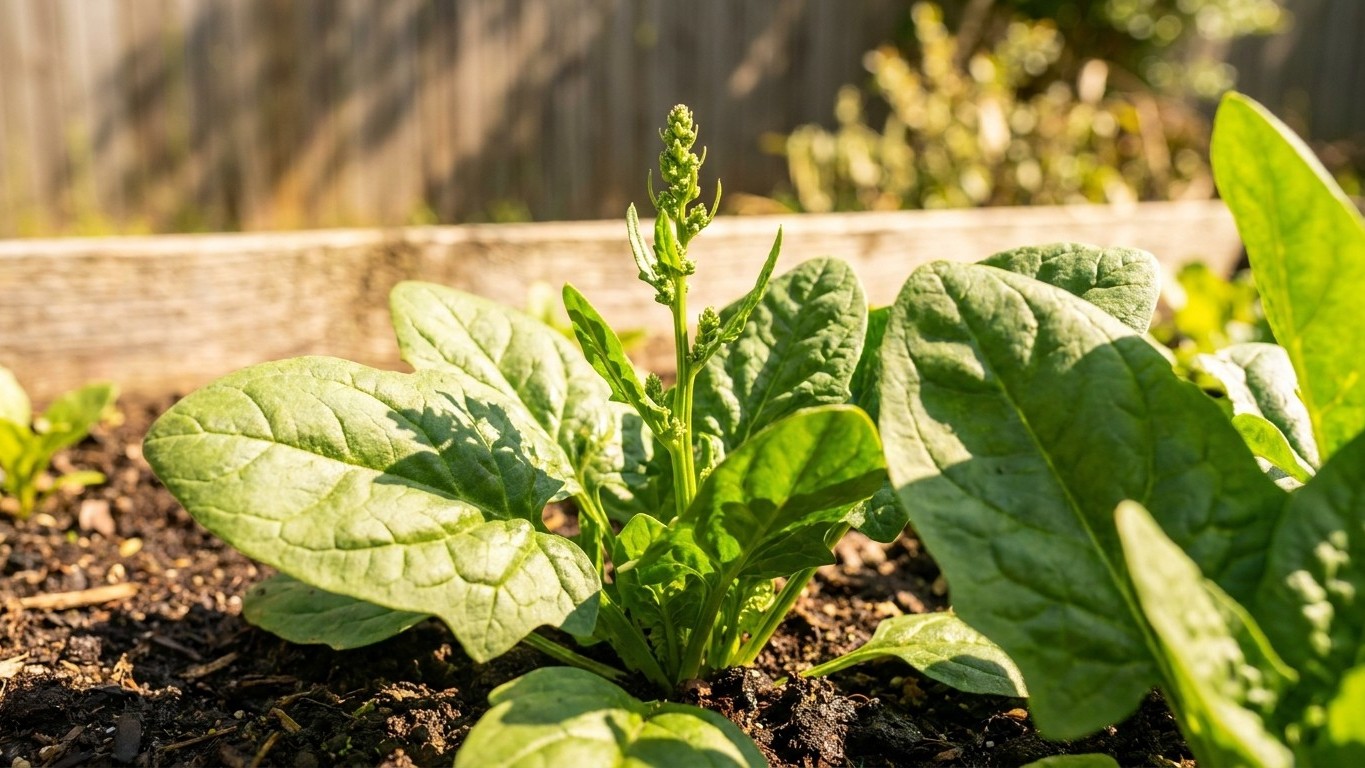

Cut spinach in Missouri during the cool weeks of spring and again in fall. Cut the whole plant the moment a center stalk starts to rise or highs settle above 75 F. Once harvested, the leaves keep days, not weeks: 32°F is the best case, and two weeks is a ceiling, not a promise. Both halves of that answer hinge on 75 F and a day length that peaks at 14 h 46. For the full growing picture, start with Growing Spinach in Missouri.
The short answer
On the longest day of the year, the Kansas City reference station gets 14 h 46 of daylight. That is a long day by any garden standard, and for spinach it is a problem. Utah State University Extension states that spinach bolts during long days and warm temperatures, and the two triggers work separately. Long days alone can push a plant to flower, even when the air stays cool.
Day length, heat, or both?
Both. The days stretch every week from the winter solstice onward, so a spring crop is racing a clock that speeds up as it grows. Heat then piles onto the day length. The same Extension source says spinach grows best where temperatures do not exceed 75 F, and Kansas City averages 32.7 days a year at 90 F or higher. That is more than a month of days well past the comfort zone, scattered through summer.
A cool, wet June does not change the math much. Gardeners in cooler states sometimes stretch the season with a mild summer, but a Missouri plant still sees 14 h 46 of daylight at the solstice, and the day length keeps nudging it toward flowering. The sources behind this page publish no exact number of daylight hours at which spinach flips to flower, so there is no tidy date to circle on a calendar. The practical signal is the plant itself. For more on reading the early warning signs, see Will Spinach Bolt Early in Missouri?
So when do you cut? Cut outer leaves once they are big enough to eat, and keep cutting while the weather stays cool. When the center begins to elongate or the forecast shows highs above 75 F, take the whole plant. Heat is also where bitterness comes in: 75 F is both the point where growth stops being good and the point where flavor suffers. One number, two consequences.
How long cut spinach really keeps
Spinach is one of the shortest-lived vegetables you can bring in from the garden. The UC Davis Postharvest Technology Center puts optimum storage at 32°F with 95 to 98 percent relative humidity, and states that spinach “will not maintain good quality for more than 2 weeks.” Wilting, yellowing and decay increase after 10 to 14 days, and faster at the 41 to 50°F typical of distribution conditions (UC Davis Postharvest, spinach facts).
Read that as a ceiling. Two weeks is the best a perfect cold room can do. A home refrigerator runs warmer than a produce warehouse, and the door is the warmest spot of all, so yellowing can show up in a matter of days there. Put the bag on the back of the bottom shelf, where the air is coldest, and keep it loosely closed so it holds humidity without sitting in water. Cut spinach in the morning, chill it quickly, and eat the oldest bag first.
How long the spring window really is
Spring spinach has two edges, and Missouri squeezes both. The front edge is set by frost: seed goes in 2 to 3 weeks before the last spring frost. NOAA NCEI climate normals put that last frost between April 6 and April 20 at the Kansas City reference station (NOAA NCEI data). The back edge is set by heat, and it is looser. Here is how to work out your own window.
- Find your last frost range. The reference station sits well north of downtown Kansas City, and the downtown station runs about five days earlier in spring. Southern Missouri is milder still, so gardeners there start earlier than April 6 to April 20 suggests.
- Count back 2 to 3 weeks. For the Kansas City range, three weeks before April 6 lands in mid-March, and two weeks before April 20 lands in early April. Sowing runs from mid-March to early April, a window about three weeks wide.
- Watch for 75 F. This is a growth ceiling, not a date. The figures behind this page do not carry an average date when afternoons cross it, so none is given here. Use the ten-day forecast. When highs start landing above 75 F, the good growing is over.
- Cut early and often. Harvest outer leaves as soon as they are large enough to use. Every week in the cool zone is a week you will not get back.
- Clear the row when the center rises. A stalk in the middle means the plant has shifted from making leaves to making seed. Cut all of it, rinse, and store it cold.
Put the pieces together and the picture is clear. Sowing opens around mid-March, the frost danger is behind you by mid-April at the latest, and then the usable harvest runs only as long as the afternoons stay at or below 75 F. In Missouri that is a matter of weeks, not months. A gardener who sows on the earliest sensible date gets the most of it, because growth made in the cool front end cannot be recovered later.
Leaves left to grow long also stay in the garden longer, which gives insects more time to find them. If holes and chewed edges show up, What Eats Spinach in Missouri, and When covers who is likely behind it and when they arrive.
The autumn crop, and when the soil lets you sow
Fall spinach is the better Missouri crop on paper, because the days are shortening after the solstice and the heat is easing. Getting it started is the hard part.
Obstacle one: soil that is still too warm
Utah State University Extension says seed germination is reduced when soil is above 80 F. That is a soil temperature, not an air temperature, and in Missouri August soil stays warm long after the calendar suggests fall is near. With 32.7 days a year at 90 F or higher, the beds hold heat well into late summer. Cold is not what blocks the autumn sowing here. Warmth is.
The window therefore opens when the soil falls, and the only reliable way to know is to measure it. A soil thermometer pushed into the bed gives a better answer than any date on a seed packet. If the reading is above 80 F, wait. Seed sown into hot ground germinates poorly and wastes both seed and a row.
Obstacle two: the frost that ends the season
The other edge is the first fall frost. NOAA NCEI climate normals put it between October 18 and October 29 at the Kansas City reference station. As in spring, downtown runs warmer and southern Missouri is milder still, so gardeners farther south have more room at the back end of the season.
The source guidance for a fall crop is to plant 50 to 75 days before the date you want to harvest. Count back from the frost range and the paper window is wide:
- Harvesting by October 18: sow between August 4 and August 29.
- Harvesting by October 29: sow between August 15 and September 9.
Those dates are only arithmetic. The early part of each range falls squarely in the hot weeks, when soil is likely above 80 F. In practice the later dates are the realistic ones, and sowing in the early part of September makes sense only if the soil has cooled and you accept a harvest running close to the frost range. The source publishes no days-to-maturity figure for spinach, so there is no tighter number to offer. Check the bed every few days, and sow on the first stretch when the thermometer reads at or below 80 F.
Common questions
When is the best time to cut spinach in Missouri?
Cut in the cool weeks of spring, after a mid-March to early April sowing, and again in fall before the first frost range of October 18 to October 29. Start with outer leaves once they are large enough to eat. Cut the whole plant when a center stalk rises or highs are regularly above 75 F.
Can a cool summer give me more spinach weeks?
No. Long days alone can trigger flowering, and Kansas City gets 14 h 46 of daylight on the longest day. A mild summer helps with heat, but it does nothing about day length, so the plant still heads toward bolting.
How long does cut spinach keep in the refrigerator?
UC Davis Postharvest says spinach will not maintain good quality for more than 2 weeks, even at the ideal 32°F. At 41 to 50°F, the range of ordinary distribution and a warm refrigerator door, it declines faster. Store it at the back of the bottom shelf, not in the door, and treat two weeks as the outer limit.
Which spinach variety bolts last?
Utah State University Extension names four varieties: Bloomsdale, Melody, Teton and Olympia. It publishes no data about any of them, so this page cannot rank them on bolting, heat tolerance or flavor. Anything claiming otherwise is not coming from that source.