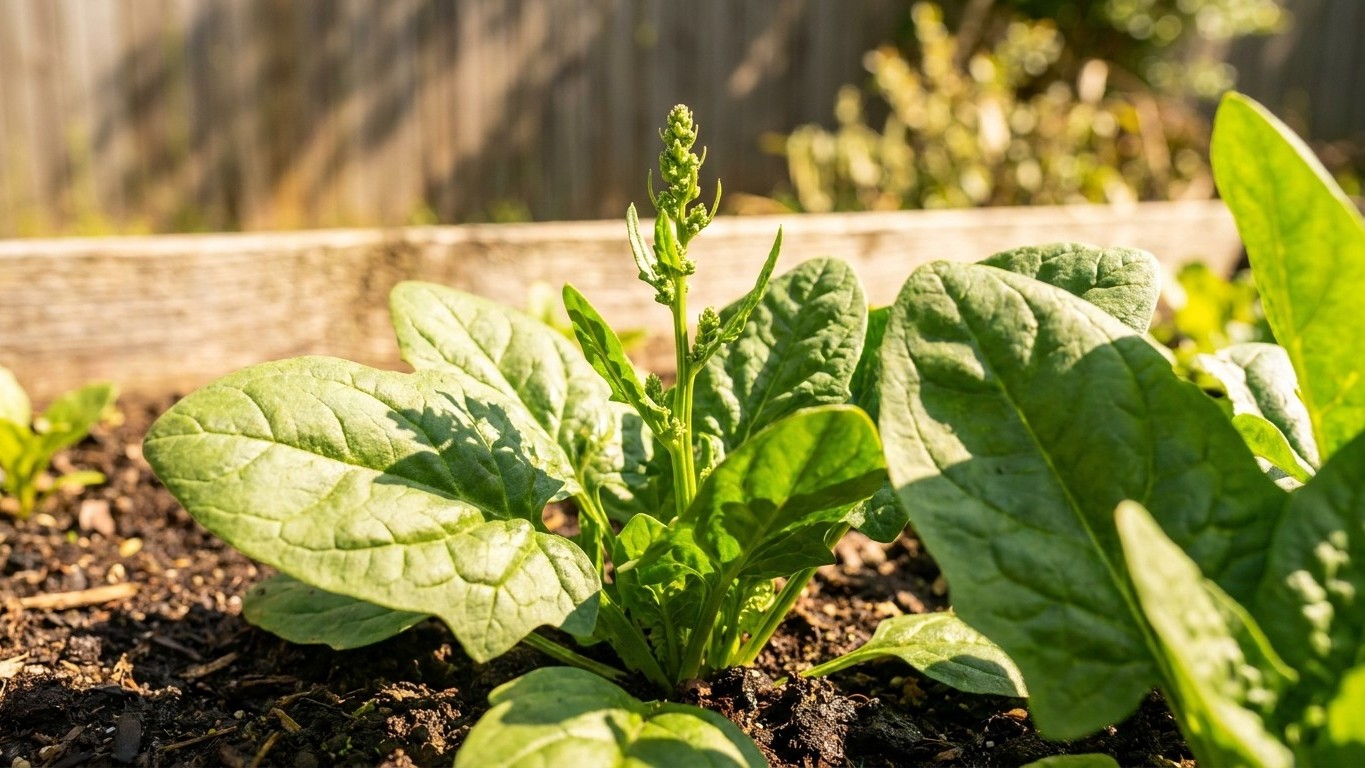

In New Hampshire, cut spinach in spring from the first leaves worth eating until daytime highs settle above 75 F or a flower stalk starts rising from the center. Cut the fall crop until the first fall frost. After cutting, the clock runs fast. Only at 32 F does spinach hold for as long as two weeks, and a fridge door costs you most of that. Here is how the calendar and the cold math work out.
The short answer
On the longest day of the year, Manchester gets 15 hours and 10 minutes of daylight. That figure is calculated from the city’s latitude and counts the geometric horizon only, so real daylight runs about seven minutes longer. It matters because Utah State University Extension says spinach bolts during long days and warm temperatures. Long days by themselves are enough to push the plant toward flowering. A cool summer, then, does not buy extra weeks. Even on a mild July, the sun is up for a stretch that tells spinach to stop making leaves and start making a seed stalk.
So the limit here is both day length and heat. Day length sets a hard calendar that weather cannot fully override. Heat adds a second ceiling. Spinach grows best where temperatures do not exceed 75 F, and that same number marks where the leaves turn bitter. One threshold, two consequences: slower growth and a harsher taste. The reference station at Manchester averages 10.9 days a year at 90 F or more, so summer heat is not the main story in this state. Day length is the quiet driver, and it does not care how comfortable your July feels. For a deeper look at the flowering side, see Will Spinach Bolt Early in New Hampshire?
That makes “when to cut” a question of timing against two clocks. In spring, you cut as soon as the leaves are big enough to be worth eating, and you keep cutting until warmth or a rising center stalk tells you the run is over. Once a plant sends up that stalk, the remaining leaves turn bitter, and waiting for more size is a losing bet. In fall, you cut until frost closes the season.
What happens after the knife matters just as much. UC Davis Postharvest lists the optimum at 32 F with 95 to 98 percent relative humidity, and it says spinach “is highly perishable and will not maintain good quality for more than 2 weeks.” Read that as a ceiling, not a plan. Wilting, yellowing and decay increase beyond 10 to 14 days, and they come faster at 41 to 50 F, which is about what a home fridge actually holds. The coldest, steadiest spot is the back of the bottom shelf, not the door, where every opening of the fridge swings the temperature. Plan to eat cut spinach within a few days and treat anything beyond that as a bonus. The full table is on the UC Davis spinach fact sheet.
Choosing a variety will not move these limits much, and not because the options are poor. Utah State names four varieties (Bloomsdale, Melody, Teton and Olympia) but publishes no data about any of them. Nothing here can tell you which one holds longer. Treat variety as a tie-breaker, not a fix.
How long the spring window really is
Spinach goes in the ground two to three weeks before the last spring frost, and growth stops being good above 75 F. The usable spring is whatever fits between those two events. Here is how to work out yours:
- Find your last frost date. At the Manchester airport station, the last spring frost falls between April 16 and April 27, based on NOAA NCEI U.S. Climate Normals for 32 F freeze probabilities (the 30 to 70 percent band, station data here). That is a reference-city figure, not a statewide promise. Suburban and rural gardens usually see the last frost one to two weeks later, and more than that at elevation, so check your own county.
- Count back two to three weeks for sowing. At the airport, that lands between the last week of March at the earliest and mid-April at the latest, as long as the soil is workable. In a hill town with a later frost, shift everything later by the same margin.
- Add the weeks after the last frost, until daytime highs begin holding above 75 F. No calendar date for that is published here, and 75 F is a temperature, never a date. Your own thermometer in a shaded spot is the only honest source.
- Cut steadily through that stretch, and stop waiting for bigger leaves once highs reach the ceiling or a stalk begins to rise from the center.
Add it up and the usable spring is two to three weeks of head start, plus however many weeks pass between your last frost and the first run of 75 F days. In New Hampshire, that second stretch is measured in weeks, not months. The head start is the part you control, which is why an early sowing matters more here than anywhere with a long, gentle spring. A bed seeded as soon as the soil can be worked is already growing when the frost date arrives, while a bed seeded on the frost date is starting from zero.
Day length makes the window even less forgiving. By the time the weather turns warm, the days are already heading toward that 15 hours and 10 minutes at the solstice, so the plant is getting a flowering signal from two directions at once. Late sowings are the ones that fail, and they fail fast. Young seedlings also draw pests on their own schedule, which What Eats Spinach in New Hampshire, and When lays out. For the full growing picture, start with Growing Spinach in New Hampshire.
The autumn crop, and when the soil lets you sow
Fall spinach looks like the easy season, with cool nights and shortening days. Two obstacles still stand in the way, and the first one surprises people: the problem at sowing time is warmth, not cold.
Warm soil blocks the sowing
Seed germination drops off when the soil rises above 80 F. Late summer soil in a sunny bed can hold that heat long after the air feels pleasant, so seed pressed into it may sit and sprout poorly or not at all. Nothing in the source says how many days of cooling it takes, and no calendar date is published for when New Hampshire soil drops below 80 F. A soil thermometer pushed a couple of inches down, read in the morning, answers the question for your bed. Wait for it to fall below the line, then sow. The window opens when the soil cools, not on a date you pick from a seed packet.
Frost sets the end date
The other limit is the first fall frost, which at the Manchester reference station falls between October 13 and October 26 (NOAA NCEI U.S. Climate Normals, 32 F freeze probabilities, 30 to 70 percent band). Gardens outside the city typically see it one to two weeks sooner, so look up your own county.
The source says to plant 50 to 75 days before the date you want to harvest. It publishes no days to maturity for spinach, so do not borrow a number from another crop. Counting back from a harvest date around the frost window gives this:
- Harvest around October 13: sow between about July 30 and August 24.
- Harvest around October 26: sow between about August 12 and September 6.
The early end of those ranges runs straight into hot soil, so in practice the later dates are the realistic ones, and the harvest then lands near the 50-day end of the guidance. A garden that frosts one to two weeks sooner than the airport should slide both ranges earlier by that much, which squeezes the gap between cooling soil and frost even tighter.
Fall has one advantage over spring. Days are shortening, so the flowering signal that dogs the spring crop fades as the plants grow. Heat above 75 F still slows growth and sours the leaves in the early weeks, so a shaded bed can help while the seedlings establish.
Common questions
Does a cool summer keep spinach from bolting in New Hampshire?
No. Long days alone can trigger flowering, and the longest day at Manchester runs 15 hours and 10 minutes. A cool stretch slows the plant down, but it does not reset the day length.
When is the best time to sow fall spinach?
Count back 50 to 75 days from the date you want to harvest, then wait until the soil is below 80 F. With the airport frost window of October 13 to October 26, that points to roughly late August into early September, depending on how fast your soil cools. Your own county’s frost date shifts that answer.
How long does cut spinach really keep?
At 32 F and 95 to 98 percent humidity, UC Davis says spinach will not hold good quality beyond two weeks, and that is the ceiling. At the 41 to 50 F a typical fridge holds, it fades faster, with yellowing and wilting appearing well before that. Keep it at the back of the bottom shelf and plan to eat it within a few days.
Which variety holds up longest?
Utah State Extension names Bloomsdale, Melody, Teton and Olympia but publishes no data on any of them, so there is no sourced answer here. A thermometer and a calendar will tell you more than a seed packet will.